Cradle of Independence
Alhóndiga de Granaditas Audio Guide
A corn warehouse that looks like a castle, finished in 1809 with advice from Miguel Hidalgo, which ten months later became the stage of the first great battle of the War of Independence and, later, the place where his head was hung.
- 60 min of audio
- Independence history
- Neoclassical architecture
- Regional museum
The story of the Alhóndiga de Granaditas starts as a public works project: a granary and grain market raised between 1797 and 1809 on a rise between two hills, from a design by José Alejandro Durán y Villaseñor that José del Mazo y Avilés modified and directed. Its 75 by 68 metre footprint, its height of 23 metres and its smooth walls with high windows gave it the look of a fortified house, and that weighed on its fate: on 28 September 1810 the intendant Juan Antonio Riaño barricaded himself inside it against the insurgent army, and the taking of Granaditas opened the War of Independence in blood and fire.
The contrast is hard to match: the building that Hidalgo helped to construct for his old friend Riaño was stormed by his own troops, and a year later the heads of Hidalgo, Allende, Aldama and Jiménez hung in cages from its four corners. After Independence it was a warehouse, barracks, school, courthouse and, for some 80 years, a prison; since 1958 it has been the Regional Museum of Guanajuato, with José Chávez Morado's murals on the stairs and a votive flame that is renewed on the 28th of every month.
Highlights
- Fortress façade — a 75 × 68 metre granary, 23 metres high, completed in 1809
- The four corners — cages with the heads of the insurgent leaders from 1811 to 1821
- East door — the iron-reinforced door that burned in the 1810 assault
- Chávez Morado murals — “Abolition of Slavery” and “Song to Guanajuato” on the stairs
- Hall of Heroes — the flame of Independence, renewed on the 28th of each month
Few buildings in Mexico concentrate so much history into so few years as the Alhóndiga de Granaditas. It was completed on 7 November 1809 as a public corn warehouse; on 28 September 1810 it was stormed in the first great battle of the War of Independence; and from 14 October 1811 until March 1821 it displayed on its corners the heads of the four leaders who had set the revolt alight. The sources do not even agree on when it all began: depending on which one you consult, the project starts in 1796, 1797 or 1798.
The story of the Alhóndiga de Granaditas did not end with the war. Two months after the assault, in November 1810, documented tradition recalls a second massacre within these walls, that of the Spanish prisoners held in the building as Calleja’s royalist army approached. Then came almost a century of civil and prison uses and, since 1958, the Regional Museum with some 9,000 pieces. Exploring it with the audio guide, from the esplanade to the Hall of Heroes, lets you read each stone in the order in which it happened, with narration that is documented and checked against historical sources.
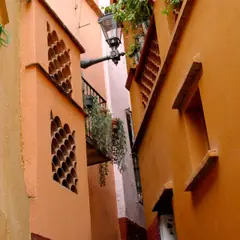
The disputed hero of the 1810 assault has his colossus high on San Miguel hill, at the Pípila Monument. About 300 metres away is the Kissing Alley, and the other, gloomier face of the city’s memory is kept next to the Santa Paula Cemetery, in the Guanajuato Mummy Museum.
A granary that looks like a castle
Alhóndiga de Granaditas
Summary of this stop
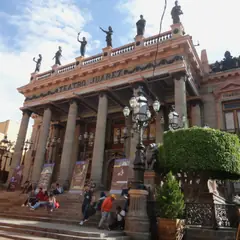
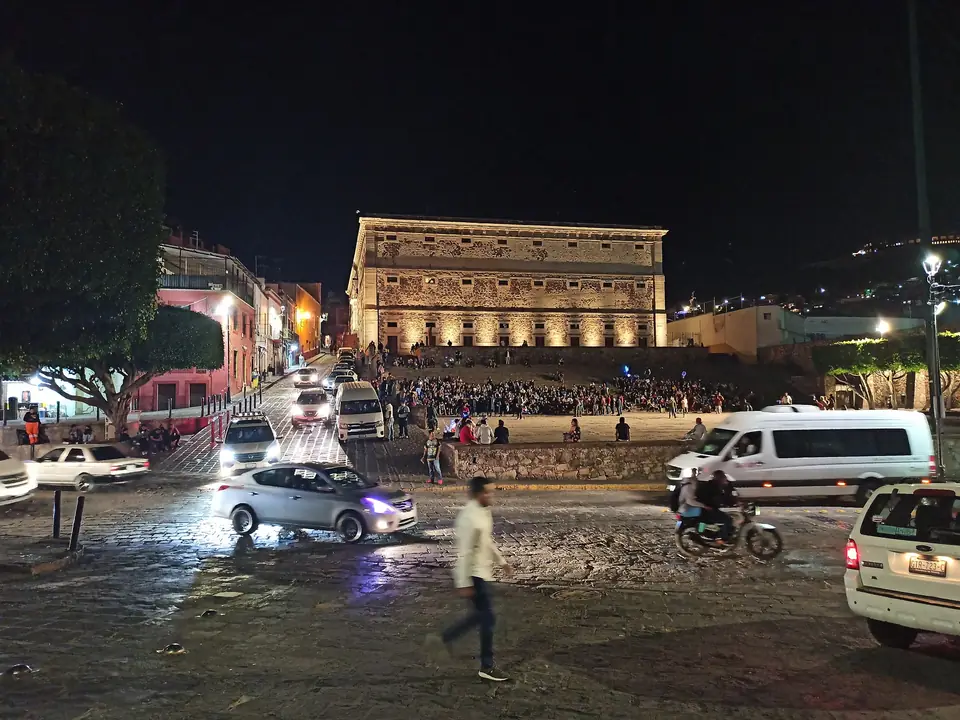
From the steps of the north esplanade, the building presents itself as what it never meant to be: a fortress. The smooth, unadorned walls, the high windows of each grain bin and the Doric cornice in greenish and reddish stone make up a mass 75 metres long, 68 wide and 23 high, raised on a rise flanked by two hills. The architecture of the Alhóndiga de Granaditas answers a very specific function, storing and selling grain, and that same sobriety is what gave it its air of a fortified house.
The work ran from 1797 to 1809, starting from a first design by José Alejandro Durán y Villaseñor that José del Mazo y Avilés modified and brought to completion. Only months after it opened, its scale and position made it the refuge chosen by the intendant Riaño: besides the stored corn, he had provisions brought in, and 24 women to make tortillas. Inside sheltered some 300 royalists facing about 20,000 insurgents, according to the most quoted figure, although other sources give very different numbers. What that siege calculation says about the intendant is better understood by listening to the narration at the foot of the walls.
Four cages for the intendant’s friend
Corner with an insurgent leader's plaque
Summary of this stop
Beneath one of the building’s corners, high on the edge, a plaque records the name of one of the four insurgent leaders. The plaques were placed many years later, on the four corners, at the very spot where, between 1811 and 1821, the cages with the heads of Hidalgo, Allende, Aldama and Jiménez hung as a warning, after they were shot in 1811.
The irony begins earlier. Miguel Hidalgo had advised on the construction of the granary of his old friend, the intendant Juan Antonio Riaño. On the day of the assault, from the Cuartel de Burras, he wrote him two letters: one demanded surrender; the other, as a friend, offered asylum to his wife. Riaño refused to surrender and thanked him for the offer.
Documented tradition completes the episode with grim details: the long journey of the heads from Chihuahua, Hidalgo’s salted for the trip, their first display in what is now the Plaza de la Paz and the blacksmith hired to forge cages made to measure. What ten years of sun and birds did to the face of the Father of the Nation is one of the revelations that the audio guide saves for this corner.
The iron door that burned
East door of the Alhóndiga
Summary of this stop
The east door is small, flanked by two columns, one of the building’s only two, and the one identified with the door set on fire in the assault. It was reinforced with iron plates. Before it burned, the attack came close to halting: with Riaño dead in the fighting, a civilian waved a white handkerchief tied to a rifle and Hidalgo ordered a ceasefire, but Lieutenant Barceló killed the flag-bearer and went back up to the roof to fire.
The burning of the door is attributed to the miner Juan José de los Reyes Martínez, “El Pípila”, shielded by a stone slab on his back. His figure, however, is disputed: the first written version of the deed appears in 1843, in Carlos María de Bustamante’s Cuadro Histórico, and Lucas Alamán refuted it in his Historia de México, where he places Hidalgo at the opposite end of the city during the assault. Some doubt that his existence can be proven and others maintain that he did not act alone. How the legend was made, and what his nickname means, is told in front of that very door.
The staircase that showed blood
Central courtyard and mural staircase
Summary of this stop
The wide central courtyard is ringed by two floors of arcades, Tuscan below and Doric above, with stone balusters between the columns. Here the assault ended, after five hours of fighting: the attackers killed not only the small guard but numerous civilian families who had taken refuge in the building, among them Riaño’s eldest son and Lieutenant Barceló, and then sacked the city. The sources still debate whether it was a battle or a massacre.
After Independence the granary was a warehouse, barracks, school and courthouse, and for some 80 years, until 1948, a prison. One of the place’s most unsettling accounts comes from that period: in 1906, according to documented tradition, visitors to the jail were shown crimson stains on the pillars of the main staircase, presented as blood from 1810, and there was a statue of the door’s labourer without any name.
That same staircase is now covered by the murals that José Chávez Morado painted between 1955 and 1966, among them “Abolition of Slavery” and “Song to Guanajuato”, with the history of the city and of Independence. What separates the stained stone from the fresco is discovered through the narration at the foot of the steps.
A flame lit on every 28th
Hall of Heroes
Summary of this stop
The route ends in the Hall of Heroes, the tribute room to Hidalgo, Morelos, Jiménez, Allende, Aldama and Guerrero. A votive lamp there keeps the flame of Independence, which is renewed on the 28th of each month in memory of the assault; every 28 September the city also holds a civic parade.
The ending has something of an act of reparation. According to documented tradition, the man who emptied the cages in March 1821 was a former enemy of the insurgents, an officer who had fought on the royalist side and who switched to the cause of Independence shortly before entering Guanajuato. His name and his change of side give meaning to the last stop.
Since 26 June 1958 the building has been the Regional Museum of Guanajuato Alhóndiga de Granaditas, with some 9,000 pieces, among them the archaeological collection that José Chávez Morado and Olga Costa gathered over 25 years. A granary that now keeps memory instead of corn.