Porfirian opera house
Teatro Juárez Audio Guide
An opera temple dedicated to Benito Juárez that was inaugurated, with Verdi's Aida, by the man who had risen up against his re-election. Beneath it, a buried convent; above, eight bronze muses for nine names.
- 40 min of audio
- Opera and the Cervantino Festival
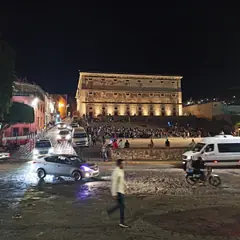
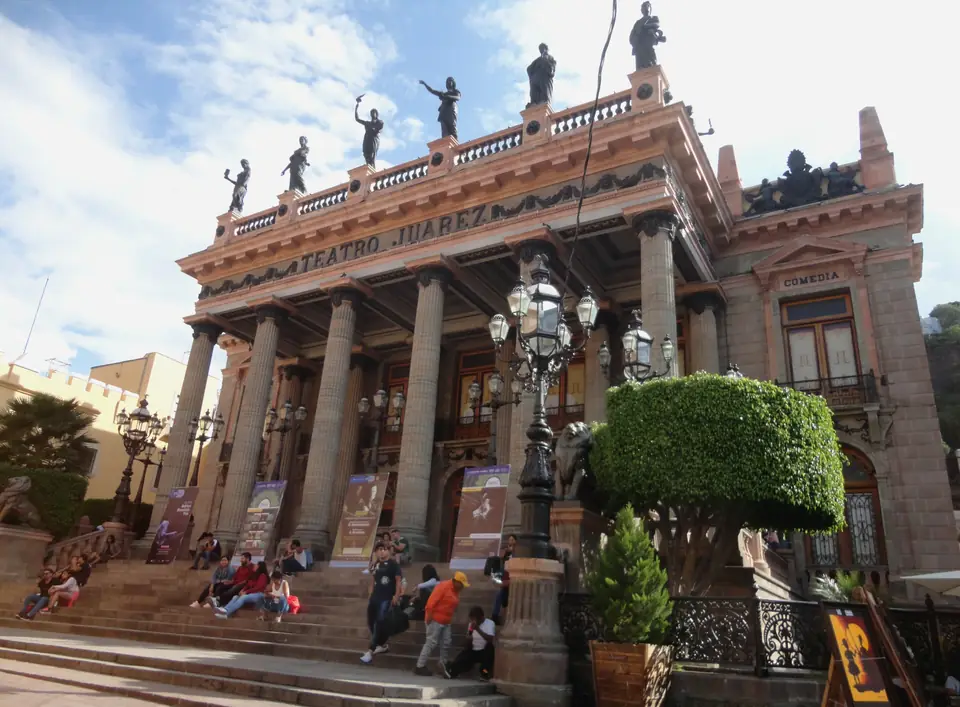
Facing the Jardín de la Unión, the Teatro Juárez took three decades to build: the first stone was laid in 1873 on the site of a Dieguino convent demolished after the confiscation of Church property, work stopped two years later and resumed in 1892 with plans revised by Antonio Rivas Mercado and Alberto Malo, who made it more ostentatious. On 27 October 1903, Porfirio Díaz inaugurated it with Aida. Its architecture joins a portico of Doric columns inspired by the Greek temple with a horseshoe-shaped auditorium for 902 spectators dressed in Moorish arches.
The splendour did not last. From 1912 the opera house became a silent cinema, dance hall, circus and wrestling and boxing ring, until in 1957, by then a ruin, it passed to the University of Guanajuato. Since 1972 it has been the main venue of the Cervantino International Festival, and the stage where blows were once traded on the canvas ended up receiving Beverly Sills, Birgit Nilsson or Leonard Bernstein.
Highlights
- Eight 3.5-metre bronze muses on the cornice, ordered as a set of nine
- Doric portico and staircase guarded by two bronze lions by Jesús Fructuoso Contreras
- Horseshoe auditorium for 902 spectators with four tiers of boxes and Moorish arches
- Baroque church of San Diego, the only part still standing of the convent the theatre was built on
- Main venue of the Cervantino International Festival since 1972
The story of the Teatro Juárez begins with a demolition. On this site stood the convent of San Diego de Alcalá of the Discalced Franciscans, pulled down in 1861 after the confiscation of Church property; later the Hotel Emporio took its place, which in turn fell in 1872. Work on the theatre started in 1873, although some sources put the start at 1872, from a design by the architect José Noriega commissioned by Governor Florencio Antillón. It stopped after two years, resumed in 1892 and was not finished until 1903. The building bears the name of Benito Juárez, who died in July 1872 and was officially named president in Guanajuato itself in January 1858, in the midst of the Reform War.
What that name hides, and what happened afterwards, makes a story of political irony, a buried cloister and almost a century of uses unthinkable for an opera house. What to see at the Teatro Juárez, the story of its construction and the secrets of its architecture are best discovered by exploring it outside and in with the audio guide, documented and checked against historical sources.
From the back of the theatre the funicular climbs to the Pípila Monument, and a short walk away, on the Plaza de la Paz, stands the Guanajuato Basilica.
Eight bronze muses for nine names
Jardín de la Unión
Summary of this stop
From the Jardín de la Unión, the façade dominates a narrow street: a portico of Doric columns inspired by the Greek temple, above a broad staircase and crowned with bronze figures. That ostentation was not in José Noriega’s original design; it came with the second stage of the work, from 1892, when Antonio Rivas Mercado and Alberto Malo revised the plans. Most sources present them as architect and engineer, although the building’s restorer maintained that both were mining engineers.
High on the cornice you can count eight muses of 3.5 metres, each with her attribute: the masks of Thalia and Melpomene, the flutes of Euterpe, the castanets of Terpsichore, the celestial globe of Urania. They were ordered from Ohio, in the United States, as a set of nine. According to a press source, one was delayed so long that the eight that had already arrived were put up, and so it stayed. The missing one is Erato, and perhaps she appears, tiny, as a figurine on Urania’s globe.
The muses that shine today over the garden are not those of 1903 either: rusted, they were replaced in the major restoration begun in 1989. The trail of the ninth is better followed with the narration, looking up at the cornice from the garden itself.
The convent that ended up under the theatre
Church of San Diego
Summary of this stop
Right beside the theatre, on a lower level, opens the atrium of the baroque church of San Diego, with its adjoining chapels of the Santo Cristo de Burgos and the Immaculate Conception. It is all that remains standing of the Dieguino convent whose grounds, with its cloister and its cemetery, reached as far as where the theatre’s façade now rises.
Beneath this atrium lies a dark story that local tradition has well documented. In 1780 a great flood swept through Guanajuato, with the stream bed clogged by mining waste: the cloister was destroyed and water flooded the nave of the church. Between 1780 and 1784, with money from the Count of Valenciana, the church was rebuilt and, to protect it from new floods, the ground was raised by some six metres. The upper floor of the cloister became the ground floor and the old ground floor was buried.
Excavated and opened to the public in 2007 as the Ex Convento Dieguino Museum, that buried cloister can now be walked below street level, behind glass windows. That is why the façade of San Diego sits lower than the Jardín de la Unión, a difference in level that here makes complete sense.
Lions for Juárez, Aida for Porfirio Díaz
Staircase of the lions
Summary of this stop
At the foot of the staircase, beside the street lamps, two bronze lions by the sculptor Jesús Fructuoso Contreras stand guard. Up these steps on the night of 27 October 1903 climbed President Porfirio Díaz to inaugurate the theatre with Verdi’s Aida, performed by Ettore Drog’s Italian company, conducted by Napoleón Sieni and Giorgio Polacco.
The irony lies in the name on the façade. The theatre honours Benito Juárez, and the man who inaugurated it was the one who in 1871 had led the Revolution of La Noria to prevent his re-election. It is also said that the opening was postponed until Díaz could attend, and that the theatre could have opened a decade earlier.
Today these steps have a different audience. On October nights they fill with young people sitting with their backs to the auditorium, watching the life of the Jardín de la Unión go by, while in the neighbouring atrium of San Diego the callejoneadas of the estudiantinas often get under way. What links that open-air grandstand to the Porfirian night is told in the audio guide, at the foot of the lions.
From boxing ring to Bernstein
Oriental-style horseshoe auditorium
Summary of this stop
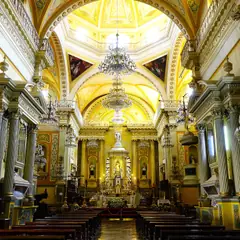
The auditorium, for 902 spectators, follows the European horseshoe model with four tiers of boxes and general seating, but its decoration is Oriental in style: Moorish arches frame the proscenium boxes, polychromy covers the walls and a crystal lamp hangs from the ceiling. Above the proscenium and on the curtain, the sources describe scenes of Constantinople, although they do not fully agree on their subject.
That décor survived almost a century of unrelated uses. In 1912 the theatre was leased to a silent-film company that went bankrupt; it later became a dance hall, circus and wrestling and boxing ring, returned to being a cinema in 1949 and in 1957, by then a ruin, passed to the University of Guanajuato. From the Entremeses of Cervantes that its students staged outdoors from 1953 was born the Cervantino International Festival, which has had its main venue here since 1972.
Where blows were once traded on the canvas, Beverly Sills sang Rosina in The Barber of Seville in 1980; Birgit Nilsson, Aprile Millo and Dmitri Hvorostovsky also performed, Yehudi Menuhin played and Leonard Bernstein and Mstislav Rostropovich conducted. In 1999 the hall hosted the world premiere of the final version of Carlos Chávez’s opera The Visitors. The rest of the bill, and what the walls of the auditorium hide, is revealed sitting in the stalls.