Minor basilica
Guanajuato Basilica Audio Guide (Basílica Colegiata de Nuestra Señora de Guanajuato)
A yellow church raised with the miners' silver between 1671 and 1696 presides over the Plaza de la Paz. Inside waits a cedar Virgin that arrived from Europe almost at the same time as the first mines were registered.
- 30 min of audio
- Patroness of the city
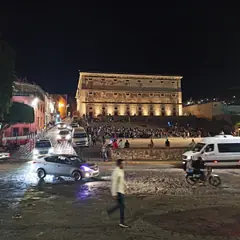
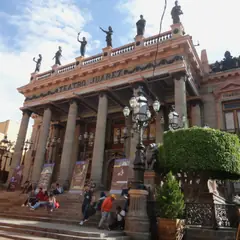
The Basílica Colegiata de Nuestra Señora de Guanajuato rose between 1671 and 1696 on the ruins of an earlier church dedicated to St Ignatius, at the height of the silver boom of the mining town. It was the miners themselves who paid for the work and its decoration, and the result still faces the Plaza de la Paz with its yellow façade, its three-tiered portal, its uneven towers and a dome that can be seen from the upper streets. In 1957 it received the title of minor basilica.
The patroness who presides over it is older than the church itself and than almost the whole city: a polychrome, gilded-and-painted cedar carving of 1.15 m, with a Child holding a bird, the same trait as the Virgen de la Antigua in Seville Cathedral. Tradition presents it as a gift from Philip II around 1557, but the dates barely fit with the first mine registers, of 1556, and the city's devotional memory gives the journey another proper name.
Highlights
- Yellow façade — a church of 1671-1696 paid for by Guanajuato's miners
- Our Lady of Guanajuato — a 1.15 m cedar carving on a solid silver pedestal
- Santa Fe de Guanajuato — the statue that recalls the city's founding name
- Pipe organ — 1,098 pipes, restored in 1989-1990 and venue of the organ festival
- Miners' pilgrimage — every May, machines covered in flowers up to the altar
In Guanajuato silver was not only exported: it was also turned into stone. The story of the Basílica Colegiata de Nuestra Señora de Guanajuato begins in 1671, when a new church started to rise on the ruins of a church of St Ignatius, finished in 1696 and paid for by the miners of the mining town. Its purpose was to house an image that had been in the city for more than a century: the Virgin had spent 131 years, from 1565 to 1696, in the Templo de los Hospitales, the first parish, the chapel of a hospital for indigenous miners. In 1702 the chapter commissioned a retable of its own for her and in 1957 the church received the title of minor basilica, dependent on the Archdiocese of León.
Its architecture is also debated: the INAH describes a neoclassical seventeenth-century building, while other sources and the plaque on site speak of a baroque church with a neoclassical exterior. To understand what to see at the Guanajuato Basilica, and why its patroness raises more questions than answers, the route works best standing in the square and under the dome, with the audio guide, documented and checked against historical sources.
The other great church raised with mining silver is the La Valenciana Church, right beside the mine mouth that paid for it, and a short walk from the Plaza de la Paz, facing the Jardín de la Unión, stands the Teatro Juárez.
A yellow façade paid for with silver
Plaza de la Paz
Summary of this stop
From the Plaza de la Paz, the church presents its yellow-orange front, the main portal in three tiers and two towers that do not resemble each other: a three-stage bell tower and another of a different style. What looks like a postcard is really a collective investment: Guanajuato’s miners paid for the construction and decoration at the height of the silver boom.
The square also holds its own memory. Opposite the basilica, a plaque records that the centre of Guanajuato has been a World Heritage Site since 1988, and on the same square stands the pink-quarry-stone Casa del Conde Rul. From its balcony, on 24 March 2012, Benedict XVI greeted the children, and the cheers of thousands gathered at the foot of the church interrupted his message at least ten times. Why the miners wanted a new home for their Virgin is better understood by listening to the narration right there.
Santa Fe and St Ignatius, the saints who founded the city
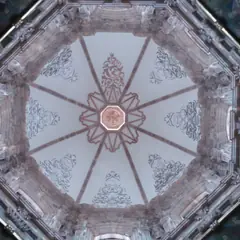
Dome and top of the central altar
Summary of this stop
Under the dome, the gaze rises to the top of the central altar, where the statue of Santa Fe de Guanajuato appears. It refers to Santa Fe de Granada and to the city’s founding title, Real de Minas de Santa Fe de Guanajuato: the place’s old name, written in a figure.
Beneath the church floor there was once a church dedicated to Ignatius of Loyola, whose image still stands beside the patroness as co-patron of the parish. According to tradition, he was the city’s first patron, and his feast on 31 July, the Día de la Cueva, still empties Guanajuato: half the city climbs the hill to hear Mass in a quarry-stone grotto that evokes the cave of Manresa. Legends say a missionary had a vision of the saint there and that Ignacio Allende hid his troops in the cave. From that festival Jorge Ibargüengoitia took the city’s literary name, Cuévano.
The Virgin who arrived before the mines
Our Lady of Guanajuato
Summary of this stop
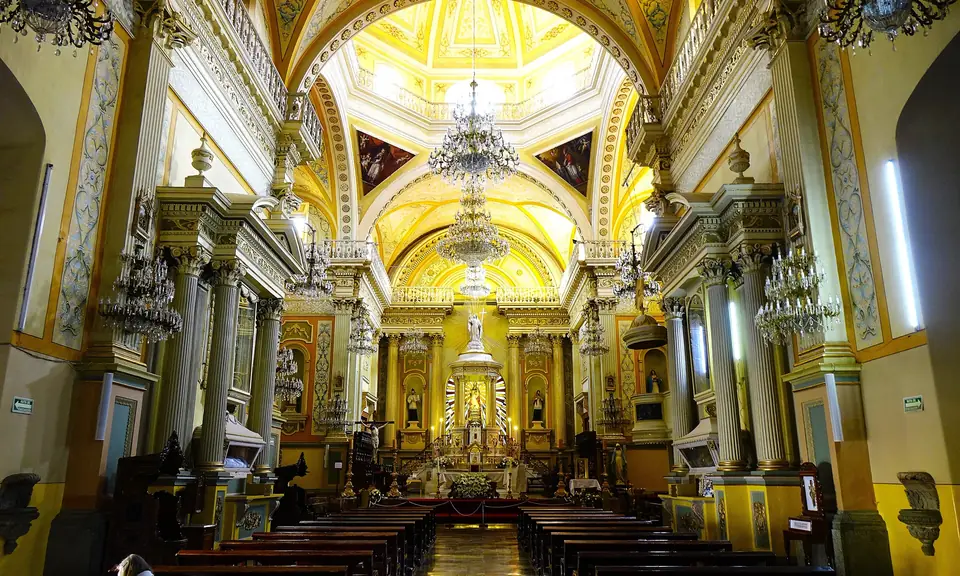
On the gilded high altar, protected by glass, stands Our Lady of Guanajuato: a polychrome, gilded-and-painted cedar carving of 1.15 m, with a crown and pedestal of solid silver. In her right hand she held a rose, replaced by a sceptre on arrival in Mexico, and the Child holds a bird in his left hand, the same trait as the Virgen de la Antigua in Seville Cathedral.
That detail complicates the most repeated version. Tradition attributes the image to a gift from Philip II around 1557, as a reward for mining prosperity, but the first known mine registers date from 1556, and the documented arrival is placed around the mid-1550s, with no exact date. Some sources add Charles I to the donation and others treat it as speculation; the popular tale, for its part, speaks of centuries hidden in a cave in Granada. Against the king, devotional memory points to a man with a first and last name, don Perafán de Rivera, the first mining judge, a disputed story that the audio picks apart calmly.
A thousand organ pipes and miners’ helmets
Pipe organ
Summary of this stop
Beside the altar rises a pipe organ of 1,098 pipes, by an unknown builder, which the German organ-builder Joachim Wesslowski restored between 1989 and 1990. It is no museum piece: on 20 August 2024 the basilica opened with it the 17th edition of the Guanajuato International Organ Festival, with Josep Solé Coll, organist of St Peter’s Basilica in the Vatican.
Around the images hang metal ex-votos shaped like arms, legs or hearts, proof of a church still in use. Since the coronation of the patroness as queen of Guanajuato on 31 May 1908, May is her month, and on the last Sunday comes the miners’ pilgrimage: companies with their men, their helmets and their machinery covered in flowers, sometimes with the Virgin mounted on a shovel. What the miners ask for as they kneel before the altar is the close of this route.