Legend of Guanajuato
Kissing Alley Audio Guide (Callejón del Beso)
Less than seventy centimetres separate two houses whose balconies almost touch. Between them was born Guanajuato's most famous love legend, and its kiss is not that of two happy lovers.
- 20 min of audio
- Popular legend
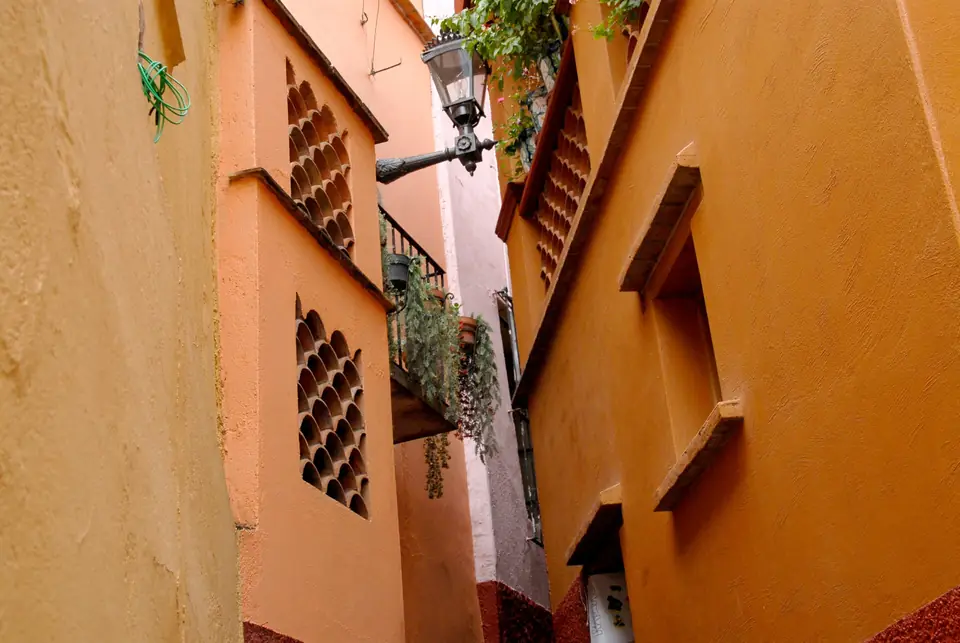
The Callejón del Beso is the narrowest of Guanajuato's many alleys: a stepped stretch of about 68 or 69 centimetres, depending on who measures it, between ochre façades of various heights, a few dozen metres from the Plazuela de los Ángeles. Up high, Ana's Balcony and Don Carlos's Balcony almost touch. No historical document backs the legend that gives it its name: it began to circulate around the late nineteenth or early twentieth century and took hold with the city's tourism boom.
Behind the romantic postcard lies a less kindly story. The third step, painted red, promises years of happiness to whoever kisses their partner, and the official photo costs money. In October 2022 the dispute over those charges between owners, photographers and guides came to blows, and the alley woke up closed with planks and suspension seals.
Highlights
- Ana's and Don Carlos's balconies — almost touching above the alley
- Third red step — seven years of happiness, according to custom
- A passage of 68-69 centimetres — the narrowest in Guanajuato
- Closed with planks in 2022 — the war over charging for the kiss
- The legend on film — a movie shot here in early 2026
What to see at the Kissing Alley fits into a few metres of steps, but the story of the Kissing Alley takes up far more. You reach it by climbing the Callejón del Patrocinio from the Plazuela de los Ángeles, on Avenida Juárez, and the stretch opens on the left: a passage about 68 or 69 centimetres wide (no official measurement has been published) between houses of several levels whose upper-floor balconies almost brush together. It is the narrowest of Guanajuato’s alleys and also the most disputed.
The legend that names it lacks any historical document; it has circulated since the late nineteenth or early twentieth century and grew with twentieth-century tourism. Even so, people have really fought here: over the balconies, over the photos and over the right to charge for a kiss. The audio guide follows that double life, that of the myth and that of the business, documented and checked against sources, in the very place where it happens.
The city’s popular tales have their darkest version in the Guanajuato Mummy Museum, and very close by, on San Miguel hill, the Pípila Monument honours a hero whose existence is also disputed.
The Patrocinio sign that promises a kiss
Junction with Callejón del Patrocinio
Summary of this stop
The climb from the Plazuela de los Ángeles along the Callejón del Patrocinio announces what is coming: a promotional sign presents the kiss as a lucky charm, and on reaching the junction the city’s narrowest alley appears wrapped in totems with QR codes and prices in plain view. Since the reopening of October 2022, only three photographers are authorised to work in it, and the estudiantinas that tour the centre with tourists stopped coming down this way to keep traffic orderly.
The curious thing is that this whole set-up rests on a story that no archive supports. And yet the legend already has its own film: in early 2026 “El Callejón del Beso” was shot here, a Mexican production set in the 1940s, with Norma Reyna and Juan Manuel Bernal, which mobilised more than 150 people and closed streets for several days. How a legend with no document made it to the big screen is what is told at this junction.
A red step in under seventy centimetres
Kissing Alley
Summary of this stop
At the foot of the steps the narrowness is felt in the body: the ochre-walled passage barely leaves room for your arms. The third step is painted red, and couples stop there to kiss to secure, they say, seven years of happiness; every weekend hundreds of them queue at any hour. Entry is free, but the official photo is charged for, with different packages depending on whether the kiss is on the step or on the balcony, and with a padlock engraved with the couple’s initials as an extra.
Popular belief says the promise has a flip side: the couple who pass without kissing carry years of bad luck in love, seven in one version, three in another. The prize also changes depending on who tells it, and has fine print. The passage, moreover, has become narrower: during the 2022 closure façades were repainted and kiosks and rubbish bins removed, but a metal bench and a post were installed that neighbours blamed on the mayor.
Ana’s and Don Carlos’s balconies: dagger and planks
Ana's and Don Carlos's balconies
Summary of this stop
Beneath the two balconies is told the legend that names the place, a tradition with as many versions as narrators. In one of them, Carmen, daughter of an authoritarian father who wanted to marry her off in Spain to an old nobleman, fell in love with Luis, a poor miner, who moved into the house opposite to talk to her from balcony to balcony. One night the father burst into the bedroom with a dagger. The ending, and the kiss that names the alley, are saved for the narration at this spot. Mario Hernández, who has been telling it at the top of his voice for decades, dates it to 1705, although no document confirms it.
Ana’s balcony belongs to a private house, and its recent history is anything but romantic. In late May 2022 it closed to the public for the first time in 27 years. In the early hours of 5 October that year, state personnel sealed off the alley with planks after a dispute over the charges that came to blows; Mayor Alejandro Navarro reopened it on the 8th, days before the 50th edition of the Cervantino International Festival, after the municipality had even floated expropriation. The fight did not end there, and its next chapter ended in an arrest.