Funerary history
Guanajuato Mummy Museum Audio Guide (Museo de las Momias)
They are not monsters or victims of legend: they are residents of 19th- and 20th-century Guanajuato whom the sun dried in their niches and an unpaid tax pulled from their graves.
- 60 min of audio
- 117 mummies in the collection
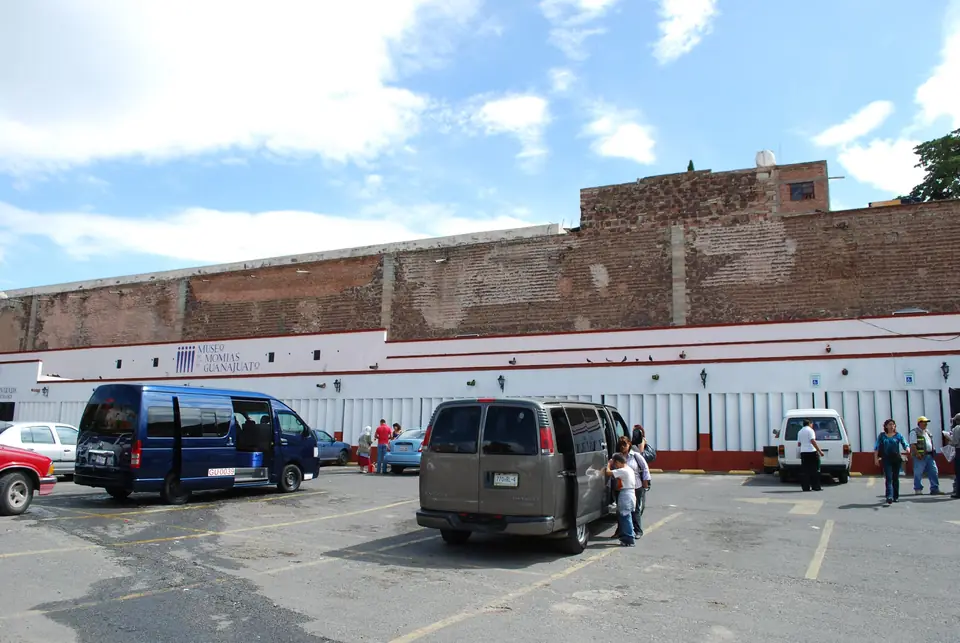
Next to the Santa Paula Cemetery, opened in 1861 with the Reform Laws, the museum gathers bodies whose families stopped paying: without the annual niche fee, the remains were exhumed to reuse the space. The heat, the dryness and the wind on the drawers set above the ground, high on Cerro Trozado, did the rest.
The exhibition began as a clandestine business of the gravediggers, who were already showing bodies in the ossuary in 1895. Today the mummies are the municipality's largest own income after property tax, and an INAH commission has been working since 2022 to give back the names that the horror nicknames took from them.
Highlights
- Remigio Leroy — the oldest mummy, a French doctor still in his suit
- The Santa Paula niches — rented drawers from which those who did not pay were removed
- The ossuary — the old crypt where gravediggers charged to look
- The Angelitos room — children dressed as saints according to funerary custom
- Horizontal display cases — since 2024, bodies lying under warm light
The story of the Guanajuato Mummy Museum begins with a bill. In 1861, when the Reform Laws were applied, burials left the churchyards and Guanajuato opened the Santa Paula Cemetery on top of a hill. Families paid an annual fee for the niche of their dead; if they did not renew it, the remains were exhumed to make room. That is how, between 1865 and 1958, most of the bodies now on display came out of their drawers: flesh-and-blood neighbours, not horror characters.
The most repeated version, that of the victims of the 1833 cholera buried in a hurry, clashes with the calendar: the cemetery did not even exist then, and among the identified bodies there are women who died in the late nineteenth century. Nor is there full agreement on why they mummified. The popular explanation speaks of a salty subsoil or mineral-rich waters; the anthropologist María del Carmen Lerma Gómez of the INAH, and the researchers who studied the bodies in 2007, point to the heat, the dryness and the air currents of drawers that sat above the ground. The collection now totals 117 mummies, 59 of them in the Santa Paula museum, and in 2021 it received 504,000 visitors. The audio guide walks the esplanade, the ossuary and the rooms with a history that is documented and checked against sources, which changes the way you look at each display case.
Guanajuato’s most famous legend, the one about love, lives in the Kissing Alley, and that of the insurgents whose heads hung for a decade from its corners, in the Alhóndiga de Granaditas.
A queue in the sun to see the aunts
Guanajuato Mummy Museum
Summary of this stop
The visit starts on the esplanade, a windy, shadeless hill beside the Santa Paula Cemetery. That sun and that wind are not a detail of the landscape: according to the INAH, it was the heat, the dryness and the air currents in the niches that dried some corpses in just five years, without anyone ever burying them underground.
Beside the entrance queue stand the stalls of charamuscas, sugar-and-cinnamon sweets shaped like mummies. In Mexico people say they are going to see the aunts, and the joke captures the atmosphere well: whole families, from grandparents to small children, turning the country’s most macabre visit into a Sunday outing. What that hill explains about everything that comes next is best understood right there, with the narration in your ear.
Rented niches and a pay-to-enter crypt
Santa Paula Cemetery niches and ossuary
Summary of this stop
The niche room reconstructs the cemetery’s walls of drawers, like stone shelving. They were not eternal rest but a rental: whoever stopped paying the fee lost the space, and the body came out into the light.
What happened next was anything but official. Before the museum, bodies were kept standing against the walls of a crypt beneath the cemetery, reached by a spiral staircase after paying a few pesos to the attendant. By 1895 the gravediggers were already displaying them in the ossuary, which around 1900 held 70 mummies, and in 1916 a travel magazine called the place the “chamber of horrors”. The ossuary is still part of the route.
Ray Bradbury passed through that crypt in the summer of 1945. He came out so shaken by the bodies propped up and held with wire that he immediately wrote the story “The Next in Line”, published in “Dark Carnival” in 1947.
Leroy, the Witch and the stolen names
Display cases of Remigio Leroy and “La Bruja”
Summary of this stop
In one of the display cases, still dressed in his burial suit, is Remigio Leroy, a French doctor with no family in Mexico to pay for his niche. He is the oldest mummy in the collection: according to the museum’s former director Paloma Robles and the local chronicle, he was buried in 1865 and exhumed in 1870, when the gravediggers found him intact, although other sources give different dates for the discovery.
Many bodies reached the ossuary with name tags and dates of death, but visitors took them away as souvenirs. The gaps were filled with nicknames and, from the early twentieth century, with horror stories invented from the appearance of the bodies. The woman displayed behind bars as “La Bruja” (the Witch), with severe scoliosis, was in life an elderly Catholic lady. Since 2022, an INAH commission has been relying on the gravediggers’ “Libro rojo” (Red Book) to restore the real names, which already appear on some labels.
In front of the body of Ignacia Aguilar, with an arm across her face and her mouth open, it is said that she was buried alive because of a heart ailment and woke up in the grave. It is a disputed story: that open mouth is what the jaw muscles leave when they relax after death. Why the legend persists, and why you do not need to believe it, is told in the audio guide in front of her display case.
Little angels dressed as saints behind glass
Angelitos room and Mother and Child room
Summary of this stop
In the Angelitos room the tone of the visit changes. Babies and children appear dressed as saints, following Mexican funerary custom, and the Mother and Child room shows a woman who died pregnant beside the fetus presented as the smallest mummy in the world. In 2007, a team from Quinnipiac University and Texas State University examined 22 mummies: the baby and the fetus turned out to have been opened and closed with sutures, a sign of embalming or autopsy, which qualifies the idea of a wholly natural preservation.
The current rooms were built in the seventies, after the museum opened around 1969, and the film “Santo contra las momias de Guanajuato” sent visits soaring. In 2024, a four-month redesign moved the bodies from a vertical to a horizontal posture and added warm light to the display cases.
Before that glass there was a night of filming. Werner Herzog, by his own account, bribed the guard to take the mummies out of their cases, lined them up from childhood to old age and used those shots to open the credits of “Nosferatu the Vampyre” (1979). What the director confessed years later about that transgression closes the visit in the audio guide.