Viewpoint and monument
Pípila Monument Audio Guide (Monumento al Pípila)
A pink-quarry-stone colossus with its torch held high watches over the whole Guanajuato ravine from San Miguel hill. It honours a miner who set fire to the door of the Alhóndiga in 1810 and whose existence, two centuries later, is still debated.
- 45 min of audio
- Panoramic viewpoint
Work on the Pípila Monument began in September 1939 and, according to the most widespread version, the statue was ready in about five months: it was inaugurated on 5 February 1940, anniversary of the Constitution, before the last surviving framers of 1917 and a choir of 500 voices. It is signed by the Guanajuato sculptor Juan Fernando Olaguíbel, author of the Diana the Huntress in Mexico City, and was built by the contractor Agustín Gutiérrez Ocampo from more than 800 tonnes of pink quarry stone carved piece by piece.
The story of the Pípila Monument has a crack in it: the hero it celebrates first appears in writing in 1843, more than thirty years after the taking of the Alhóndiga, in Carlos María de Bustamante's Cuadro Histórico. Lucas Alamán denied that he had existed, others defended him and historians still cannot agree. Meanwhile, the stone giant is hollow, and an inner staircase climbs to a glazed viewpoint at the height of his shoulder.
Highlights
- Colossal statue — more than 25 metres to the tip of the torch and 800 tonnes of pink quarry stone
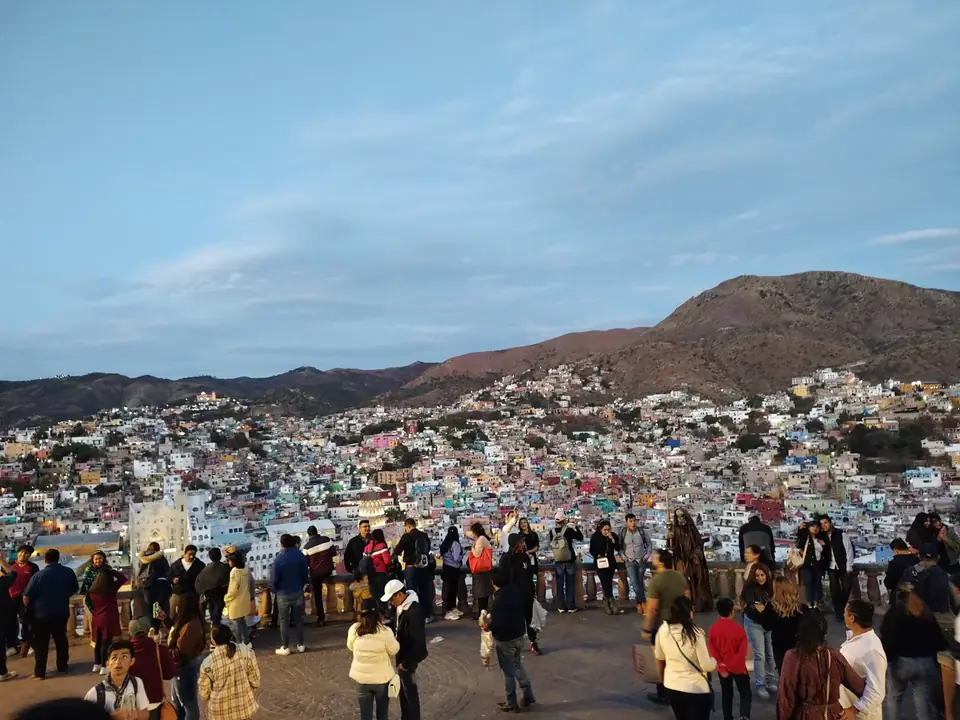
- Viewpoint over the ravine — Teatro Juárez, Basilica, Hidalgo Market and mines in sight
- 2001 funicular — 76 metres of height gain at a 42-degree incline
- Inscription on the base — “...There are still other Alhóndigas to burn”
- Interior open to visitors — a staircase up to a viewpoint on the hero's shoulder
On the crest of San Miguel hill, above the rooftops of Guanajuato, a stone miner advances with a slab tied to his back and a torch raised in his right hand. He is Juan José de los Reyes Martínez Amaro, the Pípila, a barretero of the Mellado mine born in San Miguel el Grande in 1782, to whom official history attributes the deed that opened the Alhóndiga de Granaditas on 28 September 1810. The monument that commemorates him was raised in a rush between 1939 and 1940 and has become the city’s great viewpoint: from its esplanades the whole mining ravine appears, with its churches, its theatre and its mine shafts.
What to see at the Pípila Monument goes well beyond the panoramic photo. The statue holds an unusual building technique, an inscribed phrase that sounds like a threat, a summit with a past of duels and an awkward question about the hero himself. The audio guide covers the hill in four stops, from the funicular station to the viewpoint parapet, with narration that is documented and checked against historical sources and that separates what is proven from what only tradition tells.
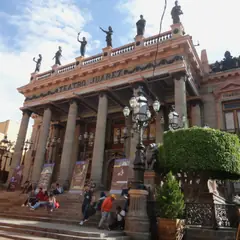
The door that, according to the story, the hero set on fire is still in the Alhóndiga de Granaditas, and the funicular descends to the back of the Teatro Juárez. The silver that Guanajuato’s miners extracted also paid for the La Valenciana Church, beside the mouth of its mine.
The hill of duels over love
Upper funicular station
Summary of this stop
The most dizzying way up is the funicular, in service since 2001: two cabins climb from behind the Teatro Juárez along a 102-metre ramp that gains 76 metres of height at a 42-degree incline. The upper station comes out right at the summit, and the traveller steps from the slope straight into the light and open air of San Miguel hill. Those who prefer to climb on foot find stairways that wind towards the centre between trees and hedges.
Before the hero, this summit had another protagonist. Here stood the so-called Cruz del Humilladero, the place chosen by those with quarrels over love to fight to the death. The terrace that now gathers couples and tourists hides, beneath the stone of the tribute, a far gloomier memory, and the narration of this first stop brings it to the surface right where it happened.
The slab on his back and the burning door
Pípila Monument
Summary of this stop
In front of the statue, the scale is overwhelming: more than 25 metres from the base to the tip of the torch, of which 16 belong to the figure, according to the most quoted figures, although other sources give different measurements. On the miner’s back you can make out the large flat carved stone that, according to the story, served as a shield against royalist muskets as he carried pitch and fire to the wooden door of the Alhóndiga. It is said that the door took almost seven minutes to give way.
The scene has its own dialogue. In the version fixed by Bustamante, Hidalgo turns to the miner among the crowd and asks whether he dares to set fire to the door; the Pípila accepts without hesitation, and the author compares him to the coal-burner who attacked the Bastille. It is a page of disputed history, and other accounts place him with more miners or with Hidalgo far from there. What is documented is what came next: once the door was open, the royalist garrison and the Spaniards sheltering inside were massacred, women and children included. The stone of glory is silent on that wound; the audio guide is not.
A giant cut like a suit
Inscription on the base of the Pípila
Summary of this stop
At the foot of the base, the statue’s body reveals its secret: it is not a single block but pieces of pink quarry stone carved one by one and fitted together like a great jigsaw. The builder Agustín Gutiérrez Ocampo applied a system of his own for large-format monuments, a small mould that was replicated at a larger size, just as a tailor does with a pattern. That explains the architecture of the Pípila Monument and the speed of a work begun in September 1939 and inaugurated on 5 February 1940, although the sources agree neither on the date nor on the number of people who worked on it.
On the base you can read the phrase “…There are still other Alhóndigas to burn”, dated “Guanajuato, September - 1939” and written by Ernesto Arnoux Siqueiros, provisional governor of the state. The terrace also has its own popular reading: the hill’s guides claim that the three steps beneath the Pípila’s feet represent three centuries of Spanish rule and that his gaze points towards San Miguel de Allende, his home town. It is a local belief rather than a fact, and the narration explains what lies behind that coded message.
A hero perhaps invented by a book
Viewpoint over the ravine
Summary of this stop
From the parapet, the ravine unfolds in full: the Teatro Juárez, the Church of San Diego, the Basilica, the Hidalgo Market and the San Juan de Rayas mine, wedged into the bottom and the slopes. It is the perfect setting for this place’s great question. His nickname has a known explanation: in El Bajío, “pípila” is the turkey, and the miners gave it to him when young, perhaps for the freckles on his face, like the bird’s speckled plumage, or for a laugh that recalled its gobble.
His existence, however, remains up in the air. No text names him until 1843; Lucas Alamán denied him in his Historia de México on the grounds that Hidalgo was at the other end of the city, and today some historians say they hold documents that prove it while others maintain that it is very hard to demonstrate. According to the versions that take him as real, the Pípila did not die before the door: he went back to the mine and lived until 1863, and tradition attributes his death to the same dust he breathed all his life. The end of that story, with the hill and the mining city at your feet, is what the audio guide reserves for the final stretch.