Churrigueresque baroque
La Valenciana Church Audio Guide (Templo de San Cayetano)
A pink-quarry-stone church sitting on the Veta Madre, with the mine mouth that paid for it open behind its wall: the silver of La Valenciana turned into three gold altarpieces and a single tower.
- 45 min of audio
- Churrigueresque baroque
Finished in 1788 and dedicated to St Cajetan, the church was raised by Antonio de Obregón y Alcocer, a miner whom the La Valenciana vein made a count. Between 1768 and 1804 that mine saw its peak output and for several decades yielded more silver than all the mines of the Viceroyalty of Peru. The work cost 360,000 pesos, and part of it was paid by the miners themselves, obliged to contribute money as well as their labour.
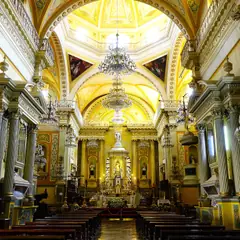
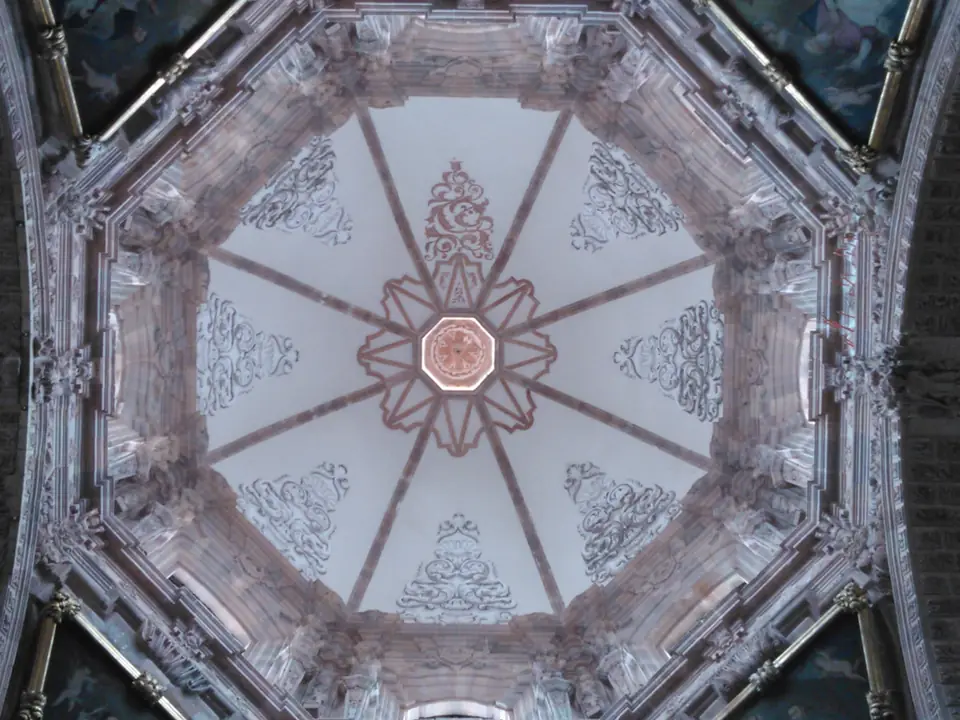
Inside, beneath an octagonal dome, three great Churrigueresque altarpieces covered entirely in gold leaf surround the titular saint. The paradox is plain to see: the most ostentatious church of a silver magnate honours St Cajetan, the saint who gave his fortune to the poor and who is now invoked to ask for bread and work.
Highlights
- La Valenciana mine mouth — the mine that paid for the church, right behind its wall
- Pink quarry stone portal — a façade carved like a stone altarpiece
- Trinity medallion — two hooded figures who probably portray the counts
- Three gold-leaf altarpieces — St Cajetan, St Peter and the Virgin of Guadalupe
- Ivory and marquetry pulpit and an organ dated 1788
High on a Guanajuato hillside, a pink-quarry-stone church stands right against the entrance to a mine. It is no coincidence: La Valenciana Church, whose official name is Templo de San Cayetano, was built with the silver that came out of that hole. The story of the church begins in 1760, when Antonio de Obregón y Alcocer, after years of hardship, obtained a loan from Pedro Luciano Otero, a merchant of the Rayas mine, and kept investing in La Valenciana until he struck the vein that would make him rich. In 1780 Charles III, at the request of Viceroy Bucareli, named him Viscount of the Mine and Count of Valenciana. Eight years later his church was finished.
What to see at La Valenciana Church goes well beyond the gold of its altars: a façade that reads like a stone altarpiece, a tower that never had a twin or lost it, a pulpit inlaid with ivory and a convent that waited for friars who did not come. Its architecture and history are best understood by exploring it from end to end with the audio guide, stop by stop, from the mine mouth to the pulpit.
In the centre, mining silver also paid for the Guanajuato Basilica, on the Plaza de la Paz, and the city’s most famous miner has his quarry-stone colossus on San Miguel hill: the Pípila Monument.
The mine that paid for the church, behind the wall
La Valenciana mine mouth
Summary of this stop
The route starts where it all started: at the stairway that descends to the La Valenciana mine mouth, which opens right behind the church’s outer wall. The church is built literally on an outcrop of Guanajuato’s Veta Madre, the lode of the city’s wealth.
A quantity of silver hard to imagine came out of here. Between 1768 and 1804 the mine saw its peak output and for several decades outproduced all the mines of the Viceroyalty of Peru, with Otero and Diego Rul as Obregón’s partners. The church cost 360,000 pesos, and not all of it was paid by the count: the miners of La Valenciana had to contribute money as well as their labour.
The wealth also had its dark chapter. According to documented tradition, in 1817 the insurgent Xavier Mina, after failing in his attempt to take Guanajuato by surprise, ordered the machinery of this same mine set on fire. What that fire means, a few steps from the golden church, is told in the narration, in front of the mine mouth.
A hooded count above the door
Church of San Cayetano
Summary of this stop
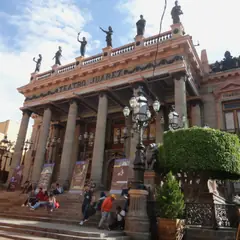
From the crenellated atrium, reached by a steep double staircase, the main pink-quarry-stone portal unfolds like a stone altarpiece, with estípites and niche-pilasters rising almost to the crown. Its main niches are empty and still bear traces of paint. Above the door, a medallion shows the Trinity as three bearded men with their feet on the globe, flanked by two hooded figures who probably portray the Count of Valenciana and his wife: the discreet signature of a miner turned nobleman.
A legend proposes another origin. It says that the Spaniard who opened the neighbouring San Ramón mine promised St Cajetan a church if the mine made him rich; documented history, however, puts the work in the name of the Count of Valenciana. Nor are there lacking guides who attribute it to the Count of Rul, who was in fact a partner in the mine.
To the right of the façade there is a gap that unbalances the whole: the twin of the only tower, which rises on the left, is missing. Some sources say the church lost it and others that it was never begun, and the cause remains unclear, because money was not lacking. In 2014 the remaining tower and the altarpieces were already a worry because of water damage and accumulated dust.
Three gold altarpieces for a poor saint
Gilded altarpieces of the chancel and transept
Summary of this stop
Under the octagonal dome of the crossing, three walls of gold leaf envelop the space. The main altarpiece, dedicated to St Cajetan, is topped by the Virgin of Light among angels; those in the arms of the transept are dedicated to St Peter and the Virgin of Guadalupe, with estípites that jut out strongly.
The work swallowed its first masters. It began, according to most sources, around 1775, although others put it as early as 1765, with the architect Andrés de la Riva and the master carpenter Manuel Antonio de Cárdenas; both died before seeing it finished and were replaced by Jorge Archundia and José Simón Cayetano Tovar. Some attribute the design to the workshop of Francisco Bruno de Ureña and regard the altarpieces as works of undocumented authorship. In 1788 the church was finished and dedicated to the saint to whom Obregón commended himself.
Here is the twist that turns the place around: St Cajetan, born into a noble Italian family, gave his fortune to the poor and founded the Theatine order. Today he is invoked as the saint of bread and work, patron of those seeking employment. How so much gold fits with that saint is one of the keys the audio guide reveals under the dome.
Ivory, an organ of 1788 and friars who never came
Ivory pulpit and organ of 1788
Summary of this stop
The church keeps its original eighteenth-century pulpit, of carved and painted wood, inlaid with ivory and marquetry, with a sounding board and a staircase balustrade of undulating lines. It is the finest detail of the church, the one that asks you to step closer for a proper look.
The organ, by an anonymous maker, is dated 1788, the same year the church was finished, and still plays: the church also serves as a concert hall and is one of the venues of the Cervantino International Festival.
Attached to the church is the building the count’s family raised for the Theatines, the order of St Cajetan. They wanted to found a convent there and even built the house, but the friars never occupied it. Today it houses the School of Philosophy and Letters and the Historical Archive of the University of Guanajuato, the last twist of a route that the narration closes at this point.