Emblem of Guilin
Elephant Trunk Hill Audio Guide (Xiangbishan)
A limestone hill that sinks its trunk into the Li River and opens beneath it an arch that, with its reflection, draws a full moon: the emblem of Guilin, with walls carved by two feuding governors and a stone belly full of rice liquor.
- 60 min of audio
- Karst hill and Song inscriptions
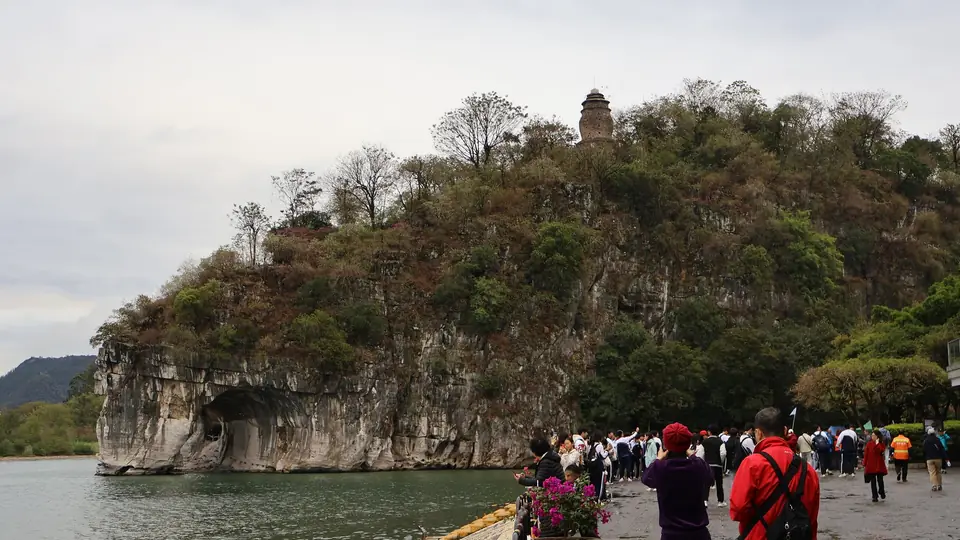
Elephant Trunk Hill rises at the confluence of the Li and the small Taohua river, in the heart of Guilin. It is pure limestone deposited on a seabed 360 million years ago: it reaches 200 metres in altitude, but only 55 above the water. Between the trunk and the animal's leg opens the Water-Moon Cave, an arch 12 metres high whose formation accelerated some 12,000 years ago. On its walls remain more than 50 rock inscriptions, and on the summit stands a Ming-era pagoda that since 1995 has crowned the city's emblem.
Beneath this postcard lies a lawsuit. In 1166 the governor Zhang Xiaoxiang renamed the cave and carved his text on the north wall; his successor Fan Chengda rejected the change and answered him on the south wall, face to face, to restore the name. Fan Chengda won: his is the name used today. And meanwhile, inside the hill, a cellar has held since the 1950s thousands of tonnes of rice liquor that are sold only one week a year.
Highlights
- Water-Moon Cave — A 12-metre-high arch that with its reflection in the Li forms a full circle
- Carved walls — More than 50 inscriptions, with Fan Chengda's reply facing Zhang Xiaoxiang's text
- Elephant Eye — An ancient 52.8-metre underground river passage running through the hill from south to north
- Puxian Pagoda — A 13.6-metre Ming pagoda on the summit, the one on Guilin's emblem
- Sanhua cellar — Thousands of tonnes of rice liquor at a constant 20 °C inside the hill
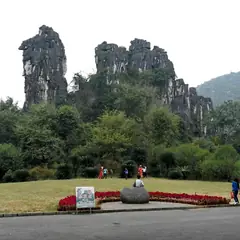
On the banks of the Li River, where the small Taohua flows in, a limestone hill seems to lean over to drink. Elephant Trunk Hill (象鼻山, Xiàngbí Shān) is the quintessential image of Guilin: in February 1995 the city’s People’s Congress put it at the centre of its emblem, with the river at its feet, the Ming pagoda on the summit and a crown of osmanthus petals, the city’s flower. In the 1980s it was already travelling in the wallets of the first foreign tourists: the 50-yuan note of the Foreign Exchange Certificates, the separate money they had to use, carried this same view of the Li.
The history of Elephant Trunk Hill begins long before. It is pure limestone deposited on a seabed 360 million years ago; it measures 108 metres long and 100 wide, and rises to about 200 metres in altitude (another source gives 220), although it stands only 55 above the water. About 12,000 years ago, the uplift of the crust and the narrowing of the river accelerated the formation of the arch between the trunk and the leg: the Water-Moon Cave, 17 metres long, 9.5 wide and 12 high. Above that hollow, the stone filled with writing. Guilin keeps some 2,062 stone inscriptions, protected as national heritage since 2001, and some of the most famous are here.
To learn what to see at Elephant Trunk Hill, the audio guide covers the hill in five stops and 60 minutes: the viewpoint on the bank, the inside of the arch with its carved walls, the Elephant Eye tunnel, the pagoda on the summit and, at the foot, the Yunfeng Temple and the liquor cellar. The thread that joins them is that this elephant is not just a postcard: it is a rock that rivers pierced, that two governors fought over with chisels, that legend killed standing and that the city still uses as a cellar and as a moon-viewing spot.
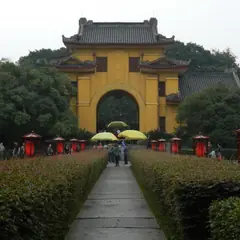
The other karst hills of the Li River line up in Seven Star Park, on the east bank, and inside that same park the Guihai Stele Forest gathers more than two hundred stone inscriptions. In the city centre, Jingjiang Princes’ City keeps in the rock of its Duxiu Peak the most famous verse carved in Guilin.
A trunk in the Li and a stone moon
Elephant Trunk Hill
Summary of this stop
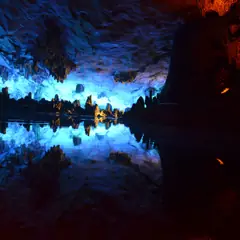
From the viewpoint on the bank, near gate 2, the animal can be seen whole: the trunk sunk in the Li and, between it and the leg, the 12-metre arch. With its reflection in the water, that hollow draws a full circle. A Song poet known as the hermit of Jibei summed it up in four lines: beneath the water there is a clear moon, above the water floats a clear moon; the water runs and the moon does not leave, the moon leaves and the water keeps running.
The scene has a name of its own, “Xiangshan Shuiyue”, the water moon of Elephant Hill, and it is among the eight ancient landscapes of Guilin. Every Mid-Autumn Festival, locals come to this bank to count three moons: the one in the sky, the one the arch draws and the one reflected in the river. In September 2013, in CCTV’s popular vote on the most beautiful place in China to see the moon, the hill came second of fifteen finalists, behind only Beijing’s Lugou Bridge and ahead of West Lake in Hangzhou and the Forbidden City. At the viewpoint, the audio guide explains how to read that circle before entering it.
Two feuding governors on the rock
Water-Moon Cave
Summary of this stop
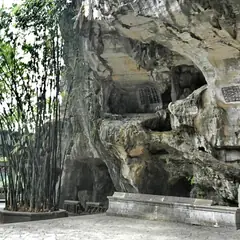
Under the arch, the rock speaks in two voices. In 1166, the second Qiandao year of the Southern Song, the governor Zhang Xiaoxiang stayed in the cave until dusk, returned shortly afterwards and renamed pavilion, cave and rock “Zhaoyang”, toward the rising sun, because the mouth faces east. He carved his preface on the north wall.
His successor disagreed. Fan Chengda, a later governor of Guilin, composed an “Inscription to Restore the Name of the Water-Moon Cave” and carved it on the south wall, right opposite Zhang’s text. Fan’s name is the one that has come down to today. Between them more than 50 inscriptions share the walls, among them a poetic manuscript by Lu You, and poems carved here appear in the anthology “Quan Song Ci” and fill gaps in the works of their authors.
Something is missing in the cave. There was a Song pavilion here, the Zhaoyang Ting, renamed in the Qing era the Deyue Tower, the tower for reaching the moon. It no longer exists: where it stood only damp shadow remains. The audio guide places each text on its wall and reconstructs the absent pavilion.
An old river that pierced the elephant
Elephant Eye
Summary of this stop
Halfway up the slope, a natural tunnel pierces the hill from south to north. The Elephant Eye (Xiangyan Yan) is an ancient stretch of underground river, older than the Water-Moon Cave itself: about 2 metres high, between 5 and 10 wide and 52.8 long. The south eye has steps and serves as a window over the city and the river; the north one gives onto a cliff with no access.
Inside, the hill turns out lower than it looks from the bank: it is those 55 metres above the water that are climbed, not the 200 of altitude. And from the south eye appears the other half of a Guilin custom. To the south can be seen Mount Chuanshan with its Moon Rock, and in the city the two are called together “the two moons of the Li”: one hangs in the sky and the other floats on the water. From here the audio guide points out where to look to find the second.
Sword hilt or Puxian’s vase
Puxian Pagoda
Summary of this stop
On the summit stands the Puxian Pagoda, of the Ming era: 13.6 metres of solid brick on a double octagonal base, with an image of the bodhisattva Puxian (Samantabhadra) carved in blue stone on the north face of the second base. From its silhouette it is called the “sword-hilt pagoda” or “vase pagoda”, and it is the one that presides over the municipal emblem.
That double nickname comes from a legend. It tells that the sacred elephant that carried the Jade Emperor’s vase fell ill passing through Guilin and its master abandoned it on the bank of the Li. Peasants healed it, and in gratitude it stayed to plough their fields. To heaven this seemed an offence: the Celestial King Li came down to seize it and, after seven days and seven nights of combat, when the animal put its trunk in the river to drink, he drove his sword into its back. It died standing and turned to stone. Another version adds that Puxian took pity, pulled out the sword and left in its place his own vase.
The legend treats the pagoda as if it were as old as the hill, but it is a Buddhist construction of the Ming era dedicated precisely to Puxian, the bodhisattva who rides a white elephant. Beside it, the audio guide tells how the monument dismantles the myth and, at the same time, feeds it.
Liquor in the belly, a siege at the foot
Yunfeng Temple and Sanhua cellar
Summary of this stop
At the foot of the hill, the elephant keeps working. Inside the rock is the Xiangshan Jiujiao cellar of Sanhua rice liquor: two levels and two caves over almost 5,000 m², at a constant 20 °C and 85% humidity, where thousands of tonnes of liquor of different vintages have been stored since the 1950s. Tourist sheets speak of an official cellar since the Song era, but what is documented begins in the mid-20th century. It sells to the public only one week a year, before Chinese New Year: locals arrive with their own drums and demijohns to “draw the liquor from the elephant’s belly” for the festivities.
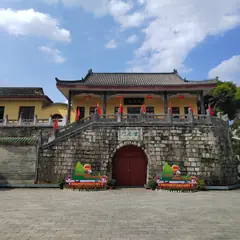
Next to it, the Yunfeng Temple, with red columns and green glazed tiles, looks old and is not. It served as a siege headquarters for the Taiping during the siege of Guilin in 1852, 33 days with some 40,000 men; it was damaged in the war against Japan and completely rebuilt in concrete in the 1970s. Today it houses a hall on the Taiping Heavenly Kingdom. At the last stop, the audio guide closes with the life that goes on inside and at the foot of the stone.