Song and Ming wall
Old South Gate Audio Guide (Gunanmen)
The old south gate of Guilin's wall has defended nothing for more than six centuries: the city has used it as a temple, barracks, theatre and courtyard, and the name the neighbourhood gave it for a banyan has outlived the tree itself.
- 30 min of audio
- Wall gate and banyan
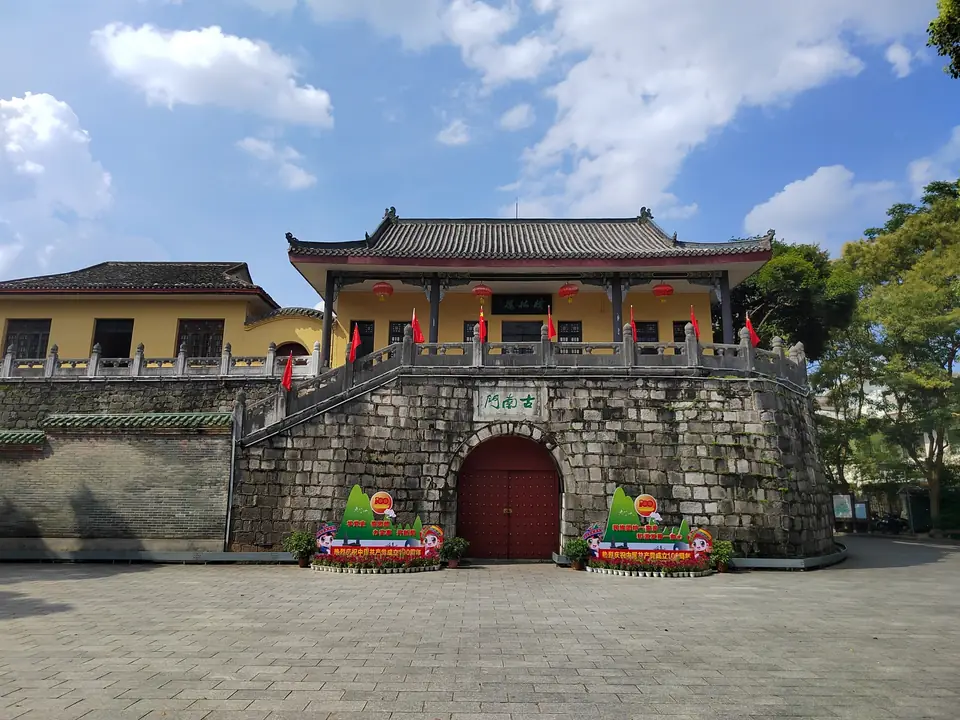
The Old South Gate looks out over Rong Lake, in the centre of Guilin. Its core is the Weide Men, the gate that the commissioner Zhu Sisun opened around 1262-1264 when extending the wall, and which a map carved in rock in 1272 already records. In 1375 the wall was moved further south, the whole old stretch was torn down and only this gate remained, which has since stood inside the city. Its 19.4-metre passage joins a Song brick vault with a stretch of Ming ashlar.
What is seen from the lake is the reverse of any defensive gate: the stairs go up on the outside, on the water side. They were added in 1600 by a governor so that the people could climb again to the Guandi temple, after a commander shut the north face inside his barracks. Over the arch a banyan grew for centuries that gave it its name, the banyan gate; today only remains, on the shore, the tree where, according to tradition, the exiled poet Huang Tingjian moored his boat.
Highlights
- 19.4-metre passage — Cross vault of Song brick joined to a stretch of Ming ashlar
- West staircase — The only one left of the two added in 1600 on the lake side
- Rongshu Tower — Pavilion rebuilt after 1945 with Ming balustrades and the name the neighbourhood imposed
- Huang Tingjian mooring banyan — 18.6 metres tall, saved in 2011 by a schoolchild's letter
- Rong Lake esplanade — Former opera audience ground, today a stage for tai chi and lantern fairs
On the shore of Rong Lake, in the centre of Guilin, a stone gate crowned by a tower opens onto nothing to defend. The Old South Gate (古南门, Gǔ Nánmén) is what remains of the old south stretch of the wall, and since 1375 it has protected nothing: that year the wall was extended as far as the Taohua river, the whole old stretch was torn down and only this gate was saved, while Rong and Shan lakes ceased to be a moat and became inner lakes. The three characters carved over the arch were written by Guo Moruo in 1963, and since 1966 it has been a protected monument of the city.
The history of the Old South Gate is disputed from its very origin. Ming and Qing texts make it Tang-era, linked to the city that Li Jing raised in 621; the city map carved in 1272 on the rock of Mount Yingwu identifies it with the Weide Men, which the commissioner Zhu Sisun opened when extending the wall around 1262-1264. What is seen from the lake, moreover, is largely a platform of 1600, and only the north brick vault is attributed to the Song period. For a banyan that grew over the arch and let its roots drop to the ground, people called it Rongshu Men, the banyan gate.
To learn what to see at the Old South Gate, the audio guide covers it in five stops and 30 minutes: the north face from the street, the passage, the west staircase, the great banyan on the shore and the esplanade facing the lake. The city has used this gate as a temple, theatre, barracks and courtyard, and the name it gave it for a tree has outlasted the tree itself.
Another wall of the same period, that of the Ming princes, still surrounds Jingjiang Princes’ City, whose works began in 1372, three years before this gate was left without a wall. West of the centre, Xishan Park keeps an even older face of Guilin: Buddhas carved in the rock in the Tang era.
The patched back of a gate with no enemy
North face of the gate
Summary of this stop
From the street, the north face looks like a dull old wall: recesses and projections, fine ashlars, irregular stone and bricks of several sizes. It is the face the city gave up for lost. Since the wall moved south in 1375, the gate has stood inside the city and its north side stopped mattering.
In 1555 the military commander Zhou Yude ordered his soldiers to clear the passage, blocked for years by earth and rubble, in about ten days. Afterwards he extended his barracks to the south and enclosed within its compound the north face with its access ramp, so that ordinary people could no longer climb to the temple that stood on top. Before this wall, the audio guide explains the traces of that vanished ramp and of centuries of patching.
From Song brick to Ming stone
Gate passage
Summary of this stop
The passage measures 19.4 metres long, 3.5 high and 2.9 wide, within a gate body 40.7 metres wide. Walking through it crosses a seam between eras. The south stretch, on the lake side, is of squared Ming ashlar, with a tablet by Chen Ziming of the Chongzhen era, now very blurred. The north stretch, about two thirds of the depth, has stone walls and a Song fine-brick vault, which in the centre crosses another, higher vault, running east-west, forming a cross.
That Song heart is the old Weide Men of the 13th century, wrapped by a later platform. The passage was closed for fifteen years, from 2008, and reopened on 28 May 2023; the upper floor remains closed as the office of a cultural association. Inside the tunnel, the audio guide points out where one era ends and the other begins.
A lone staircase and a tower without a tree
Gunanmen
Summary of this stop
From the lake, the façade reads like a list of absences. To restore to the public access to the Guandi temple, the governor Qian Mengde had a platform of ashlar built against the south face in 1600, in under three months, with stairs to east and west. That is why the stairs of this gate are on the outside, on the water side. In 1935, when the street was widened, the walls and the staircase on the east side were torn down, and the platform lost its symmetry.
Above, the tower is not the original either: the war against Japan destroyed it and after 1945 the present three-bay pavilion was rebuilt, surrounded by repositioned Ming balustrades. The banyan that embraced the arch, the one Xu Xiake saw straddling the gate in 1637, did not survive. Its name remains on the plaque, Rongshu Lou, the banyan tower: in the Ming era two imperial censors tried to rename it and people never used their names. At the foot of the staircase, the audio guide tells how the neighbourhood won.
The banyan of the exiled poet
Huang Tingjian mooring banyan
Summary of this stop
On the shore, in front of the gate, stands a great banyan 18.6 metres tall with a crown 32 wide. It is known as the one of Huang Tingjian’s mooring: in 1104, on the way to exile for the crime of “slandering the State”, the poet and calligrapher arrived by boat, moored beneath a great banyan on this bank and entered the city through the south gate, without an official welcome. He died in exile the following year. In 1176 the philosopher Zhang Shi raised a pavilion in his memory beside the tree, and in 1221 the poet Liu Kezhuang wrote that the two banyans came to know the old poet.
Its age is a small mystery. The stele attributes to it more than a thousand years; whoever identifies it with Liu Kezhuang’s banyans gives it between 800 and 915; a 2019 calculation by the Guangzhou Institute of Forestry and Gardening settles on 516. For many locals it is the “immortal of the tree”, and the local chronicle explains the longevity of banyans by their uselessness: twisted wood good for nothing, so nobody cuts them. Around 2011 it was dry and almost leafless, and beneath its branches the audio guide tells how a primary-school pupil’s letter saved it.
The wall that ended up as an audience ground
Esplanade in front of the gate
Summary of this stop
From the shore the gate, the lake and the people are taken in at a single glance. Over the arch there was from the mid-14th century a Guandi temple, and in the late Qing dynasty and early Republic, between the gate and the lake, a Guilin opera stage stood: the public filled the esplanade and the stands, and the stretch of wall served as a box. In 1963, Guo Moruo climbed the tower, wrote the characters of the arch and noted in a poem that Huang Tingjian’s mooring tree was still standing.
The esplanade is still full. As evening falls, locals practise tai chi, calligraphy and dance while the gate lights up, and at the Lantern and Mid-Autumn festivals lantern fairs are held here: in 2025 lanterns painted by children hung and a cart loaded with fish-shaped lanterns became the photo spot of the night. At the last stop, the audio guide closes facing the lake, where the gate that defends nothing has become the city’s courtyard.