Karst park
Seven Star Park Audio Guide (Qixing Gongyuan)
Seven limestone peaks laid out like the Big Dipper above a cave that was an underground river, a classroom under the bombs and the tomb of the 1944 defenders: Guilin's largest park, where landscape and memory share the same rock.
- 90 min of audio
- Peaks, cave and war memory
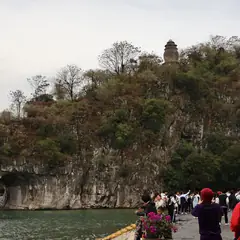
Seven Star Park is the largest in Guilin and occupies the east bank of the Li River. It is entered by the Huaqiao Bridge, born in the Song era, and inside rise the seven peaks that give the park its name: the four of Putuo Mountain and the three of Yueya Mountain, almost the same height and bearing the Chinese names of the stars of the Big Dipper. In the belly of Putuo opens Seven Star Cave, an ancient underground river channel with 814 metres of visitable route.
Beneath the surface of neighbours dancing and practising tai chi lies a war story. In the caves the city took refuge during the Japanese bombings, and on one wall the slogan of the children who attended class inside is still carved. In 1944, the same darkness became a trap: some 800 defenders died in the cave, attacked with gas and fire, and three of their generals rest today high on Putuo, buried by the neighbours.
Highlights
- Huaqiao Bridge — Four blue-stone arches that with their reflection draw four moons, plus a dry stretch against floods
- Seven Big Dipper peaks — The bowl on Putuo Mountain and the handle on Yueya Mountain
- Seven Star Cave — A fossil river with 814 visitable metres, at about 20 °C all year
- Three Generals Tower — Memorial and Tomb of the Eight Hundred on the Bowangping esplanade
- Camel Hill — The old wine jar, before whose lawn Bill Clinton spoke in 1998
On the east bank of the Li River, seven limestone peaks line up as if someone had lowered the Big Dipper to earth. Seven Star Park (七星公园, Qīxīng Gōngyuán), the largest in Guilin, gathers the four peaks of Putuo Mountain, the “bowl” of the constellation, and the three of Yueya Mountain, the “handle”, all between 241 and 265 metres in altitude and named after the Chinese names of the seven stars. Beneath them runs Seven Star Cave, a fossil river that has been a wonder to travellers, air-raid shelter, school, tomb and, very recently, theatre.
The history of Seven Star Park is that of one rock read in many ways. The cave was formerly called Qixia Dong, the cave where the sunset clouds dwell, and Bixu Yan; the name of the Seven Stars was imposed in the Song era, although the sources do not agree on since when it has been visited. In 1637 the traveller Xu Xiake explored it by the light of pine torches. Three centuries later, during the war against Japan, Guilin grew from 70,000 to more than 500,000 inhabitants, and people hid in these caves during the bombings. In 1944, the cave became the tomb of some 800 defenders.
To learn what to see at Seven Star Park, the audio guide covers it in six stops and 90 minutes: the Huaqiao Bridge, the Yueya Lou tower, the mouth of the cave, the war slogan wall, the memorial of the three generals and the meadow in front of Camel Hill. The idea that joins them is that this park of neighbours is at once a map of the sky, a fossil river and a war tomb.
In its southwest corner, the Xiaodong River passes through the caves of the Guihai Stele Forest, covered with inscriptions since the year 894. The other great karst profile on the banks of the Li is Elephant Trunk Hill, and the city’s other great cave, an ancient underground lake, is the Reed Flute Cave, to the northwest.
Four moons under a Song bridge
Huaqiao Bridge
Summary of this stop
The main entrance crosses the Huaqiao Bridge, of blue stone and with a gallery covered in green tiles, over the confluence of the Xiaodong and the Lingjian stream. It was born as the Jiaxi Bridge in the Jiaxi era of the Southern Song (1237-1240), although its chronology is confused and the sources speak of wooden bridges, stone ones and multiple restorations. Before 1949 piers sank and the parapet collapsed; after the repair of 1965 it measures 134.66 metres. Over the water it has four great arches, which with their reflection form four circles like full moons; to the west follows a dry stretch of seven small arches, designed to drain floods.
The bridge also crossed the Taiwan Strait turned into literature. The writer Bai Xianyong, author of “Taipei People”, titled one of his best-known stories with the name of a rice-noodle house at the head of this bridge, which an exile recreates in Taipei. On the bridge, the audio guide tells what photo she finally hangs in her shop.
Nuns’ noodles and a city in flames
Yueya Lou Tower
Summary of this stop
At the north foot of Yueya Mountain, the Yueya Lou tower, three storeys with pavilions and galleries, serves a vegetarian cuisine with history. It descends from the Buddhist convent that more than two centuries ago, in the Qing era, stood beneath the mountain: the nuns thanked pilgrims with meatless food, and their “nuns’ noodles” are still on the menu. The building’s sign was written by Guo Moruo when he ate there in 1963. From here one learns to read the Big Dipper in the profile of the hills.
On this same hill one of the darkest episodes of the city was lived. In the winter of 1938, the novelist Ba Jin, fled from Canton, watched from the top of Yueya the bombing of 29 December: half the sky black with smoke and the city wrapped in flames from the afternoon until well into the night, with the wall gates burning like firewood. He told it in “The Martyrdom of Guilin”. The audio guide explains what novel he kept writing in the midst of that fire.
The fossil river of the pine torches
Seven Star Cave
Summary of this stop
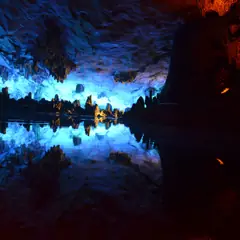
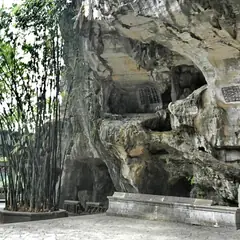
On the west slope of Putuo Mountain opens the mouth of the cave, beneath the inscription “First Grotto Under Heaven” by the Ming painter Zhang Wenxi. Inside, the temperature stays at about 20 °C all year. Seven Star Cave is an ancient underground river channel on three levels: above, remains of the vault; below, a river that keeps digging; in between, the visitable level, with 814 metres of route and up to 27 high. Other sources give different figures, partly because they measure the entire cavity and not the stretch that is visited.
Xu Xiake crossed the bridge on the second day of the fifth lunar month of 1637, climbed to the upper cave and descended to the great lower cave guided by a man with pine torches. In his diary he noted a stone carp that seemed to leap from a crack in the ceiling. At the rear exit he also read the inscription of Zeng Bu, the Song governor who gave that mouth its name when he laid a small bridge over the stream. Today the chambers are lit with coloured lights, and at the mouth the audio guide proposes looking for that carp.
The cave that was classroom and tomb
War slogan carved on the wall
Summary of this stop
On a wall of the cave a phrase is still carved: “The enemy bombs, we hold class!” It is the trace of the years when the refugee city hid in the caves during the bombings and the children of the Xin’an group gave here what they called cave education.
The same darkness that protected them became a trap. In the battle of Guilin, whose siege began on 28 October 1944, the Japanese army attacked the defenders at the mouth of the cave with toxic gas, incendiary bombs and flamethrowers. Some 800 officers, soldiers and wounded of the 391st Regiment of the 131st Division died inside; figures vary according to the source, and one account speaks of 823 remains gathered a year later. At the 2025 Guilin Festival, the cave functioned as a theatre, and an actress said the place looked very much like the underworld. Before the wall, the audio guide joins those three lives of the cave.
Three generals buried by their neighbours
Three Generals Tower
Summary of this stop
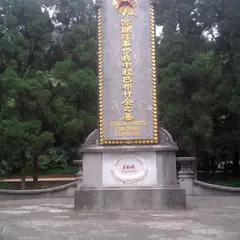
A walk uphill from the cave exit leads to the Bowangping esplanade on Putuo Mountain, among pines and cypresses. There stand the Three Generals Memorial Tower and the Tomb of the Eight Hundred Heroes. Here lie Chen Jihuan, Kan Weiyong and Lü Zhanmeng, buried by the neighbours after the fall of the city in November 1944, beside more than 800 soldiers. It is a national war memorial site.
Behind the names are gestures of farewell, gathered as documented tradition. Chen Jihuan accepted his post with his wife about to give birth and left a letter: if Guilin lives, I live; if Guilin falls, I fall. Lü Zhanmeng told his family that he was only going to carry ammunition and would be back at once. His grandson climbs up every Qingming with the family to honour the tomb. On the esplanade, the audio guide tells what Chen Jihuan wrote on a visiting card on his last night.
The wine jar they call a camel
Camel Hill
Summary of this stop
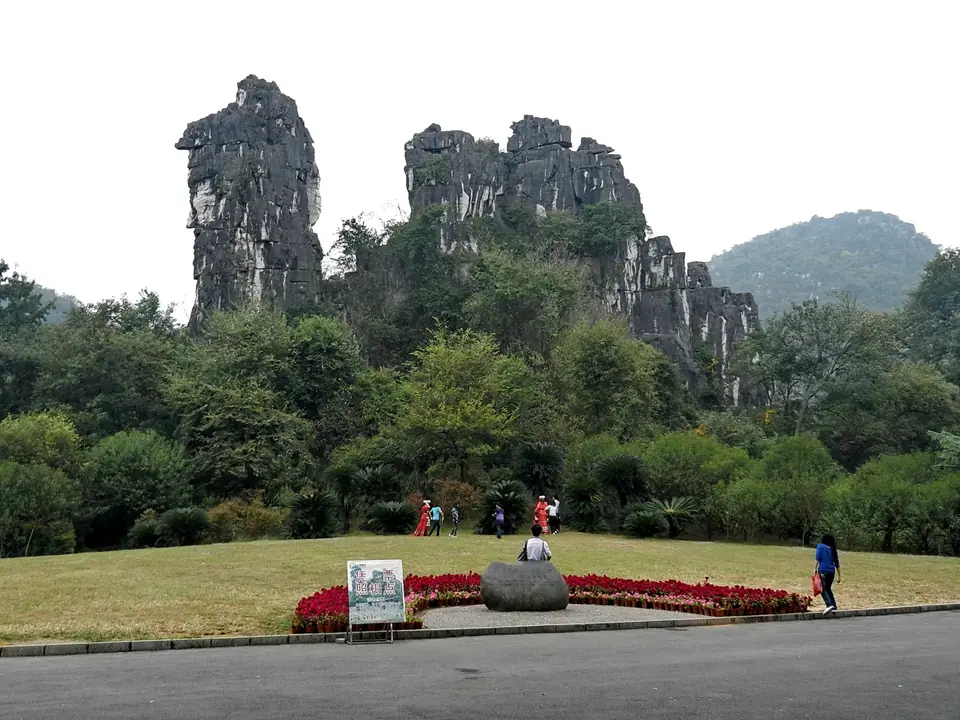
At the south of the park, an isolated crag has the shape of a crouching camel, and that is what everyone calls it: Camel Hill. But its old name was another, Hushan or wine-jar hill, for its silhouette of an ancient jar, and those characters are still carved on its neck. In the late Ming a retired scholar covered it with peach trees, and their red bloom gave its name to one of the ten views of Guilin, the Red Sunset Clouds of the Hump.
In front stretches the meadow where, on 2 July 1998, at 12:22, Bill Clinton gave his speech on the environment and global warming, after meeting seven Chinese environmentalists. He fanned himself with a folding Guilin fan and joked that it was a low-consumption air conditioner. At the last stop, in front of the stone camel, the audio guide closes a tour in which landscape and memory share the same rock.