Karst cave
Reed Flute Cave Audio Guide (Ludiyan)
An ancient underground lake beneath Mount Guangming that villagers kept as a hideout until 1959, with 77 ink signatures on its walls from the Tang era and a great chamber, the Crystal Palace, where legend froze a battle of the Monkey King.
- 60 min of audio
- Cave with Tang inscriptions
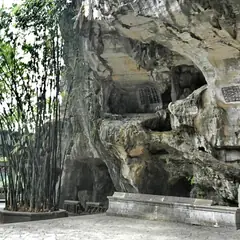
Reed Flute Cave opens halfway up Mount Guangming, northwest of Guilin. It was an underground lake that drained when the massif rose and the water table fell, leaving a pocket-shaped cavity 240 metres deep, 93 wide at most and 18 high. Its name comes from the ludi reeds that covered the slope and hid a mouth only one person could fit through. The U-shaped route, of about 500 metres, enters through that natural mouth and leaves by a tunnel opened beside it.
The cave of the state guests, as it is nicknamed since it received more than 80 heads of state and government, was never a sudden find. Its walls hold 77 inscriptions in brush and ink: the oldest dated is from 790, by a former prefect of the city, and the best preserved was left by the eunuchs of a gang of stonecutters of the princes of Jingjiang who came to look for stone. Villagers knew of it and kept quiet for generations.
Highlights
- Natural mouth — A hole halfway up the slope, covered by reeds, which before 1959 only one person could fit through
- Ink inscriptions — 77 signatures and poems from 790, from Tang monks to stonecutters of the Ming princes
- Pillars Holding Up the Sky — Two twin pillars, one joined to the ceiling and the other not yet there
- Crystal Palace — A chamber 93 metres wide read as Sun Wukong's battle against the Dragon King
- Pine and snowman — Brilliant white calcite in a cave that never drops below 20 degrees
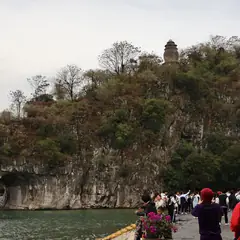
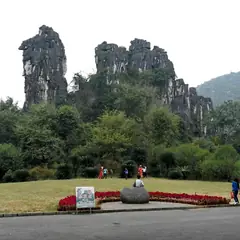
Northwest of Guilin, on the slope of Mount Guangming, a stone mouth opens onto the city’s most visited attraction. Reed Flute Cave (芦笛岩, Lúdí Yán) owes its name to the ludi reeds that covered the slope and hid the entrance: a hole only one person could fit through. Since it opened to the public in 1962, it has been called the “cave of the state guests”, because more than 80 heads of state and government have passed through it, among them Richard Nixon, Jimmy Carter and Javier Pérez de Cuéllar.
The history of Reed Flute Cave is that of a shared secret. Hundreds of thousands of years ago, more than 700,000 by the most cited figure (other sources give 600,000 or a million), there was an underground lake here; as the massif rose and the water table fell, the water left and a cavity 240 metres deep remained. Villagers in the surroundings knew of it and kept it as a hideout; during the Sino-Japanese War it served as a shelter from the bombings, and it was not until 1959 that they reported it to the municipal government. But long before, since the Tang era, other visitors had left their ink signature on the walls.
To learn what to see at Reed Flute Cave, the audio guide accompanies the U-shaped route of about 500 metres in four stops and 60 minutes: the natural mouth, the inscriptions on the walls, the twin pillars and the Crystal Palace. The thesis that joins them is that this cave of coloured lights was never a sudden discovery, but a secret that monks, stonecutters, villagers and heads of state went on signing, each in their own way.
The city’s other great karst cavity, Seven Star Cave, an ancient underground river, runs beneath Seven Star Park. And closer, in the west of Guilin, Xishan Park keeps on its limestone peaks Buddhas carved in the Tang era, the same era as this cave’s first ink signatures.
The mouth the villagers kept quiet
Reed Flute Cave
Summary of this stop
In front of the natural entrance, reached by steps, little recalls what was here. The mountain, which used to be called Maomaotou, had only a small mouth halfway up the slope, hidden behind the reeds that give the cave its name. The neighbours kept it secret as a hideout, and in the years of the war against Japan (1937-1945) it was used as an air-raid shelter. The version circulating in English speaks of refugees who supposedly discovered it in the 1940s; local sources place the modern discovery in 1959, when villagers finally informed the municipal government.
The poet and historian Guo Moruo turned that moment into verse. In his “Ode to Ludiyan” he wrote that at the mouth of the cave fetters are broken and that in the land of peach trees the immortal spirits sing. The land of peach trees is the hidden paradise of Chinese literature, reached only through a crack in the mountain, and the cave opens beside the Taohua river, the river of peach blossoms. Before the mouth, the audio guide explains why that hideout stopped being one.
From the Tang prefect to the Ming stonecutters
Ink inscriptions on the walls
Summary of this stop
Once inside, black brush strokes appear on the walls, faded and partly erased. They are 77 inscriptions in ink: 5 from the Tang era, 11 Song, 1 Yuan, 4 Ming, 4 from the Republic and 52 without an identifiable date. The oldest dated signature, according to the local inventory, is from 790: four visitors, among them Yan Zheng, who had been prefect of Guizhou, Guilin in the Tang era. Other sources take it to 792, and an official publication went so far as to attribute the oldest work to the Qi dynasty, in the 5th century, something the sinologist Tosaki Tetsuhiko rules out on the basis of the calligraphy.
The best-preserved inscription is from the Ming era: a panel of 50 by 58 centimetres with characters of 6, in which the eunuchs Zhou Xi, Guo Bao and Meng Xiang note that they arrived with a gang of stonecutters from the palace of the princes of Jingjiang to look for stone, in a dingchou year. It was no excursion: the red-veined stone of the mausoleum gate and of the Golden Water bridge of Prince Zhuangjian’s tomb comes from this very mountain. The audio guide reads the wall as what it is, a guestbook more than a thousand years old.
The twin pillar that has yet to arrive
Twin Pillars Holding Up the Sky
Summary of this stop
In the forest of columns rise two almost identical pillars, the twin “Holding Up the Sky” columns. One is already joined to the ceiling by threads of calcite; the other only appears to be, hidden by a curtain of stone. The stone keeps growing drop by drop on the floor of what was a lake: the cave measures 93 metres at its widest point and 18 at its maximum height.
Here is the most curious ritual of the route. Groups advance behind a Chinese-speaking guide who works the switches by hand: each formation lights up when the group arrives and goes dark when it leaves. Before the twins, since dripping adds from a few millimetres to twenty or thirty centimetres each century, the explanation ends with a wish for long life so that everyone may come back in a hundred years to check whether the pillar has joined yet. Sometimes, moreover, the guide begins to sing mountain songs associated with the local heroine Liu Sanjie. The audio guide explains what separates one twin from the other.
Crystal Palace, the Dragon King’s frozen battle
Crystal Palace
Summary of this stop
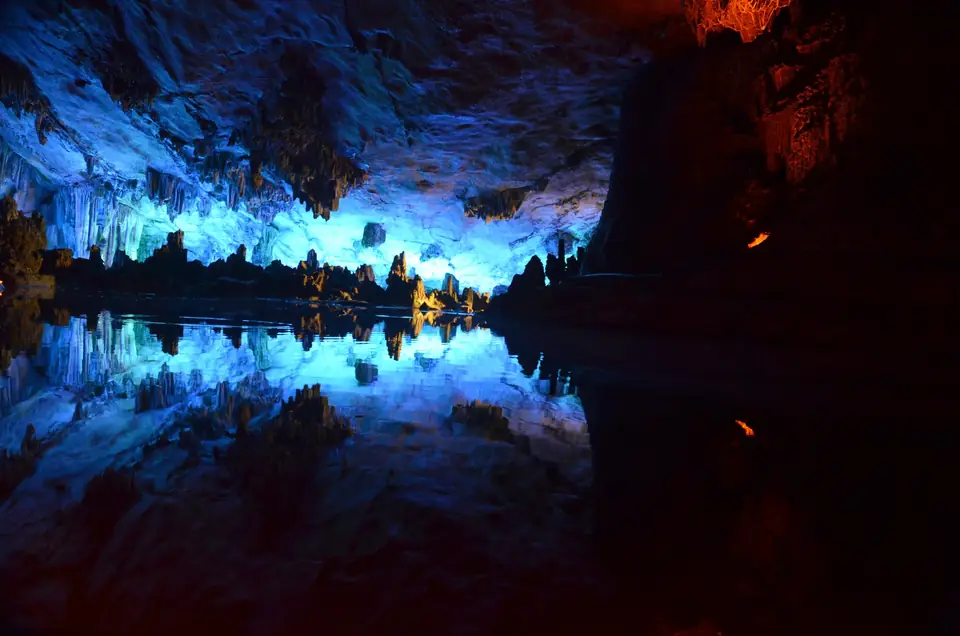
The route culminates in the Crystal Palace, the widest chamber, with an almost flat floor and ceiling from the horizontal strata of the ancient lake. According to tradition, it is the Dragon King’s palace where Sun Wukong, the Monkey King, staged the great fight to seize the needle that fixes the seas. Each rock has its role: a stone jellyfish acting as sentry, a tower half toppled by the monkey’s staff, a conch with its shell burst and a carp sinking into the mud out of pure fear. That carp was in reality a complete column: as the clay at its base sank, the upper part came away from the ceiling.
The chamber served as a set for the old television version of “Journey to the West”, the series of Sun Wukong’s adventures, and has received the state guests who give the cave its nickname. On 26 January 1986, Deng Xiaoping wrote here that he had been to the place, and Wang Zhen added behind it his name as companion. At the last stop, the audio guide proposes the chamber’s game: finding the winner of the battle, who is not standing.