Ming palace
Jingjiang Princes' City Audio Guide (Jingjiang Wangcheng)
A walled city inside Guilin where a dynasty of Ming princes lived shut in for 280 years: a palace burned in 1652, an imperial examination compound afterwards, a university campus today, and in the rock of its peak, the verse with which Guilin presents itself to the world.
- 90 min of audio
- Ming walled city
Jingjiang Princes' City began to rise in 1372 at the foot of Duxiu Peak, a solitary karst hill in the very centre of Guilin, over the old residence of an exiled Mongol prince who ended up as the last Yuan emperor. A wall of ashlar about 556 by 355 metres, with four gates, enclosed here a city within the city for the princes of Jingjiang: 14 holders in 11 generations, the longest-lived Ming branch.
It was a cage before it was a palace. Under the princes' prohibition, they could not hold office, trade or leave the compound, and one who escaped at night dressed as a Taoist monk came close to losing his title. In 1652 the Qing general Kong Youde burned himself inside with his treasures and only the stone survived. Over the ashes the cells of the imperial examinations were installed, and since 1954 the compound has been a university campus.
Highlights
- Zhengyang Gate — South entrance crowned by the Sanyuan Jidi sign honouring Guangxi's only three-time first
- Ming wall — About 1,824 metres of stone ashlar that withstood the 1652 fire
- Chengyun Dian base — Ming staircase and balustrades beneath a building of 1947
- Imperial Examination Museum — Cells of the compound that reached some 5,500 in 1832
- Duxiu Peak — 306 steps and the verse of 1201 that the stalactite hid until 1983
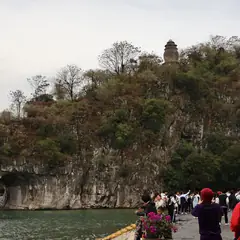
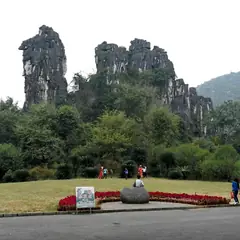
In the very centre of Guilin, a rectangle of grey wall embraces a limestone peak that rises alone among the buildings. Jingjiang Princes’ City (靖江王城, Jìngjiāng Wángchéng) was the residence of the Ming princes of Jingjiang, and its history fits in three words: cage, bonfire and classroom. Works began in 1372, the fifth Hongwu year, at the foot of Duxiu Peak, and by about 1376 the core was finished. The site was no ordinary one: in 1330 the Mongol prince Toghon Temür had arrived exiled in Jingjiang, who in 1333 ascended the throne as the last Yuan emperor, and his former residence became the mansion of the first Ming prince.
The history of Jingjiang Princes’ City is that of a family shut in. The principality lasted 280 years, from 1370 to 1650 by the most widespread count (another version speaks of 257 years and 12 generations), with 14 princes: the longest-lived Ming branch and the only one not descended directly from an emperor. Nine people arrived in Guilin; two centuries later there were about 3,000, a burden the province could not sustain. Tourist promotion presents it as older than the Forbidden City, but a nuance is called for: the wooden buildings burned in 1652, and what is Ming that remains is the wall, the bases and the carved stone.
To learn what to see at Jingjiang Princes’ City, the audio guide covers its axis in five stops and 90 minutes: the south gate, the Chengyun gate, the staircase of the audience hall, the imperial examination cells and the Reading Cave of Duxiu Peak. The compound swapped princes for candidates and candidates for university students, and the phrase with which all of Guilin presents itself to the world spent centuries hidden under the rock of its own peak.
Of the city wall there still stands, on the shore of Rong Lake, the Old South Gate, which was saved in 1375, when the old south stretch was torn down, barely three years after works on this palace began. And the verses carved in rock number in the hundreds in the Guihai Stele Forest, in Seven Star Park.
A palace gate that honours a student
Zhengyang Gate
Summary of this stop
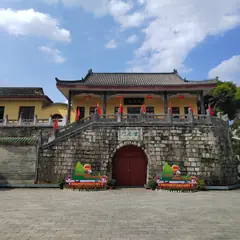
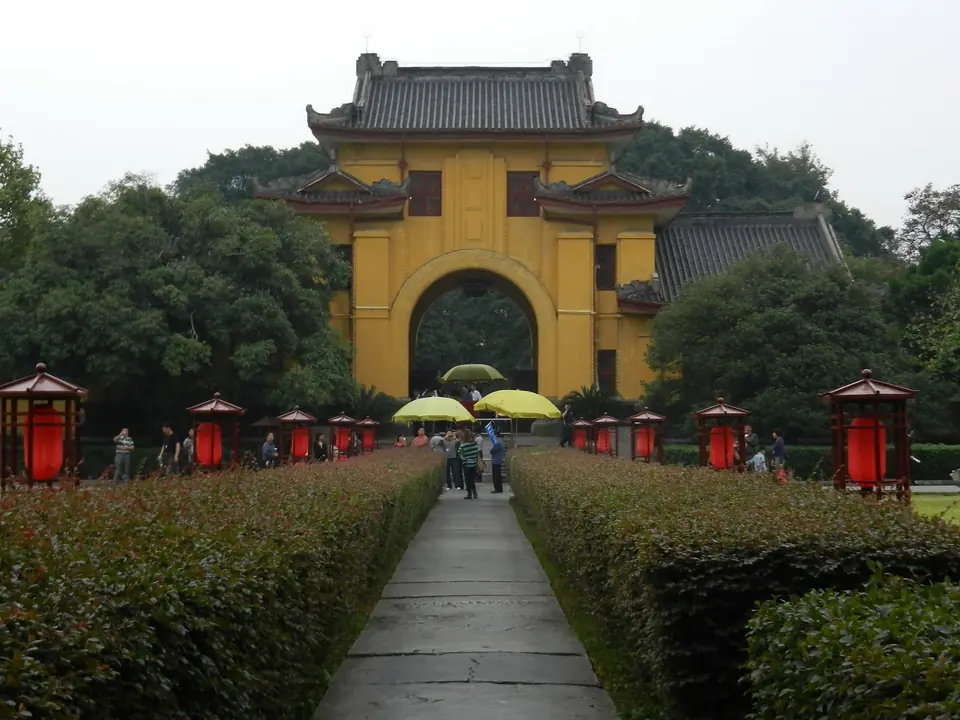
The main entrance, the Duanli or Zhengyang gate, opens in the south stretch of the wall. The stone ashlars outline a rectangle of about 556.6 metres north to south by 355.5 east to west, with about 1,824 metres of perimeter by the most cited measurement, and four gates: Duanli to the south, Guangzhi to the north, Tiren to the east and Zunyi to the west. That grey stone is the most authentically Ming thing in the compound, because it withstood the fire.
What crowns the gate is curious. A city of princes boasts on its façade of a passed examination: the great stone sign “Sanyuan Jidi”, written by the governor-general Ruan Yuan, honours Chen Jichang, of Lingui, who won the provincial examination here in 1813 and in 1820 placed first in the metropolitan and palace examinations. Three times first, the only one from Guangxi. In front of the gate, the audio guide explains how a student came to preside over the entrance of a palace.
Golden nails for princes with no way out
Chengyun Gate
Summary of this stop
The Chengyun gate, on the central axis, gave access to the audience hall; in 1376 the privilege of golden nails on red doors was authorised for it. Behind, at the end of the axis, Duxiu Peak stands out. A popular legend of Guilin considers it a dragon vein: they say Liu Bowen drew for the Ming founder a dragon with its head in Beijing and its tail in Guilin, and that the peak’s force would explain how the exiled Toghon Temür became emperor. The story is more prosaic: he rose to the throne through a chain of deaths at the Yuan court.
The first prince, Zhu Shouqian, grandnephew of the Hongwu emperor, did not enjoy his red doors for long. Summoned to Nanjing in 1380, he answered a reprimand with a poem full of complaints, was demoted to commoner and died a prisoner in 1392, buried far from Guilin. His successors lived under the princes’ prohibition hardened by the Yongle emperor: no posts, no trade and no leaving their compound. Before this gate, the audio guide tells of the night escape of the prince disguised as a Taoist monk.
The Ming base that survived the bonfire
Chengyun Hall
Summary of this stop
On the staircase of the Chengyun Dian, the great audience hall, two eras coexist in plain view. Below, the carved base, balustrades and cloud staircase are Ming; above, the building was constructed in 1947 for the Guangxi provincial government, after the destruction of 1944. Between them lies a fire.
In 1650 the Qing general Kong Youde took Guilin and made the palace his residence. Two years later, overrun by the war elephants of Li Dingguo, he shut himself in with his treasures, killed his favourite concubine and burned himself inside: the audience hall and the wooden quarters burned. A chronicle by the historian Wang Fuzhi adds an episode of documented tradition: shortly before, neighbours reportedly saw Qu Shisi and Zhang Tongchang, the Ming defenders whom Kong had ordered executed, ride into the residence on horseback. On this ground, the audio guide reconstructs the night of the fire.
Five and a half thousand cells over the ashes
Imperial Examination Museum
Summary of this stop
Over the ruins the Gongyuan was installed, the compound of the Guangxi provincial examinations: in 1657, and on a stable basis from 1681. The individual cells, where a seated body barely fitted, never stopped multiplying: in 1742 420 were added, and in 1832 they totalled about 5,500, until the examinations were abolished in 1905. Today the Imperial Examination Museum recreates some of them.
The compound never ceased to be a seat of power or of study. In 1921 Sun Yat-sen installed here the headquarters of his Northern Expedition, in 1936 the provincial government moved in and since July 1954 it has been the campus of Guangxi Normal University. From these walls, moreover, came a child prince born in 1642: when his father’s ambition failed, a eunuch carried him off on his back and hid him in a temple, where he shaved his head and took the name Shitao. Beside the cells, the audio guide tells what that fugitive became.
The verse the rock covered and 1983 uncovered
Reading Cave
Summary of this stop
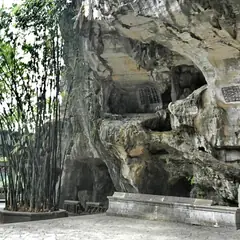
On the east slope of Duxiu Peak opens the Reading Cave, considered the oldest famous site in Guilin. Here the poet Yan Yanzhi, governor under the Liu Song in the 5th century, used to read, and from a verse of his about the solitary, haughty summit among the walls comes the peak’s name: 66 metres above the ground and 306 steps to the top.
Beside the mouth is the city’s most famous inscription: “Guilin shanshui jia tianxia”, the landscape of Guilin is the first under heaven. It was composed by Wang Zhenggong, a provincial judge of 68, in the ninth month of 1201, to encourage 11 successful candidates; almost nobody remembers the verse that follows. The idea has been attributed to others, from Fan Chengda to Guo Moruo, but this stone dates the exact formulation. For centuries it was hidden beneath a crust of stalactite, until in the summer of 1983 two heritage technicians brought it to light after several days of cleaning. At the last stop, the audio guide reads the phrase on the damp stone.