Rock inscriptions
Guihai Stele Forest Audio Guide (Guihai Beilin)
Two caves on the banks of the Xiaodong River with walls covered in writing since the year 894, and among them the blacklist of 309 traitors that an emperor ordered destroyed and that the great-grandson of one of them carved again as a roll of honour.
- 45 min of audio
- Tang, Song and Ming inscriptions
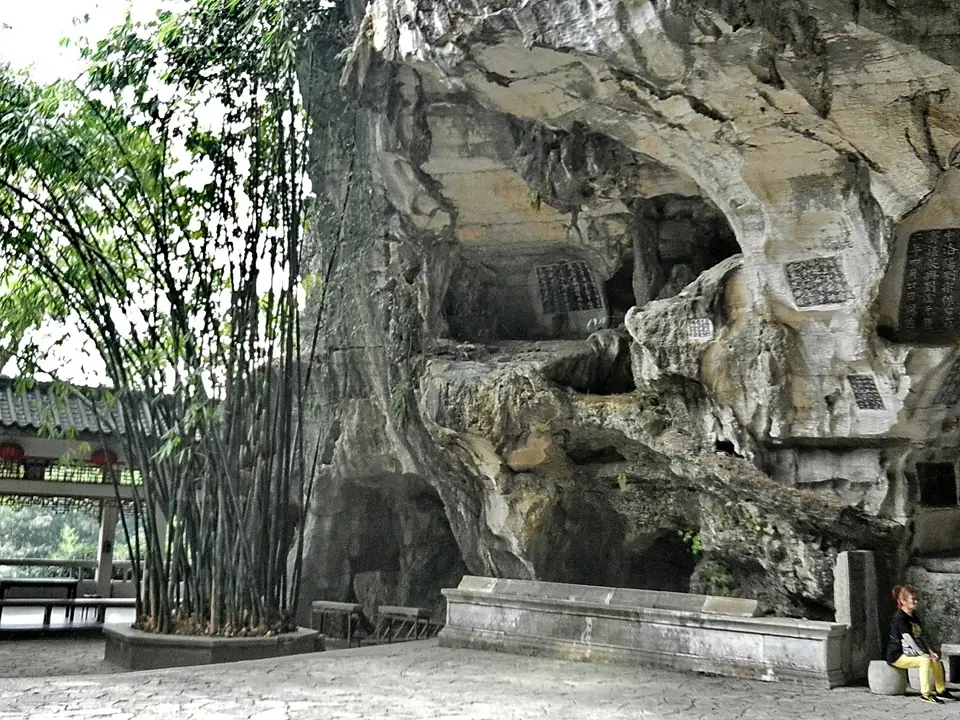
The Guihai Stele Forest occupies two cavities beside the Xiaodong River, in the southwest corner of Guilin's Seven Star Park: the Longyin Dong, a cave that water crosses from north to south, and the Longyin Yan, a vaulted overhang that drips all year. Between them they preserve 213 inscriptions from the Tang era to the Republic, more than half from the Song dynasty. In the Song era there was a Buddhist temple here; in 1965 the caves opened to the public as a stele forest.
The most famous piece is a blacklist. In 1104 Emperor Huizong had the names of 309 wicked officials of the Yuanyou faction carved and circulated throughout the empire, among them Sima Guang and Su Shi; two years later, a comet seemed an ill omen to him and he ordered all copies destroyed. In 1198, Liang Lü, great-grandson of one of the proscribed, carved it again on this rock from a family copy. The document of infamy ended up turned into pride.
Highlights
- Dragon's trail — A long groove with scale-like marks on the ceiling of the Longyin Dong
- Yuanyou faction stele — 309 proscribed names, carved again in 1198 by the great-grandson of one of them
- Panel of the three generals — Account of the 1053 campaign against Nong Zhigao
- Wang Jingshan's Buddha character — A single cursive stroke that from afar draws an old woman with incense
- Ink rubbing — A technique declared intangible heritage of Guangxi that the museum lets visitors try
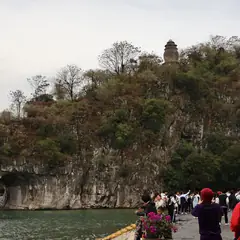
In the southwest corner of Seven Star Park, the Xiaodong River slips through a cave whose walls are so covered in writing that hardly any smooth stone is left. The Guihai Stele Forest (桂海碑林, Guìhǎi Bēilín) brings together two cavities, the Longyin Dong and the Longyin Yan, with 213 inscriptions ranging from the Tang era to the Republic: 1 Tang, 111 Song, 1 Yuan, 42 Ming, 26 Qing and 32 undated, according to the official sheet (other sources give somewhat different figures). In the Song era the overhang housed the Buddhist Shijia temple and several pavilions; in 1964 a pavilion for steles was raised on its ruins and in 1965 the caves opened to the public under their present name.
The history of the Guihai Stele Forest begins with some flowers. The oldest inscription, from 894, is an exchange of poems between Zhang Jun and Liu Chonggui about the azaleas of the stream, which they describe as “half full of water, half of flowers”. From then on, generations of scholars, officials and exiles left on the rock war reports, farewells, codes of conduct and, above all, a blacklist that an emperor wanted wiped off the map.
To learn what to see at the Guihai Stele Forest, the audio guide covers it in four stops and 45 minutes: the mouth of the cave through which the river passes, the panel of the three generals, the Yuanyou faction stele and the stele pavilion. The thesis that joins them is that this rock is not a museum of dead letters, but a place where names that someone wanted erased returned, carved by their own grandchildren.
The two caves form part of Seven Star Park, and they are not the only written rock in Guilin: some of its most famous inscriptions are under the arch of Elephant Trunk Hill, and in Xishan Park the stone keeps Buddhas carved in the Tang era and votive inscriptions.
The ceiling a dragon left behind
Guihai Stele Forest
Summary of this stop
At the south mouth of the Longyin Dong, the eye rises on its own to the ceiling: a long groove with ring-shaped marks, like scales, runs the cave from end to end. In Guilin they say that a great dragon slept in this rock and that, in a year of terrible drought, there was no way to wake it. People climbed up with gongs and drums and began to sing mountain songs mocking it for being a sleepyhead. Ashamed, the dragon flew out through the rock, and at that instant fell the downpour that saved the harvests.
Hence the names: Longyin Yan, the rock where the dragon hid, and Longteng Yan, that of the dragon that took flight. Ancient visitors sealed the legend on the stone with carvings such as “broke the wall and flew”. Beside this same stream, in 894, the first of the more than two hundred inscriptions began. Under the ceiling, the audio guide follows with the eye the dragon’s scar from head to tail.
The rivals the stone joined
Panel of the three generals
Summary of this stop
In the Longyin Dong a great inscription of 1053 is still legible: the Account of the Three Generals Who Pacified the Man. It narrates the campaign against the rebel Nong Zhigao and lists the ranks and names of the troops of Di Qing, Sun Mian and Yu Jing, together with the measures taken afterwards in the region and the rewards to the fighters. It is at once a war report and a promotion roll.
The irony lies in the names. Years earlier, Yu Jing had sent four memorials in a row against Di Qing’s appointment on the northwest frontier, branding him coarse and a mere soldier. After the victory he wrote in Guilin a stele praising his command, and the two ended up together on this panel. The stone, moreover, barely holds out: in every flood season the river covers most of the inscriptions inside and leaves them full of mud, and seepage deposits crusts of calcite over the strokes. Before the panel, the audio guide reads the story of that forced reconciliation.
309 traitors and the chisel’s great-grandson
Yuanyou faction stele
Summary of this stop
Beneath the vault of the Longyin Yan, more than three metres above the floor, the Yuanyou faction stele is preserved: the title in four characters, the preface by the minister Cai Jing and 309 names in columns. In 1104 (other sources say 1105), Emperor Huizong had this list of “wicked” members of the Yuanyou faction carved and circulated, among them Sima Guang and Su Shi, whose descendants were barred from an official career. It did not gather only the opponents of Wang Anshi’s reforms: reformers who had fallen from favour such as Zhang Dun or Zeng Bu also ended up on it. In the first month of 1106, a comet seemed an ill omen to the emperor and he ordered all copies destroyed.
This one survived because someone carved it again. In 1198, more than ninety years later, Liang Lü, great-grandson of the proscribed Liang Tao, reproduced it on this rock from a copy kept by his family. Under the Southern Song, with the proscription lifted, descendants displayed it as a reason for pride. It is often presented as authentic calligraphy of Cai Jing, but it is that 1198 re-carving, and whether it is the only complete one left is debated. In 1935 the thinker Hu Shi came to see it when it stood behind a little house inhabited by a Taoist. The audio guide explains how the list of infamy became a roll of honour.
Names that return in paper and ink
Stele pavilion and rubbing gallery
Summary of this stop
At the entrance of the stele pavilion, raised over the ruins of the Shijia temple, the rock reveals itself as a place that is read from generation to generation. Among the Longyin inscriptions there are three groups, carved side by side, in which sons and grandsons left a record of having come to look for the signatures of their fathers and grandfathers on this very stone.
Here is also kept, under cover, an anti-corruption code of the 11th century: the Discourse on the Five Miasmas by Mei Zhi, according to which the fevers of the south were less dangerous than the five vices of office, from squeezing those below to filling the house with concubines. The official Zhu Xiyan had it carved in 1190, and centuries later a rubbing travelled to the author’s native land, in Sichuan, where it was carved again. The ink rubbing of the Guilin inscriptions entered in 2016 the list of intangible heritage of Guangxi, and the museum offers visitors the chance to make their own. At the last stop, the audio guide tells how that technique keeps the names travelling.