Tang rock-cut Buddhas
Xishan Park Audio Guide
Limestone peaks and a lake west of Guilin where 242 Buddhist images carved in the Tang era flank the stairways: a Buddha dated 679, the funerary niche of a man who came from Afghanistan and the hill of six caves that was an island in a vanished lake.
- 60 min of audio
- Rock-cut Buddhist sculptures
Xishan Park, that of the West Hill, was the pleasure ground of the Tang city of Guilin. Here stood the great Xiqinglin monastery, razed in the 9th century and rebuilt afterwards, of which only a stone base remains today. On the slopes of its peaks are spread 98 niches with 242 Buddhist images, from 1.65 metres to barely 5 centimetres, and since 2001 the Xishan and Yinshan complex has been part of the Guilin Rock Inscriptions, with national protection.
The rock keeps specific names. At the feet of a Vairocana Buddha, an inscription dates the commission to 679 and names its donor, Li Shi, grandson of a duke of the Sui dynasty. Another niche, from 676, was carved for a man from Tokharistan, in what is now northern Afghanistan: proof that people from Central Asia lived and died in Tang Guilin. And many small figures have no face: it was torn off during the Cultural Revolution.
Highlights
- Guanyin Peak Vairocana — Seated Buddha of 679, the only Xishan sculpture with a certain date
- Mi Landuojin niche — Funerary record of 676 for a man from Tokharistan
- Longtou hollow — Tiny niches of up to 5 centimetres, many with the face erased
- Yinshan — The hill of six caves that was an island in a lake of more than 40 hectares
- Liyu Peak — Fan Chengda's upright fish, with a Soviet adviser's grave at its foot
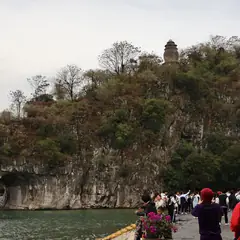
West of central Guilin, among limestone peaks and a lake, locals dance in the morning beside stairways flanked by Buddhas. Xishan Park (西山公园, Xīshān Gōngyuán), that of the West Hill, was in the Tang era the city’s pleasure ground: in 899 the writer Mo Xiufu described it so, with its great monastery three li from the walls and beside the hill of Yinshan. That monastery, called Xiqinglin and later Yanling, had been razed under Emperor Wuzong (840-846) and rebuilt by his successor.
The history of Xishan Park is written in the rock. On the Xifeng, Qianshan, Longtou, Liyu and Guanyin peaks are spread 98 niches with 242 Buddhist images, a relief stupa, 29 lamp niches and 7 votive inscriptions; some descriptions speak of more than a thousand pieces, mixing images and inscriptions. Only one has a certain date, the year 679, and the rest are attributed as a block to before the mid-Tang. In 1940, in the midst of war, the scholar Luo Xianglin related them to the great Buddha of Bodh Gaya and to Borobudur, in Java, more than to the grottoes of northern China.
To learn what to see at Xishan Park, the audio guide covers it in five stops and 60 minutes: Yinshan and the lake, the monastery base, the Buddha of Guanyin Peak, the Longtou hollow and the upright fish peak. What is seen today is what survived a drained lake, a razed temple and torn-off faces, and on that rock exiled governors and people from Central Asia left their mark.
Guilin’s other great library of stone is the Guihai Stele Forest, with more than two hundred inscriptions from the year 894. In the centre, beside Rong Lake, the Old South Gate is what remains of the old south stretch of the wall, and northwest of the city, on Mount Guangming, the Reed Flute Cave keeps ink signatures from the Tang era.
Yinshan, the island left without a lake
Yinshan
Summary of this stop
At the end of the nine-turn bridge rises Yinshan, a low hill with six caves and small pavilions. It was formerly called the coiled dragon ridge, and it was opened to strollers in the Baoli era (825-827) by the governor Li Bo, who planted flowers and raised pavilions. He had arrived in Guilin as a punishment: in 825 he defended a magistrate whom more than fifty palace eunuchs had beaten in broad daylight on amnesty day, and the emperor sent him far away.
In the 12th century the hill was an island. Fan Chengda, governor from 1172, toured West Lake by boat, landed at the northwest and linked the six caves on foot; in his book of 1175 he rated that walk among the lotuses the best in the southeast. The lake then exceeded 700 mu, about 47 hectares, but at the start of the Yuan dynasty it was abandoned and ploughed for cultivation, and the present one is only a fraction. In 1819 the governor-general Ruan Yuan escaped here on horseback on his birthday to dodge the congratulations and called it a day of retreat. At the foot of the hill, the audio guide tells what happened to that beaten magistrate.
The base of the Xiqinglin monastery
Xiqinglin Temple platform
Summary of this stop
North of the central plaza, where neighbourhood people gather today, remains of a stone base appear. It is what is left of the great Tang monastery of Xiqinglin. Tourist promotion presents it as the first of the five great Chan monasteries of the south; the only surviving Tang text, that of 899, merely calls it the prefecture’s pleasure ground.
That same text records its origin legend. According to tradition, there was nothing here but scrub until a flood carried down an enormous log; when a carpenter raised his axe, a foreign monk told him the timber had a soul. The log floated if vegetables were washed on it and sank if garlic, forbidden to monks, was washed, so they carved a Buddha from it. Beside the base, the audio guide tells how the legend links that Buddha with a dream of Empress Wu Zetian.
The Buddha of 679 and the name of its donor
Guanyin Peak Vairocana
Summary of this stop
Halfway up Guanyin Peak, past a stairway flanked by dozens of niches, a natural niche 3.8 metres high shelters a seated Vairocana Buddha 1.20 metres tall between two bodhisattvas. It is the only Xishan sculpture with a certain date. The inscription on its base dates the commission to the 8th day of the twelfth month of the first Tiaolu year, 679, and names the donor: Li Shi, sima of Zhaozhou and grandson of a duke of the Sui dynasty.
That date and that name turn the carvings into specific people, and not all of them were from here. The park also preserves the record of the funerary niche of Mi Landuojin, carved in 676 for a man from the kingdom of Tokharistan, in what is now northern Afghanistan. Before the Vairocana, the audio guide explains why Luo Xianglin looked toward India and Java to understand these Buddhas.
Five-centimetre Buddhas and missing faces
Longtou stone forest
Summary of this stop
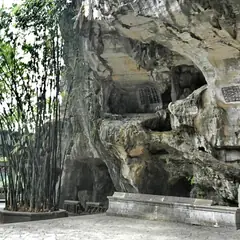
In the Longtou hollow, between Guanyin Peak and Qianshan, the small niches concentrate and force the eye to sharpen: Xishan’s largest image measures 1.65 metres and the smallest barely 5 centimetres. One of the niches gathers five figures, with the Buddha, two bodhisattvas and the disciples Kasyapa and Ananda.
Many have no face. The faces of the small images on the Xifeng cliffs were almost all destroyed during the Cultural Revolution (1966-1976), and in the 1980s the Guilin heritage commission patched the damaged sculptures. On the neighbouring Qianshan peak, where a Taoist monastery was founded in the 7th century, the three large characters on the rock are today a re-carved copy. In the hollow, the audio guide teaches how to read those absences.
The upright fish peak and the Soviet grave
Babashkin's grave
Summary of this stop
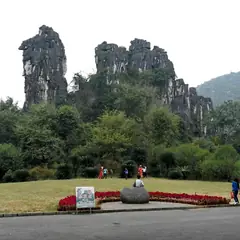
The tour ends at the foot of Liyu Peak, the upright fish. Around 1175 Fan Chengda described it as a tall, powerful peak, like a fish planted on its end, and the nickname still works eight centuries later. On the same peak rises the Xifeng pavilion, octagonal, the Sunset on West Peak viewpoint, and nearby stands Xifeng Peak, the highest in the park, at 357 metres.
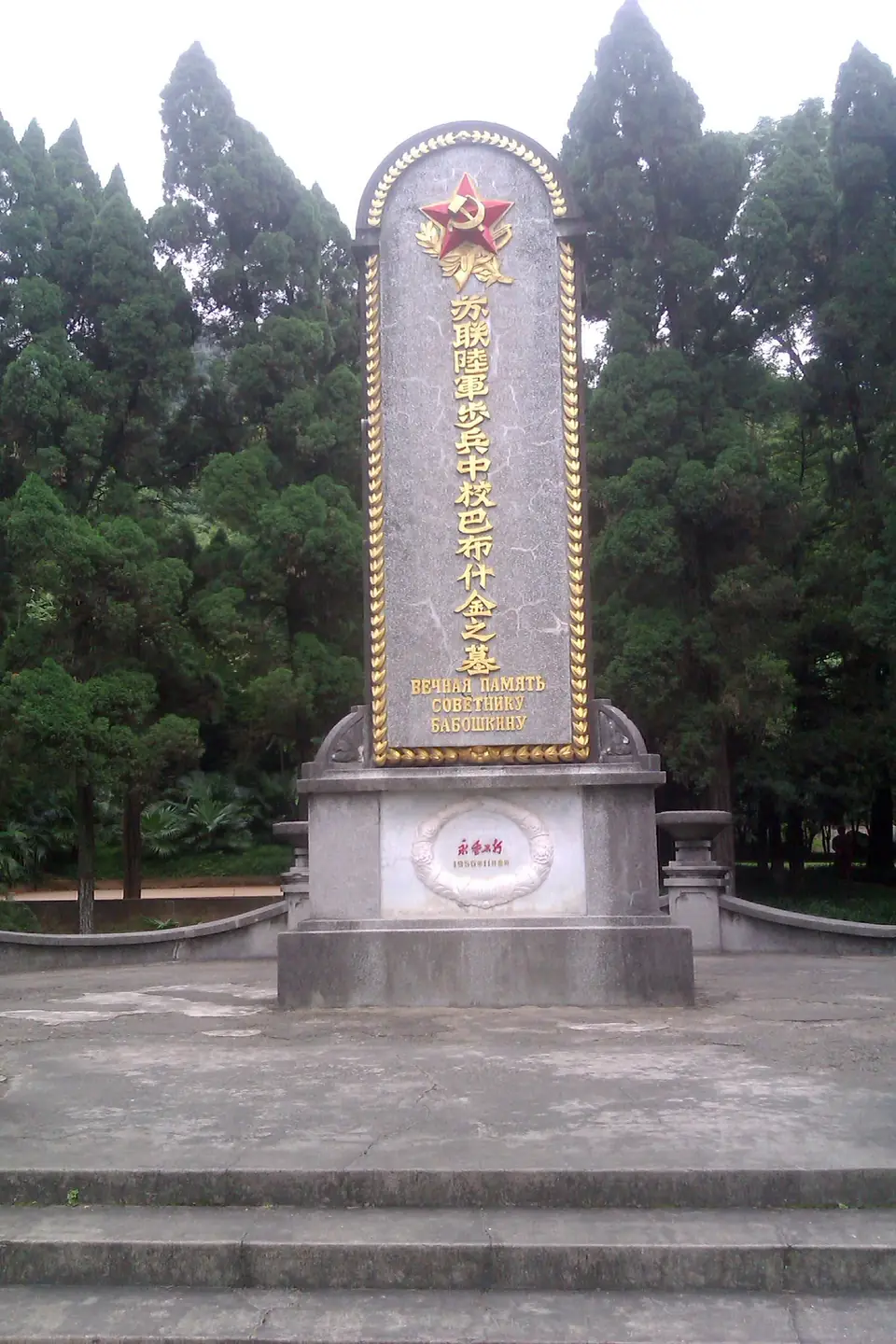
At its south foot there is a grey concrete tower in an oval enclosure: the grave of Babashkin, a Soviet military adviser to the Chinese Fifth Army from 1939, who died in Guilin in 1940, aged 35, of an epidemic after the Japanese bombings. The transcriptions of his inscription disagree on both the name, Babashkin or Babushkin, and the rank. Buried first elsewhere, he was moved here in 1956. At the last stop, the audio guide joins the eight-century-old nickname with the 20th-century memory that rests at its foot.