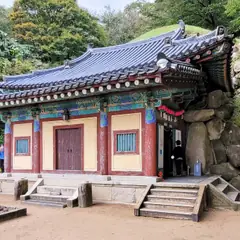
8th-century Silla temple
Bulguksa Temple Audio Guide
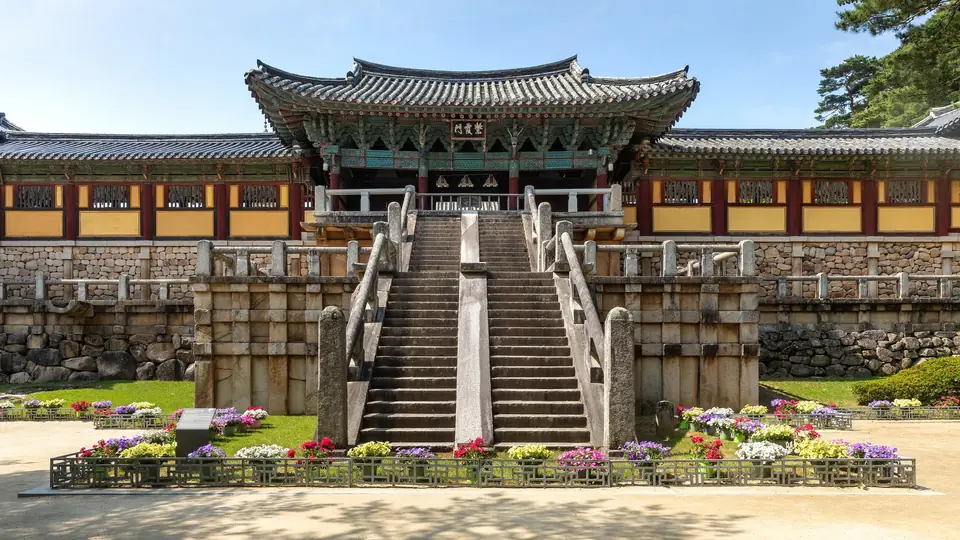
A Buddhist paradise built in stone on the terraces of Mount Tohamsan, with 8th-century bridge staircases and two pagodas that refuse to be twins. The timber burned in 1593 and was rebuilt up to 1973; the Silla stone is still where it was.
- 90 min of audio
- 8th-century Silla stone
Bulguksa, the “Temple of the Buddha Land”, began to rise in 751 under King Gyeongdeok, at the urging of the prime minister Kim Daeseong. Kim died before seeing it finished, and it was the Silla court that completed it in 774 and gave it its name. Its terraces follow the grengi technique, with natural rock at the base and cut blocks trimmed to fit its curves, stonework that the Samguk Yusa, in the 13th century, already counted the finest of the temples of the east.
The temple has two lives. In May 1593, during the Imjin War, Japanese troops burned all its wooden buildings, some 2,000 kan, and the halls seen today were rebuilt between 1970 and 1973 from their stone bases, on the orders of Park Chung Hee. The staircases, terraces and pagodas, by contrast, are Silla's own: the stone stayed while the wood burned.
Highlights
- Cheongungyo and Baegungyo — 34 steps and the oldest hongye arch in Korea
- Yeonhwagyo and Chilbogyo — lotuses carved in the steps, worn by pilgrims
- Seokgatap and Dabotap — two opposing pagodas that set the Lotus Sutra in stone
- Seokgatap niche — the 8th-century print that exposed a failed theft in 1966
- Birojeon courtyard — the Goryeo stupa that spent years in a Tokyo park
The story of Bulguksa begins, according to the Samguk Yusa, with a boy whose head was as large and broad as a fortress. His name was Daeseong, “great wall”, he was the son of a poor widow of Moryang-ri and he worked as a servant for the rich Bok-an, who had given him a small field. When the monk Jeomgae taught that giving brings blessings, the boy offered that field to the Buddha and died soon after. A voice from heaven announced that he would be reborn in the house of the dignitary Kim Mullyang, and the newborn arrived with his left fist closed around a golden tablet engraved with his own name. That man, by then prime minister, is said to have built Bulguksa for the parents of his present life.
Outside the legend, the history of Bulguksa is more tangled. The temple’s own records speak of a first foundation in 528, under King Beopheung, or even earlier, though the documentary basis is weak, and the prevailing view today is of a temple completed in stages. Its authorship is also debated: the scale of the complex fits poorly with a minister’s private project, and one theory sees it as a royal undertaking of King Gyeongdeok in memory of his father, later attributed to Kim Daeseong.
The architecture of Bulguksa reads from the bottom up, like an ascent to paradise: the stone wall of the facade, the bridge staircases, the Daeungjeon courtyard with its two pagodas and, at the very top, the Birojeon. What to see at Bulguksa depends as much on what is there as on what is missing: a vanished pond, a stone lion that is gone, a relic niche opened by thieves. The audio guide covers the temple in five stops, with documented narration checked against historical sources, from the esplanade to the highest courtyard.
On the same mountain, less than two kilometres away in a straight line, the Seokguram Grotto is the other half of the vow attributed to Kim Daeseong. And in the garden of the Gyeongju National Museum stand full-size replicas of the temple’s two pagodas, made in 1975.
A wall of rocks that embrace cut stones
Bulguksa Temple
Summary of this stop
From the esplanade, the facade of Bulguksa looks like a great stepped wall crowned with timber. The grace lies in the base: a course of uncut natural stones laid horizontally, and above them carved blocks trimmed to fit their curves. This is the grengi technique, in which the worked stone adapts to the rock and not the other way round. Beside the main staircase stands the Beomyeongnu pavilion, on stepped stone pillars.
The dry ground in front holds an absence. Here there was a large artificial pond, the Gupumyeonji, fed by water coming down from Tohamsan, which lasted until 1727, the third year of King Yeongjo. The restoration of 1970 to 1973 did not bring it back, and only stone remains are left.
The memory of that water survives in a name. Beomyeongnu reads in native Korean as “floating shadow”, and tradition explains it by the silhouette of the pavilion reflected in the pond. The poet Park Mok-wol took it into his poem “Bulguksa”, with moonlight touching that shadow on the water. Why a pavilion is still called that nearly three centuries after losing its reflection is the first scene the narration develops right there.
Thirty-four steps to the Buddha Land
Cheongungyo and Baegungyo staircases
Summary of this stop
The main entrance does not present itself as a staircase but as a bridge. Below, Baegungyo, the White Cloud Bridge, with 18 steps; above, Cheongungyo, the Blue Cloud Bridge, with 16, up to the Jahamun gate. The semicircular arch that joins the two flights is the oldest hongye arch in Korea and is listed as National Treasure No. 23. Official records count 34 steps, although other descriptions repeat the symbolic figure of 33, associated with the 33 heavens.
To the left, a smaller twin staircase, Yeonhwagyo, the Lotus Bridge, with 10 steps, and Chilbogyo, the Seven Treasures Bridge, with 8, climbs through the Anyangmun gate to the Geungnakjeon, the hall of Amitabha’s Paradise. On each step you can make out a carved lotus flower, rubbed away by pilgrims’ feet; today neither staircase can be walked on.
For many Koreans, these stairs are first of all the backdrop of a class photo. For decades, Bulguksa was a fixed stop on the end-of-year school trip, and in 2021 a Gyeongju National Park contest rewarded an image of village schoolchildren posing in front of them, titled “My Father’s Memory of Bulguksa”. What these bridges cross, according to the temple’s symbolism, is told at the foot of the steps.
Two pagodas that refused to be twins
Seokgatap and Dabotap pagoda courtyard
Summary of this stop
In the courtyard of the Daeungjeon, the main hall dedicated to Sakyamuni, stand two stone pagodas of almost equal height and opposite form. To the west, the Seokgatap, plain and austere, 10.75 metres tall, National Treasure No. 21. To the east, the Dabotap, 10.29 metres and National Treasure No. 20, with a cross-shaped base, stairways on all four sides and an octagonal body with railings. In other Korean temples twin pagodas are usually identical; here the difference is the message.
The pair sets a passage of the Lotus Sutra in stone: the Seokgatap represents Sakyamuni, the present Buddha who preaches, and the Dabotap Prabhutaratna, the Buddha of the past who appears in his tower to attest that the teaching is true. The Dabotap also bears a quiet wound. Around 1925, during the Japanese occupation, it was taken apart without a record, the relics inside disappeared, and so did three of the four lions on its stairways. Only one remains; about the whereabouts of another a version circulates, unconfirmed, that places it in the British Museum.
The courtyard changes at dusk. Before evening prayer, the monks strike the great drum for beings that walk, the bell for those who suffer in the hells, the wooden fish for those that live in the water and the cloud-shaped gong for those that fly. You can enter until 5:30 pm and there is no fixed closing time, so anyone who stays hears the chanting rise between the two pagodas. What answers when the last instrument falls silent is explained by the narration in this courtyard.
The failed theft that uncovered a treasure
Seokgatap Pagoda
Summary of this stop
The Seokgatap looks like the most silent tower in the temple, and it is the one that has kept the most. In 1966 thieves shifted the 6-tonne stone roof of its second storey to steal the reliquary. They failed, but left the relic niche, 41 by 41 centimetres, in plain sight. On 13 October that year, during the repair, the Great Dharani Sutra appeared inside, a scroll printed from wooden blocks, dated between 704 and 751, made of 12 sheets of mulberry paper totalling 620 centimetres in length.
It is one of the oldest printed documents preserved in the world, although its primacy is disputed: later finds in China are older, and certain characters from the era of Empress Wu raise the debate over whether it was printed in Korea or in China. On 2 April 2013 a crane lifted that same roof again, amid the chanting of monks, in the first dismantling in a thousand years, and a single relic was found inside.
The tower is also called Muyeongtap, “the pagoda without a shadow”. Legend says that Asanyeo waited beside a pond for the reflection of the finished pagoda carved by the stonemason Asadal, that the reflection never came and that she threw herself into the water. The tale has changed with the teller: in the temple record of 1740 she is his sister and he comes from Tang China; in Hyeon Jin-geon’s novel of 1938 he is a stonemason from Baekje. Asadal’s name appears in no chronicle. What remains of that story on the shore of the Yeongji pond is kept for the audio guide.
The stupa that came back from Tokyo
Birojeon courtyard stupa
Summary of this stop
At the highest point of the compound, the Birojeon holds a 1.77-metre gilt-bronze Vairocana Buddha, and in its courtyard stands a 2.1-metre stone stupa of the Goryeo period, lantern-shaped. A Japanese man took it illegally out to Japan, where it ended up in Ueno Park in Tokyo, and in 1933 it returned to Bulguksa. The date it left appears in some sources as 1905 and in others as 1906.
From up here the temple’s double life makes sense. In May 1593 all its timber burned; reconstruction began around 1604 and continued with some 40 partial renovations until 1805. Between February 1970 and June 1973, after a restoration committee was created in 1969, the Museoljeon, the Gwaneumjeon, the Birojeon, the Gyeongnu pavilion and the corridors were rebuilt from their bases. The Silla stone, meanwhile, did not move.
The small stupa sums up that history of losses and returns. How it fits into the balance sheet of a temple that burned, was rebuilt and recovered what had been taken from it is the scene with which the narration closes the tour.