Silla royal pond of 674
Donggung Palace and Wolji Pond Audio Guide (Anapji)
A make-believe sea for a victorious king: the pond Munmu had dug in 674, laid out so that it is never seen whole, with three islands, artificial hills and pavilions that double in the water at night. Its muddy bed gave back some 33,000 pieces of court life in 1975.
- 60 min of audio
- Silla royal garden
The Donggung Palace and Wolji Pond was born in 674, just after the unification of the Three Kingdoms, when King Munmu had a great pond dug with three islands and a chain of twelve artificial hills along its north and east shores, stocked with flowers, birds and rare animals. The eastern palace is dated to 679 thanks to a roof tile and a brick found on the bottom, and its main hall was called Imhaejeon, “the hall that faces the sea”: the sea was the pond itself.
After the fall of Silla in 935 the place was abandoned, and in the Joseon period, with wild geese and ducks settling on the ruins, scholars called it Anapji, “pond of geese and ducks”. Pottery fragments excavated in 1980 showed that in Silla it was called Wolji, “moon pond”, and in July 2011 it officially recovered that name along with that of the palace.
Highlights
- The three islands — the mountains of the immortals, according to one scholarly reading
- West-shore pavilions — the banquet hall of 881 and 931
- Curving north and east shores — a 200-metre pond that is never seen whole
- The fourteen-sided die — banquet forfeits of the Silla court
- Granite bases — 27 building sites, only 3 with a pavilion
The story of Donggung and Wolji is that of a name lost and recovered. For centuries, the pond was Anapji, a name that came from no decree: in the 15th century the poet Kim Si-seup already wrote Anhaji, of almost identical sound, before the kingdom’s geographers picked it up. It took draining the water and examining the fragments from the bottom to learn that the Silla court called it something else.
Before the excavation, beside the water there were only grasses, weeping willows and a pavilion of 1926, the Imhaejeong, which was considered a colonial-era work and in 1977 was moved to Hwangseong Park, where it still stands as Horimjeong. It is also unclear what exactly the Donggung was: the traditional reading sees it as the crown prince’s residence, others hold that the name only indicates an “eastern palace” relative to Wolseong, and recent excavations east of the pond reinterpret the west group as a space for the king’s banquets and rites.
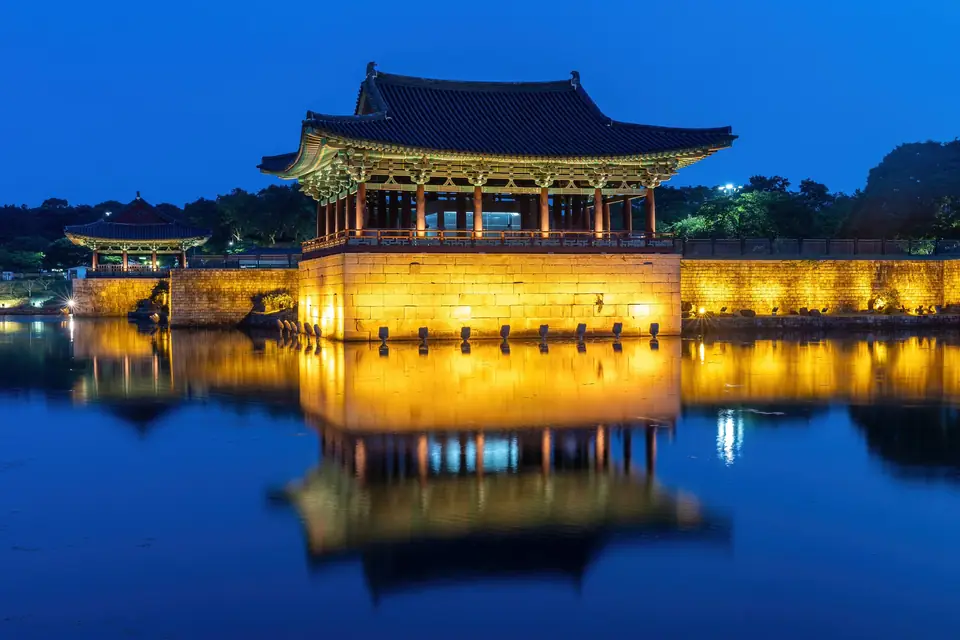
What to see at Donggung and Wolji changes with the hour: by day, a garden that plays at hiding the water; at night, three lit pavilions reflected in it. The audio guide circles the pond in four stops, from the west pavilions to the south bank, with documented narration checked against historical sources.
What the bed gave back, including the replica of the fourteen-sided die, is displayed in Wolji Hall, in the Gyeongju National Museum, some 600 metres away. And in the Gyochon Hanok Village, according to tradition, the steps of the Confucian shrine came from this pond.
A sea dug for the unifying king
Donggung Palace and Wolji Pond
Summary of this stop
At the southwest corner the ambition of the project becomes clear. In 674, the fourteenth year of King Munmu and with the Three Kingdoms just unified, a great pond was dug with three islands and a chain of twelve artificial hills along its north and east shores, where flowers were planted and birds and rare animals were raised. The eastern palace followed in 679, a date confirmed by a roof tile inscribed with the fourth year of the Uibong era and a brick of 680, both found in the 1975 excavation.
The main hall was called Imhaejeon, “the hall that faces the sea”, and in that name the pond stands in for the sea. The street that now leaves to the northeast, toward the site of Hwangnyongsa, keeps the idea: it is called Imhae-ro.
The three wooded islands that interrupt the view may not be mere decoration. According to the scholarly reading of Park Kyung-ja and Yang Byung-yi, from 1998, they represent Bongnae, Bangjang and Yeongju, the mountains of the immortals of the Taoist tradition, with the mounds of the shore as a mountain range. What sense it made for a victorious king to commission a model of paradise before his banquet hall is what the narration develops on this shore.
Banquets, a die and the last guest
Reconstructed west-shore pavilions
Summary of this stop
The three wooden pavilions of the west shore, with their painted eaves, were rebuilt up to 1980 from the excavated materials and rest on a straight stone wall. They evoke the place of the court’s feasts. In the third month of 881 King Heongang gave a banquet here for his ministers: with the wine well advanced, he himself played the geomungo, the courtiers sang and the party ended in great merriment.
An unusual object remains from those banquets. In 1975 a 14-sided oak die came out of the pond, six faces square and eight hexagonal, the juryeonggu, whose faces order forfeits such as draining a whole cup and laughing aloud, dancing without making a sound or letting everyone flick your nose. The original burned during its conservation because of a fault in the wood-hardening equipment, and today only the replica exists.
There was a banquet of a very different kind. In the second month of 931, with Silla wounded by Gyeon Hwon’s invasion, King Gyeongsun received in the Imhaejeon Wang Geon, founder of Goryeo, who arrived with some 50 horsemen. Four years later, Silla surrendered to Goryeo. What was at stake that night beneath these eaves is told in front of the pavilions.
The shore that hides the water
North-shore hills
Summary of this stop
From the north shore the garden’s trick becomes clear. The pond measures some 200 metres east to west and 180 north to south; its west and south shores are straight walls, but those of the north and east trace complex curves between wooded hills, so that from no point can it be taken in whole and it looks like a bigger sea than it is.
The bed confirmed that the garden was also a collection of animals: it preserved 228 mammal bones, 14 bird bones and 29 teeth, and pollen analysis identified 25 planted species, among them willows, pines and pear trees. After the fall of Silla in 935, the paradise was left to geese and ducks, hence the name Anapji given to it by the Joseon scholars.
The court’s intimate life also reappeared outside the water. In September 2017, in the excavations beside the northeast corner of the enclosure, a latrine some 1,300 years old came to light, with a granite slab, a brick floor and an underground channel for waste. Why it was considered an unprecedented find in Korea is one of the details the audio guide reserves for this shore.
What the pond bed gave back
Granite bases of the lost buildings
Summary of this stop
From the south bank, the pond reveals itself as an archive. The dredging begun in 1974 started to bring up so many pieces that in March 1975 it was halted and gave way to an excavation of about two years. Some 33,000 objects came from the bed, although figures vary by source: roof tiles, bricks, Buddhas, bowls, spoons, gilt-bronze scissors, wooden tablets and a boat.
The boat appeared in April 1975, upside down between the middle and the small island: three joined logs, some 6 metres long, the oldest then found in Korea. When it was hoisted it bent and cracked in the middle, the press headlined “the boat broken in two” and the excavation chief, Kim Dong-hyun, offered a resignation that was not accepted. On the shores, fields of granite bases mark the columns of the buildings that are missing: of 27 identified sites, only 3 have a pavilion today.
The bed also held a devotion. A Silla vessel inscribed “Dragon King” and the mention of a Dragon King office in the Samguk Sagi speak of a water cult believed to have died out with the kingdom. In December 2024, reviewing Joseon porcelain fragments taken out in 1975 and 1976, the Gyeongju National Museum found something that changed that idea, and it is the revelation with which the narration closes the tour.