8th-century Buddhist grotto
Seokguram Grotto Audio Guide
A Buddhist grotto that is not a cave: some 360 granite slabs assembled without mortar high on Tohamsan, with a 3.5-metre Buddha gazing at the East Sea. The 20th century took it apart, encased it in concrete and ended up sealing it behind glass.
- 45 min of audio
- Silla granite behind glass
The Seokguram Grotto was born in 751 as Seokbulsa, the “temple of the stone Buddha”, on the initiative of Kim Daeseong, prime minister of King Gyeongdeok; the Silla court finished it in 774, after his death. Because the peninsula's granite cannot be hollowed out, its builders did not carve a cave: they assembled the dome of the main chamber from some 360 flat slabs, without mortar, and covered it with earth until it looked part of the mountain.
What is visited today is also a 20th-century work. The Japanese colonial government took it apart and reassembled it between 1913 and 1915 inside a concrete dome that blocked its ventilation, and the South Korean restoration of 1961 to 1964 added another dome on top and a wooden hall in front. Since 1976 a glass wall has separated visitors from the Buddha, and the interior is reserved for conservation staff.
Highlights
- Granite dome — some 360 slabs without mortar and a keystone split in three
- Main Buddha — 3.5 metres of granite facing east, toward the sea
- Lotus halo — a roundel on the wall that is a true circle only from eye level
- Eight Legions — the guardians that were straightened into a line in the 1960s
- Eleven-faced Avalokitesvara — the only figure seen from the front and a vanished pagoda
The story of Seokguram is made of vows and dismantlings. According to the Samguk Yusa, Kim Daeseong built Bulguksa for the parents of his present life and this grotto for those of a previous one. The scale of the work and its orientation toward Donghaegu, a burial area of the Kim royal house, have led others to see it as a project of the crown, and one hypothesis holds that the minister’s authorship was spread later to erase the link with King Gyeongdeok’s line.
Twelve centuries later the grotto lived a second, less pious birth. In 1907 Japan presented it as its own discovery and planned to dismantle it and carry it off; the opposition of the people of Gyeongju stopped the move. For them it was no discovery: the grotto was still in local use and was known as Jogasa. What came afterwards, the concrete, the leaks and the asphalt, explains why the Buddha is seen today behind glass.
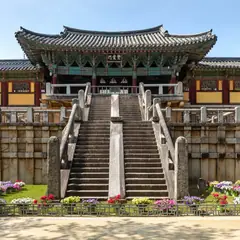
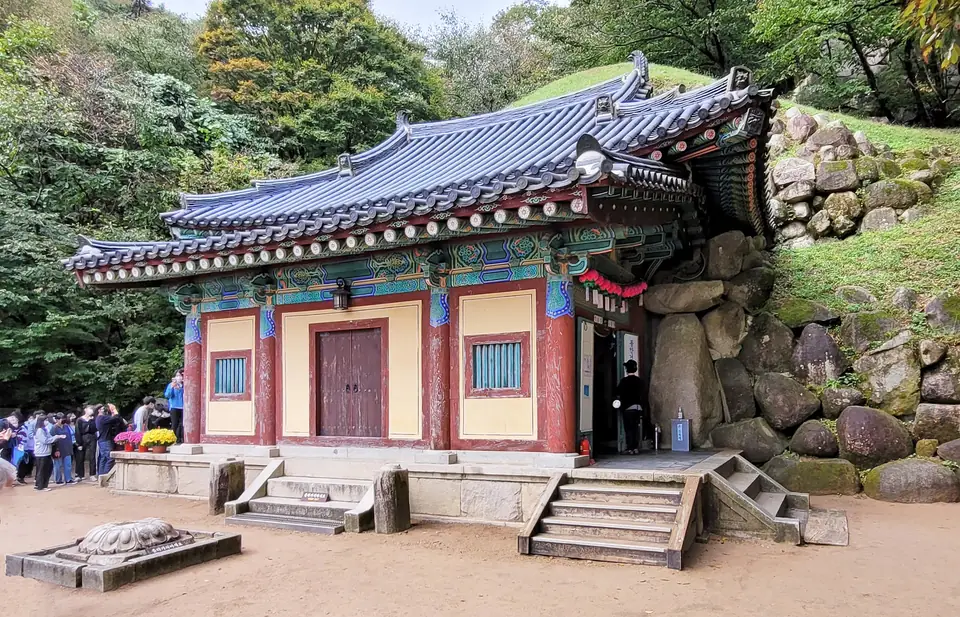
What to see at Seokguram fits into a few metres: the terrace open to the east, the wooden hall at the entrance with the reliefs of the Eight Legions, the corridor of the Heavenly Kings and, on the other side of the glass, the rotunda with the Buddha and the figures around him. The architecture of Seokguram is geometry at the service of a gaze. The audio guide covers it in four stops, with documented narration checked against historical sources, from the terrace to the back wall.
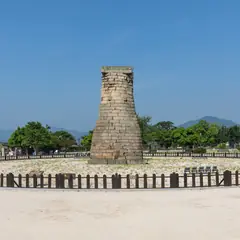
Down the slope, the Bulguksa Temple completes the pair of temples that tradition attributes to Kim Daeseong. In the centre of Gyeongju, the tower of Cheomseongdae shows another way Silla read the sun, with a window that catches the equinox light.
A cave nobody dug
Seokguram
Summary of this stop
From the terrace, Seokguram looks like a small hermitage set against the slope. The grotto behind it was not dug out: it is a granite construction, a dome of some 360 flat slabs fitted without mortar and then buried under earth. This is how Silla’s builders solved a problem of geology, because the hard rock of the peninsula does not yield to the pick like the sandstone of other Buddhist grottoes in Asia.
The work began in 751 under the name Seokbulsa and was finished by the Silla court in 774, after Kim Daeseong’s death. The founding tale of the Samguk Yusa presents it as a debt to the parents of the minister’s previous life, and what is told of that life roots the founder in this very mountain.
According to that tradition, Daeseong was a poor boy from Moryang who donated with his mother the field they farmed, died soon after and was reborn in the house of the minister Kim Mullyang, with his fist closed for seven days around a gold tablet bearing his name. As an adult, he hunted a bear on Tohamsan. What the bear demanded of him that night, and how it changed the hunter’s life, is the story with which the narration begins on the terrace.
Guardians straightened under a concrete dome
Eight Legions reliefs
Summary of this stop
Through the wooden hall at the entrance you pass into the antechamber, flanked by the reliefs of the Eight Legions, Buddhist guardians in rows on both sides, and by the muscular pair of Vajrapani guarding the mouth of the corridor. Everything seems ancient, but the space around the visitor is a reconstruction. After the visit of Governor-General Terauchi Masatake, the colonial government took the grotto apart and reassembled almost all of it between 1913 and 1915, and wrapped it in a concrete dome that cut off its breathing: from the summer of 1916 leaks and condensation began.
The great South Korean restoration, from September 1961 to June 1964, added a second concrete dome over the Japanese one, separated by an air chamber of about a metre, and raised this tiled wooden hall in front. To make room for it, the fourth and eighth reliefs of the Eight Legions, Asura and Garuda, which used to turn inward, were aligned straight. Kim Won-yong opposed it; the works director, Hwang Soo-young, imposed it.
The decision is still disputed. It was justified with a painting by Jeong Seon, tiles that were found and an inscription of 1891, but later researchers hold that this evidence does not show a front hall and that the original grotto was open and brighter. What was gained and what was lost in straightening these guardians is told before the reliefs themselves.
The Buddha who gazes at the winter sunrise
Main Buddha
Summary of this stop
At the back, beyond the corridor of the Heavenly Kings, sits the main Buddha: 3.5 metres of granite on a lotus pedestal of 1.34 metres, though measurements vary by source. He faces east, toward the sea, with his right hand in the earth-touching gesture. On the forehead shines a crystal jewel, replaced in 1966.
The perfection of the grotto lies in its tricks. The halo is not attached to the head: it is a granite roundel with lotus petals fixed on the back wall, the only asymmetrical element of the ensemble, calculated to look like a perfect circle from a height of about 160 centimetres. Above the Buddha, the keystone of the dome is a 2.5-metre canopy stone carved with a lotus and crossed by three fracture lines; the Samguk Yusa tells that it split while Kim Daeseong was carving it and that a celestial being set it in place at night.
The orientation is no accident either. The grotto’s axis of symmetry coincides with the direction in which the sun rises at the winter solstice, and sunrise over the East Sea draws crowds: on New Year’s Day 2005 some 6,000 people crowded into the car park and other spots on Tohamsan to see the first sun. Why that gaze matters so much is revealed in front of the Buddha.
The pagoda that left and the niches with spotlights
Eleven-faced Avalokitesvara
Summary of this stop
At the centre of the back wall, right behind the Buddha, the eleven-faced Avalokitesvara, 2.18 metres tall, is the only relief that looks straight out; the others appear in profile. From the glass it can barely be made out. Above the reliefs of the rotunda open small niches: of the 40 original figures 38 remain, because in the time of the Korean Empire, between 1897 and 1910, some Japanese took the statuettes of niches 1 and 10, which now hold spotlights.
There was another absence. On 26 April 1909 the Japanese vice resident-general Sone Arasuke visited the grotto and was photographed with his entourage before the Buddha. In front of the Avalokitesvara there was then a small five-story marble pagoda that later vanished; Yanagi Muneyoshi recorded that Sone had probably taken it, though he could not confirm it, and its whereabouts remain unknown.
The glass is the last chapter of that story. To stop the leaks, drains were buried in 1917 and asphalt was applied between 1920 and 1923, which worsened the damp, and in 1927 the moss and mould on the sculptures were cleaned with hot steam. Since 1976 glass has closed the rotunda, and in 2013 an inspection found a one-metre crack in the pedestal. Some studies hold that the original design admitted the humidity and regulated it. Seokguram remains a Buddhist hermitage dependent on Bulguksa, and how a living shrine that can no longer be touched is cared for is what the audio guide leaves for the end.