Royal tombs of Silla
Daereungwon Tumuli Audio Guide
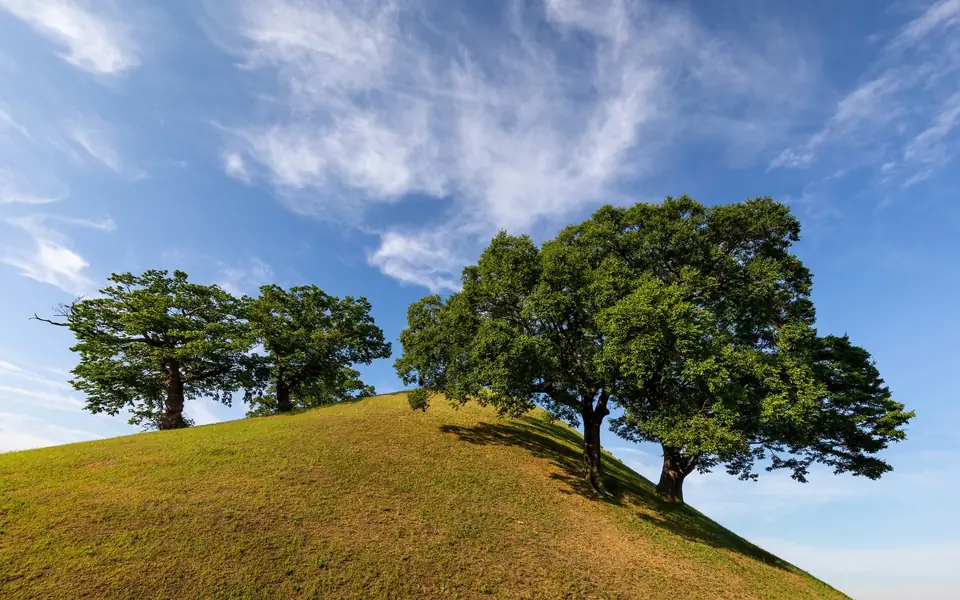
Twenty-three grassy hills in the heart of Gyeongju that are the tombs of kings, queens and nobles of Silla. One can be entered, the Heavenly Horse tomb; another, double like a gourd, held 58,441 objects, almost all of gold.
- 60 min of audio
- World Heritage
The Daereungwon Tumuli group 23 tombs of kings, queens and nobles of Silla built between the 4th and 6th centuries to reinforce royal authority and show power before Goguryeo and Baekje. They are wooden-chamber tombs covered with a mound of stones and then earth, a construction so massive that it hindered looting and preserved the grave goods until the 20th-century excavations. Since 2000 they have been part of the World Heritage Gyeongju Historic Areas.
The park's name comes from a single line of the Samguk Sagi: Michu, first king of the Kim clan, was “buried in Daereung”, the Great Tomb. His hill is not the biggest in the enclosure, but it is the only one surrounded by a wall, and the Samguk Yusa credits it with a ghost army and a dispute between spirits. The larger tombs, by contrast, still have no certain owner.
Highlights
- King Michu's tumulus — the only one with a wall, a shrine and a legend of bamboo soldiers
- Cheonmachong — the Heavenly Horse tomb, the only one in Gyeongju you can enter
- Reconstructed chamber — wood, stones and earth with replica grave goods in place
- Hwangnam Daechong — a 120-metre double mound and 58,441 objects from a royal couple
- The magnolia — the clearing between mounds with spring's longest photo queue
The gentle hills of Daereungwon are mountains made by hand. Beneath each one lies a wooden chamber, a mound of stones and a layer of earth, and inside, in many cases, the gold of kings whose names nobody can vouch for. The history of Daereungwon as a protected place is much more recent: on 28 July 2011 the heritage administration merged five burial groups, protected separately since 1963, into a single historic site, No. 512.
The site also holds less solemn episodes. In 1926, in the Noseo-dong group of tumuli, now inside the same enclosure, the Japanese colonial administration staged an excavation for Crown Prince Gustaf Adolf of Sweden, on his honeymoon and an archaeology enthusiast: the gold crown was left buried until he arrived to “discover” it. Adorned with phoenixes, it gave the tomb its name, Seobongchong, with a syllable of Sweden inside.
What to see at Daereungwon is spread along curving gravel paths: Michu’s walled tomb with its shrine, the inside of Cheonmachong, the gourd silhouette of Hwangnam Daechong and the magnolia clearing. The audio guide covers the park in four stops, with documented narration checked against historical sources, from the wall of the first king of the Kim clan to the life the park carries on today among its dead.
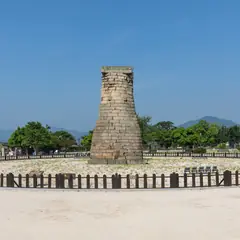
The original apron of the Heavenly Horse is kept in the Gyeongju National Museum, which gathers the gold of Silla’s royal tombs, and less than a kilometre away, on the same plain of tumuli, rises the tower of Cheomseongdae.
The only king with a wall and ghosts
King Michu's tomb
Summary of this stop
The tour starts in front of the tumulus of King Michu, who reigned between 262 and 284 and was the first Silla king of the Kim clan. It stands 12.4 metres high and 56.7 across, and a low wall surrounds it, something exceptional in the enclosure. In front are the offering stone and the Sunghyejeon shrine, burned in the Imjin War and rebuilt in 1794 for ancestral rites.
Legend turns this tomb into a guardian. According to the Samguk Yusa, in the year 297 people of the kingdom of Iseo attacked the capital and Silla was losing, until soldiers appeared with bamboo leaves pinned to their ears, turned the battle around and vanished. Afterwards bamboo leaves were found heaped on Michu’s tumulus, and that is why it is also called Jukhyeonneung, “the tomb where the bamboo appeared”.
The same chronicle tells of another supernatural visit: a whirlwind that rose from the tomb of General Kim Yu-sin and came all the way here to complain of an injustice. How a dead king mediated between spirits, and what his tomb gained from it, is what the narration develops in front of the wall.
A birch-bark horse in a rehearsal
Cheonmachong
Summary of this stop
Cheonmachong, the Heavenly Horse tomb, is the only one in Gyeongju you can enter. Its interior was reconstructed with replicas of the finds to show the wooden chamber, the mound of stones and the earth covering it, with the coffin and grave goods placed where they were found. The deceased lay with the head to the east and the gold crown on, and 504 pieces of the grave goods were related to horses. Whom it belonged to is still unknown: some sources point to King Jijeung, others to King Soji or an unknown king.
This tomb was opened to practise. It was excavated in 1973 as a trial before opening the great Hwangnam Daechong, and in August, a month after the crown, the Cheonmado came out: a winged horse painted on a birch-bark apron so fragile that it seemed to crumble at a touch. The head of the excavation, Kim Jeong-gi, trembled and repeated that it should not have come out then, because Korea did not yet know how to conserve organic materials.
The original is kept in the Gyeongju National Museum; here the replica remains, beside a disputed interpretation that sees in the figure a qilin and not a horse, because of the horn on the head and the breath from the mouth. What happened to that apron in the hours after the find is told inside the chamber.
Two hills, a couple and 58,441 objects
Hwangnam Daechong
Summary of this stop
The park’s largest silhouette is a gourd profile: Hwangnam Daechong, a double tumulus 120 metres north to south, 80 east to west and 23 high. It was the tomb the government wanted to excavate first, and it was opened between 1973 and 1975. In the south mound lay a man with a gilt-bronze crown; in the north, a woman with a gold crown and a silver bracelet inscribed “Buindae”, the lady’s belt.
From here came 58,441 objects, the largest number of Silla-period pieces taken from a single tomb, almost all of gold, from jewellery to rice bowls. The couple remains unidentified: the man would be one of the kings Naemul, Silseong or Nulji, according to the proposals, and none is confirmed.
From the flanks the two summits can be seen, the southern and the northern. Why the most valuable crown lay in her hill and not in his is one of the questions the audio guide raises as you walk round the tumulus.
The magnolia that steals the queue from the kings
Magnolia among the tumuli
Summary of this stop
Behind Hwangnam Daechong, in a clearing between two tumuli, grows a magnolia that has become Daereungwon’s most famous photo spot. When it blooms in early spring, long queues form from first thing in the morning to be photographed beside it for a few seconds.
It is the modern ritual of a park the city has learned to inhabit. Since 4 May 2023 entry to the enclosure has been free, although the inside of Cheonmachong is paid separately, and Daereungwon receives on average more than a million visitors a year. Its domed tumuli, some half-moon or gourd-shaped, have been part of the Gyeongju World Heritage belt of tumuli since 2000.
Strolling, taking photos and picnicking beside kings from fifteen centuries ago is simply normal here. What that coexistence means for a city that lives among its dead is the reflection with which the narration closes the tour.