The treasure of Silla's capital
Gyeongju National Museum Audio Guide
An 18.9-tonne bronze bell cast in 771 hangs in the open air by the entrance, and inside wait gold crowns, the giant roof ornament of a vanished temple and a fourteen-sided die from the court's banquets. Pieces that travelled, were lost, came back and still ring.
- 120 min of audio
- Silla archaeology
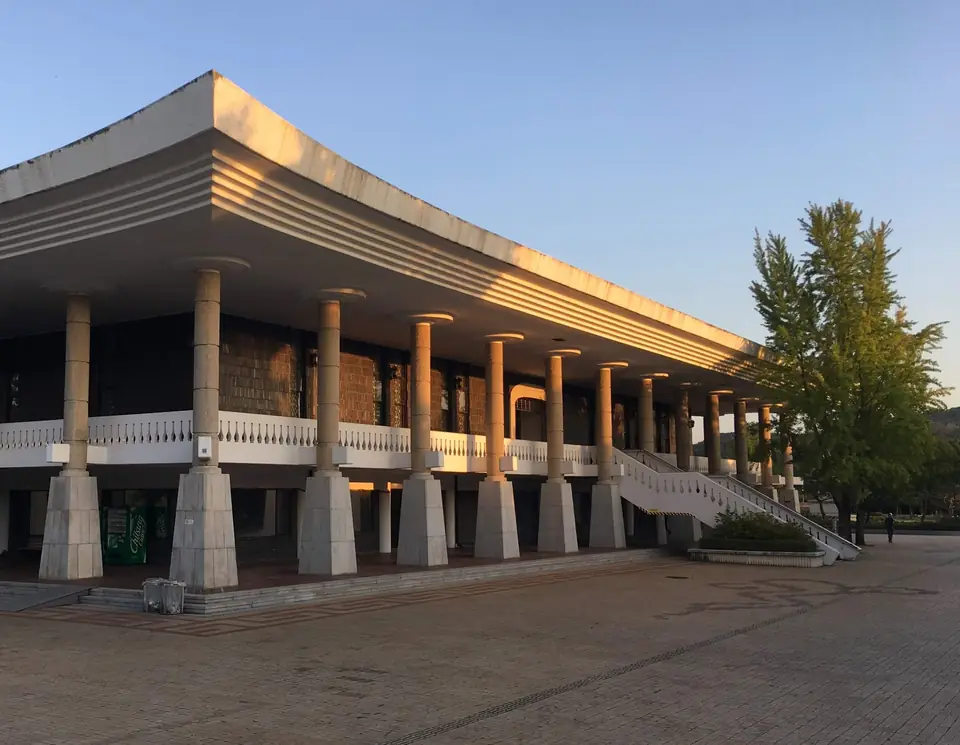
The Gyeongju National Museum begins in 1913, when the Gyeongju Gojeok Bojonhoe association opened an exhibition room in a building of the city's former Joseon administration, which in 1926 became a branch of the Government-General Museum. It reopened as a branch of the National Museum on 7 October 1945, after liberation, and in 1975 moved to Inwang-dong, to a building by the architect Lee Hee-tae, with the rank of national museum.
Its most famous piece is not in a display case. The Bell of King Seongdeok, commissioned by King Gyeongdeok in honour of his father and cast in 771, hangs in an open pavilion held by a Silla bar that the engineering of 1975 could not replace. It has hardly been struck since 1992, and on 24 September 2025 it rang in public for the first time in 22 years.
Highlights
- Bell of King Seongdeok — 18.9 tonnes of bronze from 771 and the legend of Emille
- Gold crowns of Silla — the gold of the royal tombs and a 1927 theft with no culprit
- Hwangnyongsa chimi — a 182-centimetre roof ornament, taller than a person
- Wolji Hall — the objects from the royal pond and the replica of the 14-sided die
- Goseonsa pagoda — rescued in 1975 from a site that a dam was going to flood
The Gyeongju National Museum keeps objects that have not stayed still. A bell that passed through two temples before reaching the museum, gold crowns that vanished for six months, a smiling roof tile that came back from Japan after more than ten letters. That tile, “the smile of Silla”, came from the site of the Yeongmyosa temple, was bought by a Japanese doctor from an antiques dealer and in 1972 was returned to the museum through the efforts of its director, Park Il-hoon; in 2018 it was declared a Treasure.
The museum’s own subsoil also speaks. In 2000, when excavating the site of its new art gallery, a stone well from the Unified Silla period came to light, some ten metres deep, with the skeleton of a child of 7 or 8 upside down, surrounded by neatly placed vessels and animal bones. Whether he fell by accident or was thrown in during a rite remains unresolved.
What to see at the Gyeongju National Museum calls for choosing: the bell in the outdoor pavilion, the Silla History Gallery with its crowns, the chimi of the vanished Hwangnyongsa, Wolji Hall with the objects from the royal pond and the stone garden. The audio guide covers it in five stops, with documented narration checked against historical sources, from the bell to the pagoda rescued from the waters.
Many pieces have their place of origin nearby: the Heavenly Horse came from the Daereungwon tumuli and the objects in Wolji Hall from the Wolji Pond, some 600 metres away. The garden replicas point to the Bulguksa Temple, on Mount Tohamsan.
Nineteen tonnes hanging from a dragon
Gyeongju National Museum
Summary of this stop
By the entrance, in an open pavilion that can be walked around, hangs the Bell of King Seongdeok. In 1997 the museum itself weighed it: 18.9 tonnes. On its body, two kneeling celestial maidens flank the striking point and an inscription of 1,050 Chinese characters fills a block of bronze; above, the hook is shaped like a dragon’s head, beside the sound tube.
The bell has travelled. It was first at the Bongdeoksa temple, moved to Yeongmyosa in 1460, reached the old Gyeongju museum in 1915 and was installed in the new Inwang-dong building in 1975, in a move that many townspeople took part in.
In that move they wanted to replace the original suspension bar, 8.5 centimetres thick, with a steel one. It was not possible: a bar strong enough would not fit through the arch of the dragon hook, and modern calculations call for at least 15 centimetres. How the Silla bar that still holds almost 19 tonnes was made is the technical marvel the narration unveils beneath the dragon.
Emille, the child who was never in the bronze
Apsaras and inscription of the bell
Summary of this stop
The bell has a nickname everyone knows: Emille. According to the legend, a woman so poor she had nothing to donate for the bell offered her child, the child ended up in the molten metal, and ever since the bronze would sound like a call to its mother. The story is much later than the casting: its first printed versions date from the late 19th and early 20th centuries, among them a 1906 book by Homer Hulbert that placed the bell in Seoul, and the alloy analysis found no calcium phosphate, a component of bone. There are different versions about exactly when the tale took hold.
The documented story is that of a son and a father. King Gyeongdeok commissioned the bell in honour of King Seongdeok, died in 765 and the work was cast in 771, under his son, King Hyegong.
For generations it was struck 33 times on New Year’s Eve, until in 1992 the strikes were suspended over the risk of damage. On 24 September 2025 it rang again in public before 771 people chosen by lottery from 3,800 applicants, and every day the museum plays its recorded toll on the hour and at 20 and 40 minutes past. What is really heard in that sound is told in front of the celestial maidens.
Gold crowns and a theft with no culprit
Gold crowns of the Silla History Gallery
Summary of this stop
In the Silla History Gallery, the 1975 building by Lee Hee-tae with traditionally inspired roofs, gleam the gold crowns of the royal tombs, with branch- and antler-shaped ornaments, beside belts and earrings. In 2025 the six known gold crowns of Silla were brought together in Gyeongju for the first time in 104 years, since in 1921 that of Geumgwanchong was the first to come to light.
That gold lived a novel-worthy episode in the old exhibition hall opened in 1913. On the night of 10 December 1927 some 90 gold pieces from Geumgwanchong disappeared; the crown, however, stayed in its place. Six months later, on 21 May 1928, the thief left almost all the loot in front of the Gyeongju police chief’s residence.
No one was ever arrested, although there were suspicions about the Japanese man who had directed the 1921 excavation. Which pieces never came back and why the suspect’s alibi caused talk is what the audio guide tells in front of the display cases.
The court’s fourteen-sided die
Replica of the 14-sided die in Wolji Hall
Summary of this stop
Wolji Hall, the 1982 annex designed by Kim Swoo-geun, gathers the finds from the royal Wolji pond, the former Anapji, from which more than 30,000 objects were excavated. After the solemnity of the gold, here the Silla court becomes approachable: everyday pieces taken from the mud of a banquet garden.
The most talked-about display case holds a replica: the juryeonggu, a 14-sided oak die, six faces square and eight hexagonal, with the forfeits of a drinking game inscribed, such as laughing out loud after emptying a cup.
The original did not survive its conservation and was lost while being dried. How exactly it ended, and what other forfeits it offered the court’s guests, is told in front of the case.
A pagoda rescued from the dam
Three-story Goseonsa pagoda
Summary of this stop
In the outdoor garden, near the Silla Art Gallery, stands the three-story Goseonsa pagoda, of weathered granite, a national treasure since 1962. It arrived in 1975, when the Deokdong dam was going to flood the site of the Goseonsa temple, where the monk Wonhyo is said to have been abbot, and was moved stone by stone to the museum. A safety assessment later suggested that the block of the second storey may have been set wrongly oriented when it was re-erected.
That same year the full-size replicas of the Dabotap and Seokgatap pagodas of Bulguksa that occupy the garden were made, to commemorate the museum’s move. The stone garden thus becomes a miniature map of the city.
A temple now under water, a rescued pagoda and two copies that point to another temple: how all this ties the museum to the rest of Gyeongju is the idea with which the narration closes the tour.