7th-century star tower
Cheomseongdae Observatory Audio Guide
A bottle-shaped granite tower just over nine metres tall, raised in the time of Queen Seondeok: the oldest surviving observatory in East Asia, with a window that catches the equinox sun and a purpose that is still debated.
- 20 min of audio
- A calendar in stone
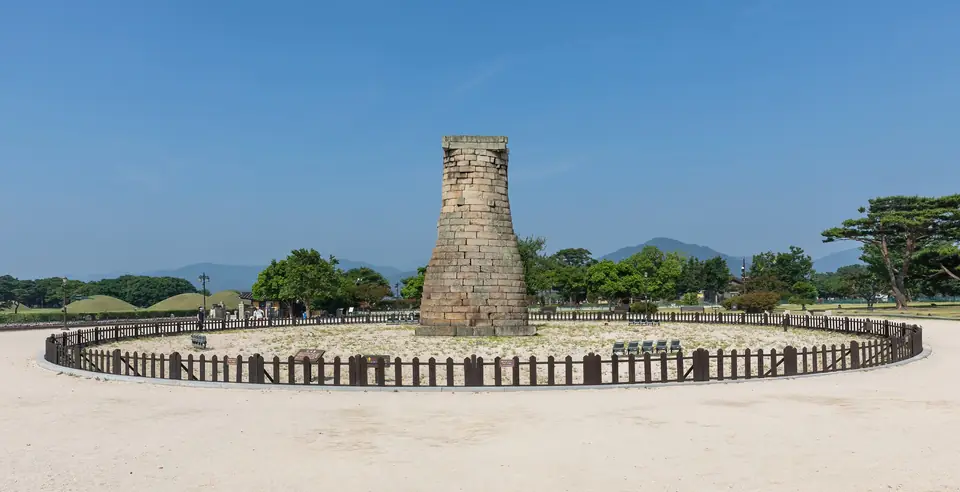
The Cheomseongdae Observatory was built of cut stone during the reign of Queen Seondeok of Silla, between 632 and 647, and its name literally means “tower for gazing at the stars”. It stands 9.17 metres tall and has three parts: a square base, a curved cylindrical body of some 362 blocks in 27 courses and a square top that, seen from above, draws the character for “well”. It has been National Treasure No. 31 since 1962 and, since 2000, a World Heritage Site within the Gyeongju Historic Areas.
The tower is not straight. It has accumulated 22.58 centimetres of tilt toward the north-northeast, two of them gained in the September 2016 earthquake, and it is watched like a patient: annual inspection since 1981, a system that measures it every hour since 2007 and a 3D scan in 2009. As to its real use, observatory, altar or political symbol, each generation proposes a different answer.
Highlights
- The bottle body — 27 courses of granite for Silla's 27th ruler
- The square base — square below, circle above: round heaven, square earth
- The south window — the opening through which the equinox sun lights the floor inside
- The well-shaped top — a broken corner and missing iron clamps
- The tilt — over 22 centimetres to the north, measured hour by hour
The story of Cheomseongdae has a problem of origin: nobody wrote down what it was for. The first mention is in the Samguk Yusa, compiled in the 13th century, which only places it in Seondeok’s time; other later chronicles give 633 or 647, the year of the queen’s death. The reading as an observatory starts from a report published in 1910 by the Japanese meteorologist Wada Yuji and from the name itself, which echoed that of the first observatory of the Goryeo dynasty.
Since the 1960s alternatives have appeared: a solar gnomon, an altar inspired by the Buddhist Mount Sumeru, an altar to the god of agriculture. The lack of a door and a tiny summit feed the doubts, and in November 2025 the set designer Park Dong-woo proposed another reading, that of a great incense burner before the royal tombs, which he tested by burning incense in a 3D-printed model. What is known is that, according to one reading, after the tower went up Silla’s celestial records multiplied fivefold.
The architecture of Cheomseongdae can be covered in a few steps on the lawn of the plain, with the royal tumuli on one side and the old Wolseong palace to the south. What to see at Cheomseongdae is, above all, learning to read it: its numbers, its window and its tilt. The audio guide circles the tower in three stops, with documented narration checked against historical sources.
The tower shares its plain with the Daereungwon tumuli, less than a kilometre away, and some 500 metres off lies the Gyochon Hanok Village, on the site of Silla’s academy. Far from the centre, on Mount Tohamsan, the Seokguram Grotto aligns its Buddha with the winter solstice sunrise.
Nine metres of granite facing the tumuli
Cheomseongdae
Summary of this stop
From the west side, the first surprise is the scale: Cheomseongdae is lower than the neighbouring burial hills. It was built during Seondeok’s reign, between 632 and 647, and its name, 瞻星臺, means “tower for gazing at the stars”. Its 9.17 metres divide into a square base of a single course of 12 stones, a cylindrical body that narrows before opening out slightly and a square top like the rim of a well.
Looked at calmly, the tower is geometry loaded with numbers. The square below and the circle above echo the idea of round heaven and square earth. The body totals some 362 granite blocks, although the count varies to 365 or 366 depending on whether an interior slab is included, and is divided into 27 courses that have been read as an allusion to Seondeok, the 27th ruler of Silla.
That reading turns the tower into a stone portrait of a queen. How many of those numbers were sought on purpose and how many were found afterwards is the question with which the narration opens the visit.
The window that lights the floor
South window of the tower
Summary of this stop
On the south face opens the only aperture: a square window between courses 13 and 15, with 12 courses below and 12 above, figures associated with the 12 months and the 24 solar terms. Below the window, the interior is filled with gravel and earth; above it, the tower is hollow. At the equinoxes, at midday, the sun enters through it as far as the interior floor; at the solstices the light vanishes from its lower part. The tower thus works as a calendar of light.
Someone climbed up there. The stones that project in courses 19 and 20, 25 and 26, and the interlocked ends of the top allowed ladders to be propped to enter by the window and reach the summit. Wada Yuji even imagined an armillary sphere on a wooden frame at the top.
To the south appears the Wolseong enclosure, where the queen resided, and with it a tradition: in February 647, in the midst of Bidam’s rebellion, a shooting star seemed to fall on the fortress and was taken as an omen of the end of the reign. How General Kim Yu-sin answered that adverse sky, and what that says about Silla’s politics, is what the audio guide tells in front of the window.
A tower that leans to the north
Well-shaped top
Summary of this stop
From the east you see what the eye does not expect: the tower leans to the north. It rests on former pond ground, with a foundation of mud and crushed stone that cushions tremors. In 2009 a tilt of 20 centimetres was measured; the magnitude 5.8 earthquake of 12 September 2016 added about 2 more and opened the southeast corner of the top by 5 centimetres, and by October 2021 it had gained a few millimetres, reaching 22.58.
The people of Gyeongju have their own explanation: they believe the tower began to lean more after the Korean War because of tanks and heavy vehicles passing along the road on the north side. The exterior is washed to remove moss and sensors watch it every hour.
At the top, the well-shaped crown holds another suspicion. In 2012 the researcher Chang Hwal-sik pointed to a corner broken diagonally that, in his view, no natural cause explains, and noted that the four metal clamps of that course are missing; his disputed reading is that the tower suffered at least one collapse and a rebuilding. What that would mean for the image of a tower intact for fourteen centuries is what the narration leaves for the end.