Temple of the Chinese merchants
Fujian Assembly Hall Audio Guide (Hội quán Phúc Kiến)
The Fujian merchants built an insurance against shipwreck here: a sea goddess, a junk with eyes and, at the end of a 120-metre axis, twelve celestial midwives to whom people still pray for children.
- 30 min of audio
- Chinese Fujian temple
The Fujian Assembly Hall, the Hội quán Phúc Kiến, was born on top of an old Buddhist pagoda, Kim Sơn Tự. According to the official Hội An record, the Fujian merchants bought the land in 1697, at the height of the port's boom, and in 1757 they rebuilt the original timber hall in brick and tile. The complex stretches 120 metres from Trần Phú Street to Phan Châu Trinh, with three courtyards, stairways and a three-opening gate before the shrine of Thiên Hậu, the goddess of seafarers.
For a community that lived off the sea far from home, the hall was at once a place of worship, a home for fellow countrymen and an oracle. In the first days of the lunar year the line of worshippers advances almost 300 metres to the altar to shake a tube of numbered sticks and receive the year's fortune on a slip of paper, while overhead spirals of incense hang loaded with written wishes.
Highlights
- Tam quan gate — the old name Kim Sơn Tự still on top
- Ironwood door 'Quốc thái, dân an' — kept shut almost all year
- Altar of Thiên Hậu — the sea goddess and her sentinels of sight and hearing
- 2-metre model of a merchant junk with painted eyes on the bow
- Rear hall — six Ming generals and the 12 Bà Mụ, each with a baby in her arms
The history of the Fujian Assembly Hall begins before the hall itself. On this site there was a Buddhist pagoda, Kim Sơn Tự, and tradition says it was paid for with the gold found in the belly of a Buddha statue that arrived floating down a river that ran where the houses in front now stand. According to the official Hội An record, in 1697 the Fujian merchants bought the land to build their meeting and worship hall, and in 1757 the community enlarged it, rebuilt it in brick and tile and renamed it Phước Kiến Hội quán. Other sources give different dates, from 1690 to 1792, and the chronology of the foundation is still not settled.
What is not in dispute is its function. For traders who crossed the South China Sea in ocean-going junks, the hall was at once travel insurance, an embassy of their homeland and a place to ask about the future. Here they prayed to Thiên Hậu, the goddess of seafarers born in the same province as the builders; here they honoured the founding ancestors; and here fellow countrymen gathered. That need still lights incense: at Tết the line of worshippers winds almost 300 metres to the altar to ask the goddess for the year’s fortune.
What to see at the Fujian Assembly Hall runs along an axis of 120 metres, from Trần Phú Street to Phan Châu Trinh: the tam quan gate, the front hall with its almost always closed door, the shrine of Thiên Hậu and the rear hall of the generals and the midwives. The audio guide walks it in four stops, with narration researched and fact-checked against historical sources, and keeps for each point what the altars do not explain at first sight.
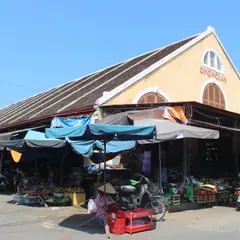
On the same Trần Phú Street, the Quan Cong Temple completes the map of the port’s Chinese cults, facing the Hoi An Central Market.
Kim Sơn Tự: the name of a vanished pagoda
Fujian Hall gate
Summary of this stop
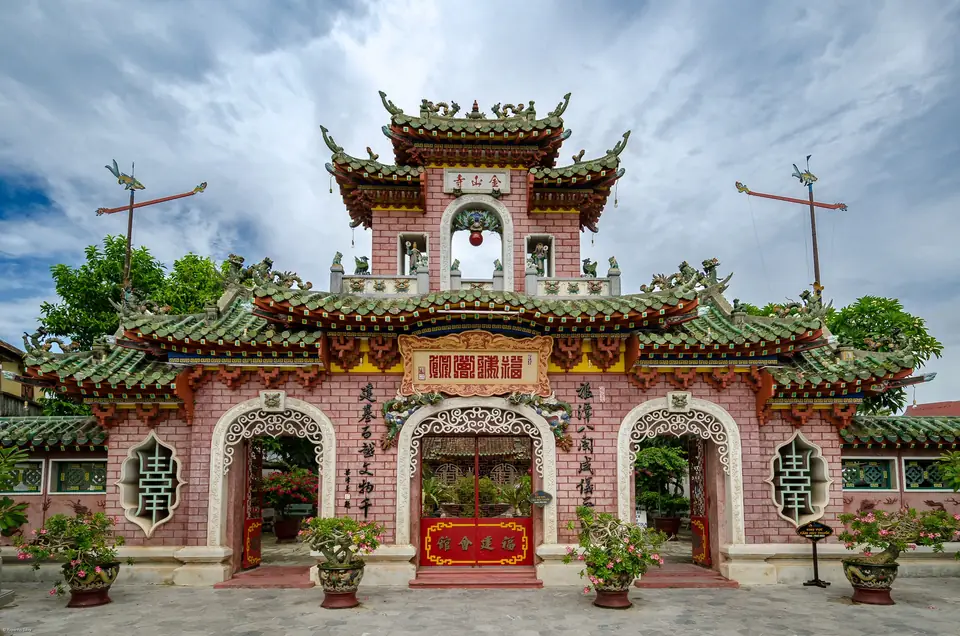
The tour starts on Trần Phú Street, before a large reinforced-concrete gateway added in the restoration of 1970 to 1974, the biggest the complex has seen. That work also rebuilt the tam quan gate, paved the courtyards and added the pond in the outer courtyard, shaped like an apricot blossom with five carp raising their heads and spouting water before a sun in relief.
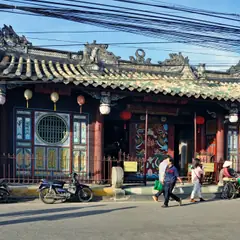
Behind rises the tam quan: a long wall with a central opening and two side ones, green-glazed tubular tiles and figures on seven tiers of roof. At the top, between the gods of the Sun and the Moon, the old name “Kim Sơn Tự” is still written in Chinese characters, that of the pagoda that stood here before the Fujian merchants arrived.
That sign is the clue to the founding legend, the one of the Buddha full of gold arriving on the water, which the sources do not even tell the same way: some travel guides speak of a statue of the sea goddess herself found off the coast. Why there is a temple at exactly this spot is what the narration reveals in front of the gate.
The ironwood door that almost never opens
Gỗ lim door 'Quốc thái, dân an'
Summary of this stop
The front hall greets the visitor with its most imposing door shut. It has two leaves of ironwood, gỗ lim, framed in stone and carrying four characters that read “Peace in the country, tranquillity for the people”. Visitors go in by the side doors: according to popular belief, keeping it closed stops negative energy from slipping into the temple, and it opens only at the great festivals and, tradition says, for the community’s weddings and funerals.
On the outer wall, two reliefs preview what waits inside: in one, the six founding ancestors storm the capital; in the other, Thiên Hậu rescues a shipwrecked boat. Above, the ridges of the three halls, covered in ceramic figures, dip in the middle and rise at the ends like a buffalo horn or a ship’s hull.
Those ridges of a Chinese temple are the work of Vietnamese carpenters and masons from Kim Bồng, on a hall the Fujian community had rebuilt in brick and tile in 1757. What that mix of hands says about the Hội An of the merchants is one of the keys the audio guide explains at the door.
Thiên Hậu and the junk that looks out to sea
Altar of Thiên Hậu
Summary of this stop
In the central niche of the shrine stands the large red-and-gold lacquered statue of Thiên Hậu Thánh Mẫu, protector of seafarers, with a small Quan Âm in a glass case at her feet. She is flanked by her two sentinels: Thiên Lý Nhãn, “Thousand-Mile Eyes”, and Thuận Phong Nhĩ, “Ears of the Favourable Wind”, who warn the goddess of ships in trouble. Thiên Hậu is Lâm Mặc Nương, born in Bồ Điền, in ancient Mân, present-day Fujian, and the Vietnamese court honoured her too: Minh Mạng granted her a title in 1826 and Tự Đức extended it in 1850.
To the left of the altars rests a model of a merchant junk, 2 metres by 0.80, taken to be the vessel in which the goddess goes to rescue the shipwrecked. On its bow it has two painted eyes, and in Hội An it is believed that a ship needs eyes to see sea disasters in time. From the ceiling hang large spirals of incense with petition slips that, so it is said, burn for about a month before the wishes are consumed so that they rise with the smoke.
The goddess’s festival falls on the 22nd and 23rd of the third lunar month, the date of her birth according to legend: on the eve her gilded statue is washed and given a new robe, and on the 23rd a roast pig, the Kim Trư, is offered, which closes the rite in a singular way. How that ceremony ends, and what story of the girl of Bồ Điền explains the cult, is told by the audio guide at the altar.
Six Ming generals and twelve celestial midwives
Rear hall altars
Summary of this stop
In the rear hall the temple moves from the sea to the family. In the centre are venerated the Lục Tánh Vương Gia, six Ming generals from Fujian who rose against the Qing to restore the Ming and died in battle. They are the community’s own protectors, and every 16th of the second lunar month their descendants return from everywhere for the worship of the founding ancestors: in 1992 the official record put the gathering at some 4,000 to 5,000 people, so many that the hall became too small.
On one side are the three Bà Chúa Sanh Thai, Vân Tiêu, Huỳnh Tiêu and Bích Tiêu, and on lower steps the 12 Bà Mụ, celestial midwives dressed in colours, each with a baby in her arms and one for each month of a child’s first year. With the old Chùa Bà Mụ gone, this is the only place in Hội An where they are venerated, and couples come here to ask for children. On the other side, the god of wealth, Thần Tài, completes the altar.
Over the pond in the rear courtyard coils a giant dragon with scales of broken pottery and glass. But the most unexpected story is at the altar of the three goddesses: tradition holds that their role of bringing life into the world began as a sentence from Heaven. What fault they are charged with is the tale with which the audio guide closes the tour.