Old-town river
Hoai River Audio Guide (Sông Hoài)
It was the water street of the port the Japanese called Faifo, and today it is rowed by boatmen who are almost all over 70. The Hoai River has lived by lantern light since Hội An decided, in 1998, to switch off its streetlamps for the old-town nights.
- 45 min of audio
- Lanterns and rowing boats
The Hoai River, the Sông Hoài, is the arm of the Thu Bồn that separates Hội An's old town from An Hội island. Between the 16th and 19th centuries it was a trade route linking the town with merchants from China, Japan and Europe, which is why the rows of old houses face the water. In the 19th century the Đại estuary narrowed and the Cổ Cò River silted up: large ships stopped docking and the port lost its international role.
The half-light that defines it today is not an intact inheritance, but a decision. On 8 September 1998 the town trialled the Old Town Night for the first time, with modern lighting off and only lanterns lit, despite the initial resistance of residents. Since 2022 each rowing boat may carry only two traditional lanterns. And the same river lit by floating candles rose in October 2025 to 3.4 metres and left Chùa Cầu under water.
Highlights
- Bạch Đằng quay — a 780 m pedestrian promenade built between 2015 and 2017
- Rowing boats with only two traditional lanterns, by rule since 2022
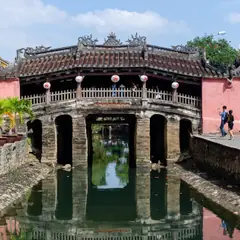
- Chùa Cầu — the covered bridge the 2025 flood left submerged
- An Hội Bridge — floating candles on the river at dusk
- An Hội island — night market and bài chòi sung bingo, UNESCO heritage
The history of the Hoai River begins in a dictionary. Alexandre de Rhodes’s Vietnamese–Portuguese–Latin dictionary, printed in Rome in 1651, records the word “Hoài phô” and defines it as a village in Cochinchina inhabited by Japanese, who called it Faifo; the same author’s map of Annam labels it “Haifo”. Where the name comes from is still debated: one theory derives it from “Hội An phố”, another holds that the Thu Bồn itself was once called the Hoài River, and a popular etymology, much repeated by local agencies, translates “Hoài” as “longing for home” and attributes it to the Chinese and Japanese residents.
Between the 16th and 19th centuries this narrow arm of the Thu Bồn was the street of an international port, until the silt of the 19th century left Hội An without large ships. Today it separates the old town from An Hội island, is lined by a quay built in 2015-2017 and fills every night with lantern boats and paper candles drifting with the current. It is also a river that gets dirty and overflows: in 2017 a kayak excursion premiered here to fish out rubbish instead of looking at lanterns, and in 2025 the flood matched the record of 1964.
What to see at the Hoai River runs along one bank and one bridge: from the Bạch Đằng landing to Chùa Cầu, from the An Hội Bridge to the night market bank, from where the old town is seen as the ships saw it. The audio guide walks that stretch in four stops, with narration researched and fact-checked against historical sources, and keeps for each point the story the water does not tell at first sight.
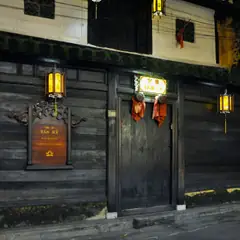
Beside its bank, the Japanese Covered Bridge was left under water in the 2025 flood, and Tan Ky House has marked on a pillar the floods the Hoai has brought into its home.
A Faifo port rowed by grandparents
Bạch Đằng boat landing
Summary of this stop
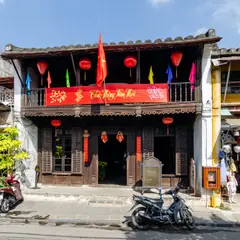
On the Bạch Đằng quay the ghe, wooden rowing boats, wait in line for passengers. Behind them stand the low tiled houses with yellow facades of the old town, which do not face the water on a whim: between the 16th and 19th centuries the river was the route by which merchants from China, Japan and Europe arrived, and the town was built facing it.
The boat business has grown fast. In 2019 there were 140 boats authorised to take tourists out, grouped in a self-managed cooperative; in 2022 there were almost 300, with 7 boarding points on both banks and an official fare of 150,000 đồng for a 15-minute ride for 1-3 passengers and 200,000 đồng for 4-5.
What stands out is who rows. In Hội An the Hoài is fondly called “the river of sunset”, because almost all the boatmen are over 70, and the women rowers call out to foreigners in an English of their own that is understood only here. One of the river’s veterans presents himself as the first to take tourists out on it, for a coin; how that trade began is the story the narration tells beside the boats.
Chùa Cầu and the water that always returns
Japanese Covered Bridge
Summary of this stop
At the western end of the promenade stands Chùa Cầu, the covered bridge that joins Trần Phú and Nguyễn Thị Minh Khai streets over a small stream flowing into the Hoài. From here the town’s ambivalent relationship with its river becomes clear: the same silt that in the 19th century choked the Cổ Cò River and narrowed the Đại estuary took Hội An’s large ships and its role as an international port.
The quay running along the bank is the modern attempt to tame it. It was built between November 2015 and March 2017, from Chùa Cầu to Cẩm Nam, for more than 135 billion đồng, over 80 billion of it from a state climate-change programme; it included dredging the channel and turned Bạch Đằng Street into a 780-metre pedestrian promenade. Even so, on 30 October 2025 the flood reached 3.4 metres in Hội An, matched the 1964 record and left Chùa Cầu submerged, with residents going around the old-town streets by boat.
Eight years earlier, in November 2017, another flood had swamped the riverside streets just as the region was preparing to host an international summit. What the town managed to do in barely six days, and why that episode ended precisely at this bridge, is revealed by the audio guide in front of Chùa Cầu.
The night the streetlamps went out
An Hội Bridge
Summary of this stop
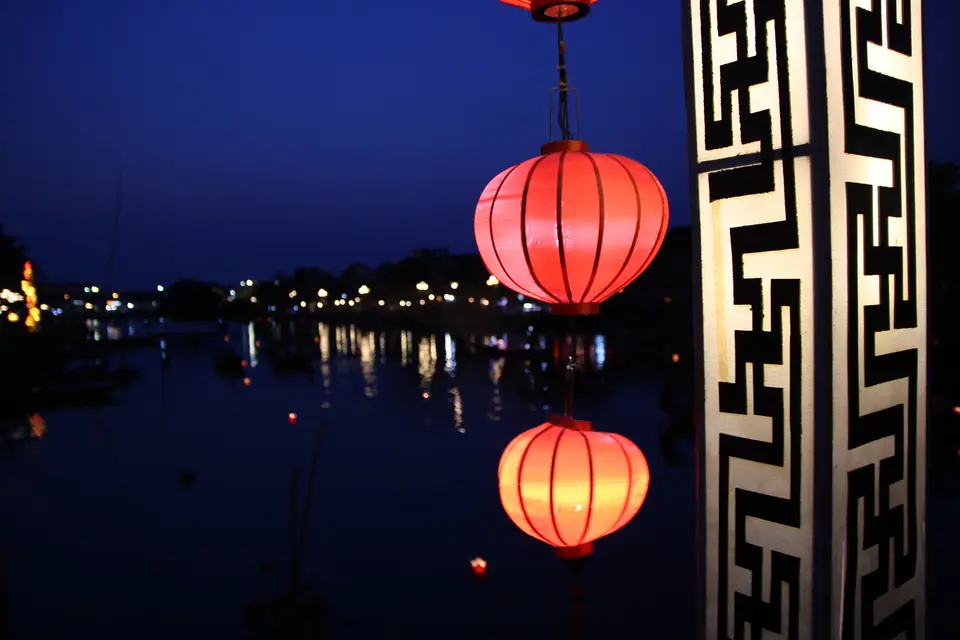
From the middle of the An Hội Bridge the river can be taken in at dusk, and this is where it is clearest that lantern light is a recent decision. On 8 September 1998 Hội An trialled for the first time the “Old Town Day”, later renamed Old Town Night (Đêm phố cổ). The rules required switching off all modern and public lighting, lighting only with lanterns or old lamps and clearing goods from the pavements. In its first 20 years more than 230 periodic nights were held with more than a million visitors, plus 82 organised for conferences and official delegations. Some travel blogs place the origin in 1988, without a source; the Vietnamese press dates the first official trial to 1998.
Not everyone liked it. The Minh An and Cẩm Phô wards formed teams that asked residents to light lanterns on their porches and children not to fish out the floating candles, the hoa đăng, in the face of the residents’ initial resistance. Regulation has continued since: in March 2022 the council banned garish coloured lights and spinners on Hoài boats and allowed them to carry only two traditional lanterns.
That same month, after two years without tourism, a fourth-grade primary schoolgirl was selling homemade floating candles with her mother on this bridge at 5,000 đồng each. How much she raised in an hour, and what that figure says about a town lighting up again, is the detail the narration closes the stop with.
Folding lanterns and sung bingo on An Hội
Hoi An Night Market
Summary of this stop
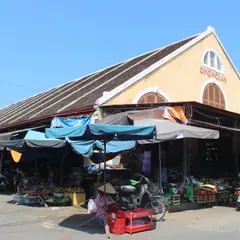
On the other side of the bridge begins An Hội island, some 27 hectares shaped like a leaf between the Thu Bồn to the south and the Hoài to the north, joined to the rest of the town by three bridges: An Hội, Cao Hồng Lãnh and 18 Tháng 8. Its north bank holds a park of stone sculptures by artists from several countries, and along An Hội and Đông Hiệp streets stretches the Nguyễn Hoàng night market, which had a difficult start and filled with visitors from 2016, when the neighbouring Nguyễn Phúc Chu Street was declared pedestrian.
Among its stalls lanterns abound, and many of them fold. That format has an author: in the 1990s, with the arrival of foreign tourism, the craftsman Huỳnh Văn Ba, born in Thăng Bình, devised the folding bamboo-and-silk lantern after an Australian tourist could not fit one of his in a suitcase.
Very near the water, in a circular little square, bài chòi is sung every night, the sung bingo of central Vietnam, with a deck of 33 painted bamboo tablets and a caller who announces each card with verses and popular sayings. The game had withered in the town and returned to the old town in September 1998, with the first lantern nights; in December 2017 UNESCO declared it intangible heritage of humanity. How a game is won, and why this bank is the best place to look back at the facades of the old port, is what the audio guide keeps for the end.