Old-town market
Hoi An Central Market Audio Guide (Chợ Hội An)
Beneath its stalls sleep three markets and, deeper down, the old bed of the Thu Bồn River. The Hoi An Central Market has spent almost two centuries selling fish, spices and cao lầu between the Quan Công temple and the water that sometimes floods it.
- 40 min of audio
- French-era market
The Hoi An Central Market, the Chợ Hội An, moved to its present site around 1848, the first year of Tự Đức's reign. Before that it stood in front of the Đình Ông Voi communal house and on the riverbank. In the early 20th century the French colonial administration built over the Tự Đức market a hall with 4 rows of brick pillars, 3 aisles and a fish-scale tile roof, extended with concrete wings in the 1960s and completed in 1988 with a rear pavilion.
The ground of the market was once river. A 2009 excavation found the stacked foundations of its three eras and, beneath them, the filled-in bed of the Thu Bồn with 2,307 pieces, including 1,016 fragments of Chinese porcelain. The same river reclaimed its place in the record flood of October 2025, which left the stalls under mud.
Highlights
- Roofed well facing Chùa Ông — the only public well in the old town with a roof
- Food area beside the well — almost 100 stalls of cao lầu, mì Quảng and bánh xèo
- French hall of brick pillars — three markets stacked beneath the floor
- Fish section facing the Thu Bồn — where the old landing stage stood
- Record flood of 2025 — the river above the 1964 mark
The history of the Hoi An Central Market begins on the riverbank. Between the 16th and 19th centuries the market occupied the front of the Đình Ông Voi, Hội An’s communal house, and stretched along the water between the present Lê Lợi and Trần Phú streets. An old description places it east of the Diên Phước district, with the Cái River to the south, two rows of tile-roofed houses stretching for about two dặm and boats coming and going “like loom shuttles”. Many Qing Chinese merchants lived there, and cinnamon and pepper from xứ Quảng were sold in abundance.
Around 1848, the first year of Tự Đức’s reign, the market moved to its present site, facing the Quan Công temple. Since then the Tự Đức market, the French hall of the early 20th century and the extensions of the 1960s and of 1988 have followed one another on the same spot. Beneath all of them, the 2009 excavation confirmed that the ground was once the bank and bed of the Thu Bồn.
What to see at the Hoi An Central Market runs from the temple to the river: the roofed well at the entrance, the food area where cao lầu is served, the hall of brick pillars and the fish section that still faces the water. The audio guide walks that route in four stops, with narration researched and fact-checked against historical sources, and leaves for each point the story the stalls do not tell at first sight.
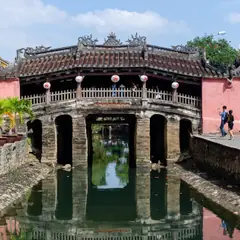
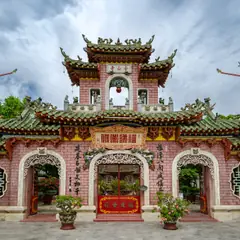
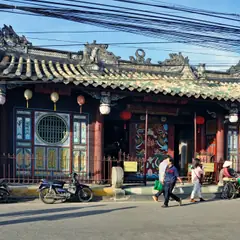
Facing the market entrance stands the Quan Cong Temple, and about a hundred metres away, the Fujian Assembly Hall of the Chinese merchants.
A roofed well facing Chùa Ông
Market entrance
Summary of this stop
The market entrance gives onto Trần Phú Street, which until 1975 was called Cường Để and in French times Rue du pont japonaise, “Japanese bridge street”. Right opposite, at no. 24, stands the Quan Công Miếu, known as Chùa Ông. The market came here around 1848, although that date allows two explanations: some sources tie it to the moving of the tomb of the monk Lương Huệ Hồng, which occupied the land in front of the temple, to the Chúc Thánh pagoda; others, to the opening of Nguyễn Thái Học Street after 1840 and the market’s move from the front of the Đình Ông Voi.
At the five-street crossing stands a round brick well, with a mouth of 155 cm and a rim of 60 cm, covered by a four-pitched roof of fish-scale tiles on a timber frame. It is the only public well in the old town with a roof. According to tradition, it was built when the market was founded and supplied fresh water to the market itself, the neighbourhood and the trading ships that docked there.
Even its name is unclear. Some call it “giếng Mái”, the roof well; others, “giếng Máy”, the machine well, after the winch that once raised the water. What role local cooking attributes to the water of this well is one of the details the narration reveals beside the rim.
Cao lầu beside the machine well
Food area beside the well
Summary of this stop
Beside the “giếng máy” crowds the market’s food area: in 2017 it had almost 100 stalls, about 20% of the market, open from 6:00 to 19:00. The display cases show prepared food, the price signs are in Vietnamese and English, and the tables seat groups of 5 to 10. The menu repeats from stall to stall with variations: cơm, bún, cao lầu, mì Quảng, bánh xèo, smoothies and chè. Among Hội An cooks it is held that cao lầu calls for well water and that with tap water it would be “vô duyên”, without charm.
The division of roles has old roots. In the market of the 16th to 19th centuries men did the itinerant trade and selling at the stalls was mostly done by women, so much so that the saying “Trai khôn chọn vợ chợ đông” advised the clever man to look for a wife in the busy market.
One of the best-known trajectories of local cuisine also began among these stalls. In 1981 a family opened a small eatery in their own home, inside the market, and in 1990 offered it to their three daughters: the eldest only wanted to sew and the youngest was studying at university. What the middle one did with that stove, and which dishes that today pass for Hội An specialities carry her mother’s mark, is told by the audio guide in the food area itself.
Three markets under the brick pillars
Hall of brick pillars
Summary of this stop
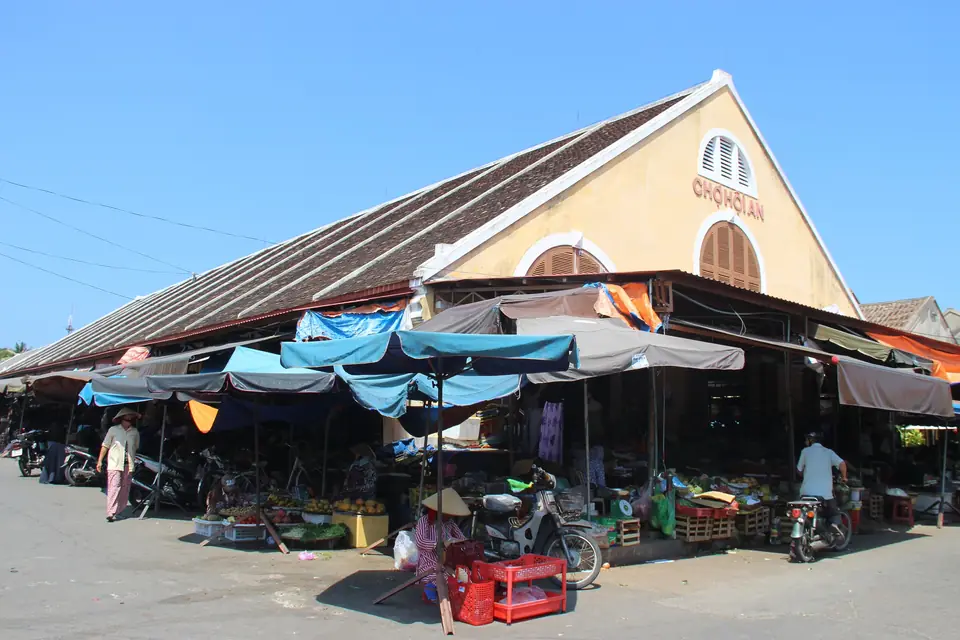
The front pavilion, unit 1, is the French-era building raised in the early 20th century on the site of the Tự Đức market: 4 rows of brick pillars divide the interior into 3 aisles under a fish-scale tile roof, and the floor stands about 45 cm above Trần Quý Cáp Street, with steps to climb. The Vĩnh Tân photo studio portrayed it in the 1930s. In the 1960s flat reinforced-concrete slabs were added on both sides and the main facade was remodelled; in 1988 the roof was repaired while the rear pavilion, unit 2, was built behind.
The architecture of the Hoi An Central Market reads best from below the floor. During the restoration of the pavilion in 2009, an archaeological excavation brought to light three phases of foundations: the laterite and lime plinths of 40 × 40 cm of the Tự Đức market, with sandstone bases spaced between 2.90 and 3.20 m; the brick foundation of the French hall, of 17 × 58 m; and the concrete footings of the 1960s extension.
The test pits, down to 1.9 m deep, also showed that the site was riverbank and riverbed, gradually filled in towards the south by the changes of course of the Thu Bồn. From that fill came 2,307 pieces dated from the 18th century onwards, including 1,016 fragments of porcelain, mostly Chinese from the kilns of Guangdong, Fujian and Jingdezhen, and coins from the reigns of Gia Long, Minh Mạng, Thành Thái and Cảnh Hưng. What that riverbed says about Hội An’s trade is the revelation the narration keeps for the centre of the hall.
Fish from the Thu Bồn and the mud of 2025
Fish section facing the Thu Bồn
Summary of this stop
On the side facing the river and Bạch Đằng Street are concentrated the stalls of fish, prawns and seaweed. It is no coincidence: between the 16th and 19th centuries fish was sold at the river landing stage, with flying fish, herring, anchovy, mackerel and tuna, and from that abundance comes the xứ Quảng saying “ăn cơm cá như má với con”. In the centre of the market, vegetables, fruit and herbs are displayed in wooden baskets beside juice stalls, and beyond wait the spices, areca, cinnamon, pepper and chilli, as well as a fabric section where clothes are ordered made to measure.
The same river that brings the fish is the one that floods the market. In the historic flood of late October 2025 the Thu Bồn beat the 1964 record and reached between 3.45 and 3.50 m in Hội An. On 31 October the stalls were covered in thick mud and debris, and many vendors reckoned losses of between 60 and 80%.
The market dried out on 31 October and reopened, but on 3 November the water came in again, up to half the height of a motorbike, and it had to close after a single day of trading, while Trần Quý Cáp Street, on its flank, was still deeply flooded. How this market has risen again and again over the old riverbed is the story the audio guide closes the tour with.