National relic of Vietnam
Japanese Covered Bridge Audio Guide (Chùa Cầu)
Eighteen metres of timber under a tiled roof: paid for by Japanese merchants, carved by Vietnamese carpenters, and given a shrine without a Buddha by the Chinese. The Japanese Covered Bridge of Hoi An is the stitch that joined the quarters of a great port.
- 20 min of audio
- Wooden covered bridge
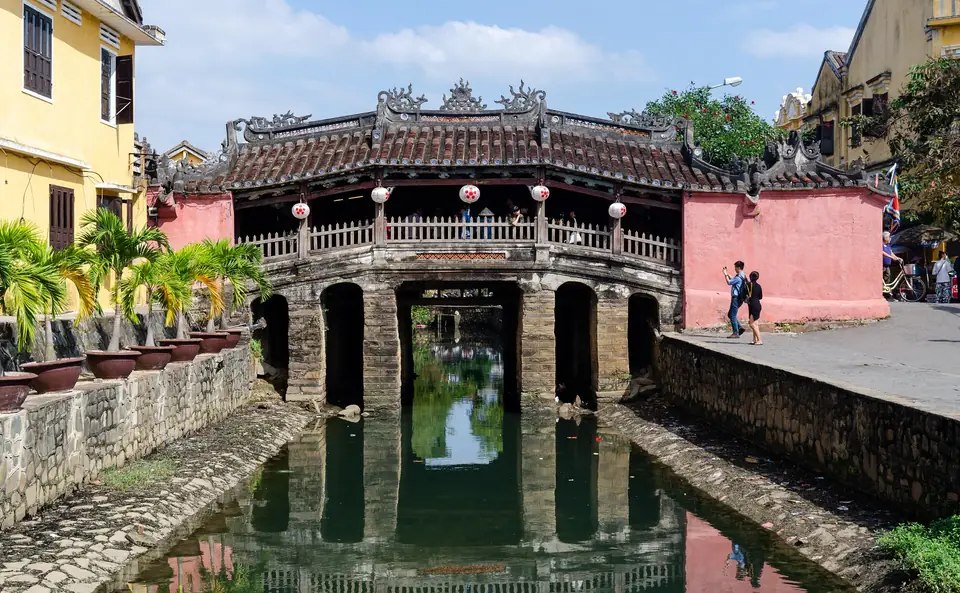
The Japanese Covered Bridge, Chùa Cầu to the locals, was built between the late 16th and early 17th centuries with money and a design from Japanese merchants, and Vietnamese carpenters from Hội An put it up. It served the Japanese quarter that grew up when, from 1592, the red-seal ships of the Tokugawa shogunate began trading at the port. It measures about 18 metres long by 3 wide over a canal of almost 10, and since 1990 it has been a national historical and cultural relic: the only old bridge the town still has.
Despite being called a pagoda, there is no image of the Buddha inside. The shrine jutting out over the water venerates Bắc Đế Trấn Võ, the Taoist guardian of the north, invoked to keep the ground stable, and at the two ends two wooden monkeys and two wooden dogs stand guard, painted to look like stone. Legend says the bridge is a sword driven into the back of a monster that links India with Japan.
Highlights
- Monkeys and dogs at the bridgeheads — four wooden guardians, 110 cm tall
- Lai Viễn Kiều panel — the name Lord Nguyễn Phúc Chu gave it in 1719
- Bắc Đế Trấn Võ shrine — a pagoda with no image of the Buddha
- Carved ridge beam — the restorations of 1763, 1817 and 1865
- T-shaped plan over the canal — the bridge on the 20,000 dong note
The history of the Japanese Covered Bridge of Hội An fits into four proper names. It was paid for and designed by Japanese merchants, who arrived from 1592 on the red-seal ships authorised by the Tokugawa shogunate; in 1596 a group of them bought land to lay out streets and build pagodas, and that is how the Japanese quarter the bridge served was born. It was carved by Vietnamese carpenters. In 1653, with the Japanese already gone from the town, the Chinese community added a shrine, and in 1719 Lord Nguyễn Phúc Chu christened it Lai Viễn Kiều, “bridge for those who come from afar”.
The exact date of its construction is unknown. Some give 1593 as the start and 1595 as the end of the work, the monument’s official record places it between the late 16th and early 17th centuries, and other sources take 1617 as the limit, the first documented mention of the name “Japanese Bridge” (Nhật Bản Kiều). Nor is there full agreement on who drove each phase: some texts credit the Minh Hương, descendants of Ming Chinese. What is clear is that since 17 February 1990 Chùa Cầu has been a national historical and cultural relic and the only old bridge Hội An has left.
What to see at the Japanese Covered Bridge comes down to about 18 metres of walkway: the monkeys and dogs at the bridgeheads, the lacquered panel of 1719, the Taoist guardian of the shrine and the carved steles and dates that record four centuries of repairs, up to the restoration reopened in August 2024. The audio guide walks it in four stops, from the canal bank to the dogs’ end, with narration researched and fact-checked against historical sources that keeps for each point what the timber does not tell at first sight.
The bridge looks onto the Hoai River, which in floods can cover it, and the trace of the Japanese quarter that paid for it reappears in the 17th-century bowls kept at the Museum of Trade Ceramics.
A wooden T over the canal
Canal bank facing the shrine
Summary of this stop
From the bank, facing the shrine, the bridge can be read whole at a glance. The plan fits two end bays and seven central ones into an “I”, like the character 工, and the shrine joins the span to form a “T”, like the character 丁. The whole measures about 18 metres long by 3 wide and crosses a canal of almost 10, under a roof of alternating concave and convex tiles topped by two stylised dragons fighting over a pearl.
That timber stitch joined the Japanese quarter, born of the 1596 land purchases, to the rest of the port. Today its silhouette is so recognisable that since 2006 it has appeared on the back of the 20,000 dong polymer note: a good share of those who come to see it already carry it in their wallet.
The view from the water is the only one that shows the full plan, with the shrine projecting towards the canal and its reflection beneath. Why such a short bridge ended up as the image of an entire town is the idea the narration opens with on this bank.
The monkeys that hold down a monster
Japanese Covered Bridge
Summary of this stop
At one bridgehead two seated wooden monkeys wait, 110 centimetres tall, painted to look like stone; at the other, two dogs. Three of the four figures are old and only the male dog was remade, in 1956. They are not mere decoration: on the 1st and 15th of each lunar month, mùng một and rằm, locals leave trays of fruit, incense and candles before them, because the bridge is still an active place of worship.
The best-known explanation comes from legend. Popular tradition says a gigantic water monster sleeps under the sea, called Cù by the Vietnamese, Namazu by the Japanese and Câu Long by the Chinese, with its head in India, its back running under the Hội An stream and its tail in Japan. When it stirs, Japan shakes and Hội An floods. The bridge is said to have been built right on its back, like a sword driven into the spine, and the monkeys and dogs would be the gods that keep it pinned down.
It is not the only reading. The official record notes that the pairs could be a Japanese way of dating the work or totem animals, and elders in Hội An hold that work began in a Year of the Monkey and ended in a Year of the Dog; the sources do not even agree on which bridgehead each pair occupies. What it means to step onto this stretch of timber if you believe the legend is what the audio guide reveals beside the monkeys.
A pagoda without a Buddha on a Japanese bridge
Bắc Đế Trấn Võ Shrine
Summary of this stop
Halfway along the walkway, the room that juts out towards the water explains the monument’s name. In 1653, according to the official record, the Chinese community took charge of the bridge and added this shrine; since then locals have called it “chùa”, pagoda, and that is where Chùa Cầu comes from. Other versions credit the temple to Japanese residents, and the debate is still open. At the back, behind wooden partitions and doors, there is no image of the Buddha: only a half-metre standing figure of Bắc Đế Trấn Võ, the Taoist guardian of the north, invoked to keep the ground stable.
Above the door hangs the horizontal wooden panel, 59 × 145 centimetres, that Lord Nguyễn Phúc Chu granted on his visit in 1719, with the three characters of Lai Viễn Kiều in relief and his seal on the left; below, two round “door eyes” painted red. Looking up, the ridge beam still bears the carved dates of the restorations of 1763, 1817 and 1865.
Local tradition recalls that the 1763 repair was led by Truong Hoang Co, head of the Minh Hương commune, with all his neighbours, and that in 1915 the French official Lesterlin Galtier devoted part of his funds to renewing the bridge. How a Japanese bridge ended up looked after by Chinese, Vietnamese and French is the episode the narration tells in front of the panel.
Guard dogs and a freshly painted skin
The dog statues
Summary of this stop
At the dogs’ bridgehead, four large stone steles with inscriptions in Chinese characters, set into the walls on both sides of the entrances, record the major repairs: the oldest dates from 1817 and the most recent from 1917. How many restorations the bridge has had depends on the source, because different series of dates circulate, but all agree on the essentials: Chùa Cầu survives because it is rebuilt again and again.
The latest major work began on 28 December 2022, with an approved budget of 20.2 billion dong split between Quảng Nam province and the town, funding from the Japanese Sumitomo Foundation and experts from the JICA agency: four centuries later, Japan was again putting money and judgement into the bridge. After 19 months of work in full view of the public, it reopened on 3 August 2024. Not without controversy: faced with criticism that it looked “less old”, on 29 July the chairman of the Hội An People’s Committee, Nguyễn Văn Sơn, ordered the paint redone, with a softer red and darker sides. The authorities argued that the original pieces had been preserved as far as possible and that the colour will mellow with the weather.
The figures at the bridgeheads, which look like stone, are made of wood, and a local legend explains it with a theft, years of floods and a spell that lost its power. What disappeared, when it came back and why, as the story goes, Hội An still pays for every rainy season is the story the audio guide closes the tour with.