18th-century merchant house
Tan Ky Old House Audio Guide (Nhà cổ Tấn Ký)
A merchant shophouse that runs through the block from the street to the river, joined in ironwood without a single nail. The Lê family still lives on the upper floor, and a pillar at the back has the floods the river has left inside marked on it.
- 25 min of audio
- Nail-free shophouse
Tan Ky House, the Nhà cổ Tấn Ký on Nguyễn Thái Học Street, is dated to 1741 in the most repeated version, although other sources push it to the late 18th century. Gathering the timber and bringing it to Hoi An took 10 years and the building another 3: 80% is ironwood, the Vietnamese lim, and the whole frame was fitted with mortise-and-tenon joints. In 1990 it received from the Ministry of Culture the certificate of national historical and cultural monument, the first old house in Hoi An to get it.
It is a living house and a wet one at once. It was shop, warehouse, rental space and home, and today it is also the ancestral hall of the Lê lineage. Being so close to the river, it floods often: in 1964 the water reached the ceiling of the ground floor and in October 2020 alone it came in nine times. The pulleys that once hoisted goods up to the loft now lift the furniture when the flood arrives.
Highlights
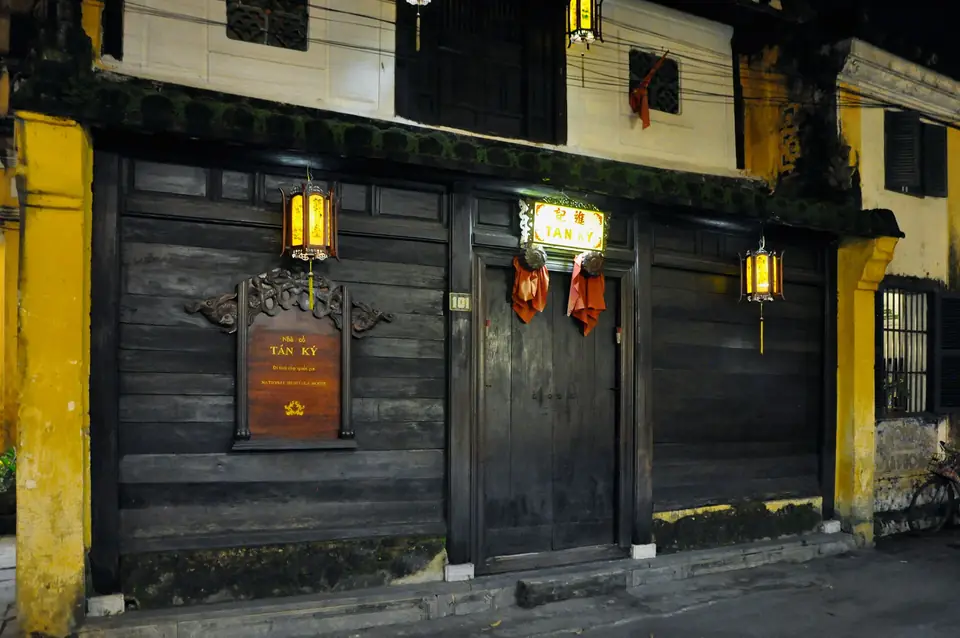
- Plank facade on Nguyễn Thái Học — the old counter of the family shop
- Nail-free ironwood frame — crab-shell vault and stacked beams in the Japanese tradition
- Mother-of-pearl couplets and the Hundred Birds couplet, written in 100 strokes shaped like birds
- Lacquered 'Tấn Ký' plaques and the four-character one given by Emperor Bảo Đại
- Flood pillar — the 1964 flood up at ceiling height
The story of Tan Ky House is that of a merchant family that built to trade with the river and ended up learning to live with it. The most quoted date is 1741, with seven generations of the Lê family under the same roof, although the Da Nang tourism portal places it in the late 18th century and the 1992 official record speaks only of “more than 200 years”, with no written genealogy. What is not in dispute is the method: ten years to gather the timber, three of building and an ironwood frame fitted piece by piece, without a single nail.
The house entered the protection list of the Hoi An Monuments Management Office in 1985 and in 1990 was the first old house in the town to receive the national certificate from the Ministry of Culture; some sources move that title back to 1985, but the official record keeps the two dates apart. Until then it had had no major renovation since the days of the great-grandfather of Lê Chương, the fifth-generation heir, and in February 1990 the courtyard eaves, the gallery around it, two ornamental fish and the gutters were redone.
What to see at Tan Ky House runs from the street towards the water: the facade that was a counter, the carved timber hall, the lineage plaques and, at the back, the pillar where the floods are marked. The audio guide walks the house in four stops, with narration researched and fact-checked against historical sources, and keeps for each corner the story the timber does not tell at first sight.
A few streets away, the Museum of Trade Ceramics occupies another merchant shophouse, and at the rear the house opens onto the Hoai River, the same river that marks its floods on the pillar at the back.
A plank counter on Nguyễn Thái Học
Tan Ky House facade
Summary of this stop
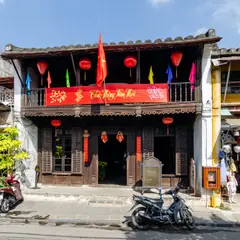
The Nguyễn Thái Học Street facade is not a door but a shop. Its three openings, two side ones of 2 metres and a central one of 1.2, close with horizontal planks fitted between square pillars: it was the counter from which the Lê family sold to the street. Above the lintel of the main door, two carved wooden pieces with a yin-yang swirl and a bodhi leaf, the “door eyes”, watch whoever enters; the same pair is repeated on the door of the third section.
Behind, the house stretches through several sections until it crosses the whole block. The front was the shop and the rear, opening onto Bạch Đằng Street beside the river, served to receive goods unloaded from boats. In the loft of the first section a trapdoor of 1 metre by 1 opens, through which goods were hauled up to the warehouse.
That double face, one towards the buyers and one towards the ships, explains the shape of the whole house. How that business worked from one end of the block to the other is what the narration unpacks in front of the facade.
An ironwood frame without a single nail
Crab-shell vault
Summary of this stop
Under the roof of the front hall, the carpentry becomes the star. 80% of the timber in the house is lim, Vietnamese ironwood, and the whole frame is held by mortise-and-tenon joints. Between the fifth and sixth rows of columns curves the “vì vỏ cua” vault, in the shape of a crab shell, made of jackfruit wood, whose brackets are carved with two crossed swords wrapped in a silk ribbon; it widens the hall and was used to hang lamps.
A little further on, between the fourth and fifth rows, 2.5 metres apart, the roof rests on stacked beams in the Japanese tradition, the “chồng rường giả thú” system, carved with the eight treasures, plum, orchid, chrysanthemum, bamboo and stylised gourds that act as load-bearing pieces. The round columns, 30 centimetres in diameter, stand on stone bases with lotus flowers.
Two pulleys also hang from the loft crossbeam. In the days of trade they raised goods to the upper-floor warehouse; today, according to the house’s custom, the family uses them to hoist the furniture each time the river overflows. Why those pulleys foreshadow the end of the tour is clear once you hear it under the vault.
From the orphan Công to the emperor’s plaque
'Tấn Ký' and emperor's plaques
Summary of this stop
In the hall, business turns into lineage. In the second generation the family adopted the trade name “Tấn Ký” for its trade in farm produce, and the signs of the different generations are kept in the house. The translation of the epitaph of Lê Tấn Ký, founder of the trading house, is also on display, telling how the orphan Công rose through his own effort to become a respected man who helped the poor. On his origins the sources disagree: some describe him as a Vietnamese merchant and others as a maritime trader, without further detail.
From the columns hang pairs of vertical couplets 2.2 metres by 15 centimetres, several with the Chinese characters inlaid in mother-of-pearl on black lacquer and others in gold lettering. Among them stands out the “Bách Điểu” couplet, the Hundred Birds, written in 100 strokes in which each stroke is a bird taking flight. Above, the horizontal plaques lacquered in red carry the names “Tấn Ký”, “Tấn Bửu” and “Lê Từ đường”, along with a four-character one, 80 by 60 centimetres, given by Emperor Bảo Đại.
The family boasts that no other house in Hoi An has received so many leaders: through this hall have passed, by their account, General Secretary Trường Chinh, Chinese president Jiang Zemin and Thai prime minister Thaksin Shinawatra, and in 2017 it was one of the four stops for the APEC finance ministers. What the emperor’s plaque says is one of the secrets the audio guide reserves for this point.
The pillar where the river signs its floods
Flood pillar
Summary of this stop
At the back of the house, beside the souvenir area, a pillar is marked with the heights and years of the floods. The one of 1964 sits at ceiling height on the ground floor. Because of its closeness to the Hoài River, the house floods often: in October 2020 alone the water came in nine times. That is why the family lives upstairs and leaves the ground floor open to visitors, in a house that is both a home and the ancestral hall of the Lê lineage.
In a nearby display case is kept a small cup that, if filled above a certain level, empties itself completely. In the family’s memory, the founding ancestor bought it from merchants who came from China, and legend says it arose from a lesson of Confucius on the golden mean. On its age there are different versions, from an estimate of between 550 and 600 years to those who identify it as 16th-century Fujian porcelain.
Beyond the pillar, the back door opens onto Bạch Đằng Street and the bank where goods used to arrive. The full legend of the cup, with a thirsty Confucius in the desert, is the story the audio guide closes the tour with.