17th-century Chinese-Vietnamese temple
Quan Cong Temple Audio Guide (Quan Công Miếu)
Opposite the Hội An market, traders swore their deals before the god of loyalty as in a court of law. Today the nearly three-metre General Quan Vũ and his red horse Xích Thố still receive offerings in the Quan Cong Temple.
- 20 min of audio
- Temple of the god of loyalty
The Quan Cong Temple, Quan Công Miếu or Chùa Ông to the locals, was built by the Minh Hương community, of Chinese origin, and Vietnamese neighbours in honour of General Quan Vũ. A stele of 1753 that is still inside states that it was already more than a hundred years old by then. Its plan in the shape of the character 口 encloses a square courtyard between two galleries, with beams and columns 50 cm in diameter and ridges of coloured pottery made by craftsmen from Kim Bồng.
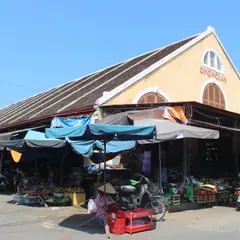
Its location explains its role. Right across from the market, the temple of the god of loyalty was the spiritual centre of the small traders: before Quan Thánh, contracts, debts and loans were sworn, and the god acted as witness and as punishment for anyone who broke what was agreed, working as a kind of 'economic court'. That trust is still visible in the two life-size horses of the shrine, which every lunar new year draw lines hundreds of metres long.
Highlights
- Facade facing the market — the temple where contracts and debts were sworn
- Stele of 1753 — proof the temple was already over a hundred years old
- Statue of Quan Công — almost 3 metres, in red and gold
- Xích Thố and the white horse — two life-size cult horses
- Over thirty lacquered panels — signatures of emperors, poets and guilds
In a trading port, a given word was worth as much as the goods, and in Hội An that word had a house of its own. The Quan Cong Temple, Quan Công Miếu in Vietnamese and Chùa Ông in the mouths of the locals, is dedicated to General Quan Vũ, venerated as the god of loyalty, and stands on Trần Phú Street, at the corner with Nguyễn Huệ, right across from the market. It was built jointly by the Minh Hương community, of Chinese origin, and Vietnamese neighbours; for generations it was looked after by the Council of the Ngũ Hương of Minh Hương village, and since 1997 it has been run by the Hội An Cultural Heritage Management and Conservation Centre. One travel guide attributes the work to Cantonese merchants, but the official record and the cultural press maintain Minh Hương authorship.
The history of the Quan Cong Temple left written traces from very early on. In 1695 the monk Thích Đại Sán stayed here for a while and described it in his travel account, “Hải ngoại kỷ sự”. In 1775 Nguyễn Nghiễm, father of the poet Nguyễn Du, left a poem on passing through the town, and in 1825 Emperor Minh Mạng donated 300 lạng of silver to it, three times what he gave the temple of the goddess Thiên Phi in the same village. The imperial chronicle Đại Nam nhất thống chí describes it as splendid in design.
What to see at the Quan Cong Temple fits in a short, dense visit: the carved timber facade facing the market, the square courtyard under pottery roofs, the red-and-gold shrine with the general’s statue and his two horses, and the walls covered in lacquered panels. The audio guide walks it in four stops and 20 minutes, with narration researched and fact-checked against historical sources, and keeps for each point the episode the timber and stone do not tell at first sight.
A few steps away, the Fujian Assembly Hall shows how another Chinese community of the port prayed to the sea goddess, and opposite opens the Hoi An Central Market, whose deals were sworn here.
The sacred notary of the Hội An market
Temple entrance
Summary of this stop
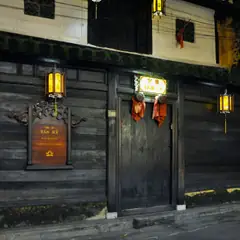
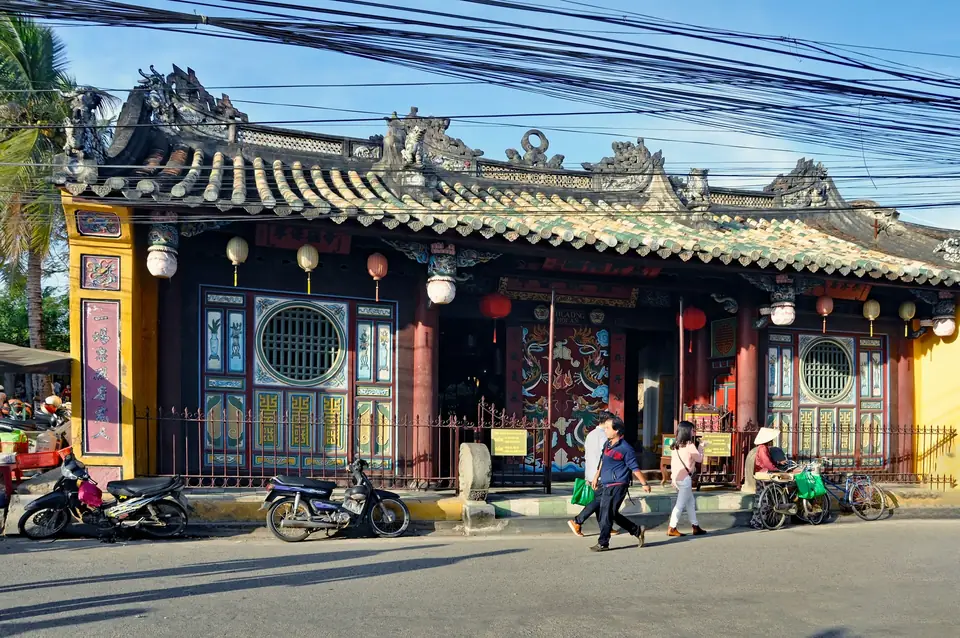
The three-bay front section lines up with the street a step from the bustle of the market. Its wooden doors follow the “thượng song hạ bản” type, lattice above and panel below, carved with leaves and clouds; above the lintel, two dragon-headed “door eyes” watch the entrance, and from the gables hang wooden lanterns pierced with lotus flowers.
That closeness to the haggling is no accident. Standing in front of the market and consecrated to Quan Thánh, the temple became the spiritual centre of the small traders: here contracts, debts and loans were sworn before a god who acted as witness to what was promised and as punishment for whoever failed it. Sources go as far as describing it as an arbiter, a true “economic court” of merchant Hội An.
Tradition goes further and says that in the port, credit sales of whole ship cargoes were closed before Quan Công, with the oath in the temple as the only guarantee. How that justice without judges worked, out on the street, is what the narration reveals in front of the facade.
A stele of 1753 and the years of neglect
Square courtyard and stone steles
Summary of this stop
Crossing the threshold opens the square courtyard, surrounded by two galleries that join the front section to the shrine according to the plan in the shape of the character 口. The beams and columns reach 50 cm in diameter, and on the ridges of glazed tubular tiles coil dragons and nghê, guardian lions, covered in fragments of coloured pottery by Kim Bồng craftsmen. According to local custom, carp, a symbol of patience in Chinese mythology, also peer from the courtyard eaves.
The temple’s age is told by a stone. A stele dated 1753 states that the temple of Quan Thánh Đế and the pagoda of Quan Âm in the village had already been standing for more than a hundred years, so the temple existed, at the latest, in 1653. Many guides give that year as the exact founding date, although it is really a deduced limit, and other sources speak of the second half of the 17th century or even the early part of that century. The steles on both sides of the building record repairs in 1753, 1783, 1827, 1864, 1904 and 1966, and yet the temple keeps its original state.
There was silence too. From 1975 the temple was closed, in the hands of the Minh An ward and with nobody to sweep it regularly, until in 1987 it passed to the Hội An Monuments Management Board, which put a permanent guard back on it. What exactly those stones say about the temple’s past is heard on the audio guide beside them.
A three-metre general and the horse Xích Thố
Statue of Quan Công and his horses
Summary of this stop
In the shrine the scale changes. The central statue of Quan Công, lacquered in red and gold, is almost 3 metres tall, flanked by Châu Thương, his loyal servant, and Quan Bình, his adopted son, beside wooden thanh long đao halberds. Before the image a small traditional protocol applies: you must take off your shoes to step onto the dais, and when someone leaves an offering, the keeper strikes a bronze cup once.
On the sides wait two life-size cult horses: the white one on the left and, on the right, Xích Thố, Quan Vũ’s red horse. On the lễ vía of Quan Thánh Đế Quân, which institutional sources place on the 24th of the sixth lunar month, the statue is fumigated with incense from 6 in the morning, a whole roast pig is offered with sticky rice and cakes, and the lion and dragon dance parades from the Hội An Museum along Lê Lợi Street to the temple. Some guides instead place a “birthday” of the general in the middle of the first lunar month.
Those horses, which look like pure decoration, live their big night at Nguyên tiêu, the first full moon of the lunar year: on 4 March 2026 the line to get in stretched nearly a kilometre along Trần Phú and Nguyễn Huệ. According to popular belief, touching Xích Thố brings a reward. Which one, and why so many hands reach for its back, is told by the narration in front of the altar.
Lacquered panels: emperors, poets and rival guilds
Lacquered panels and couplets
Summary of this stop
The walls and columns of the temple read like a guest book. More than thirty horizontal lacquered panels, the hoành phi, hang there, and ten pairs of couplets; the panel “Trung thiên nhật nguyệt”, as bright as the sun and the moon, dates from 1784, and others carry dates of 1856 and 1904. Among them is also kept the poem Nguyễn Nghiễm wrote in 1775 together with Nguyễn Lệnh Tân and Uông Sĩ Dư.
Imperial generosity left its trace: in 1825, on his journey south, Minh Mạng passed before the temple and donated 300 lạng of silver, three times what the temple of Thiên Phi received. Very close, an inner passage leads to the adjoining Quan Âm pagoda, the same one named on the stele of 1753.
In 1904, when a restoration was completed, several panels were offered to celebrate it, and documented tradition says the Chinese congregations of Hội An stood behind them, communities that competed in the port. What each wrote in the house of the god of loyalty, and why that wall is a rare agreement between rivals, is the story the audio guide closes the tour with.