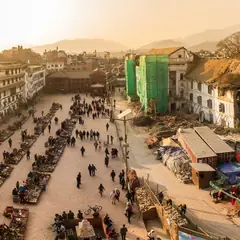
Newar market square
Asan Audio Guide
Six streets flow into Asan, the old caravan crossroads between India and Tibet, and on its southeast corner a goddess with no statue shines under three golden roofs: Annapurna is a silver pot.
- 45 min of audio
- India-Tibet route
- Annapurna temple
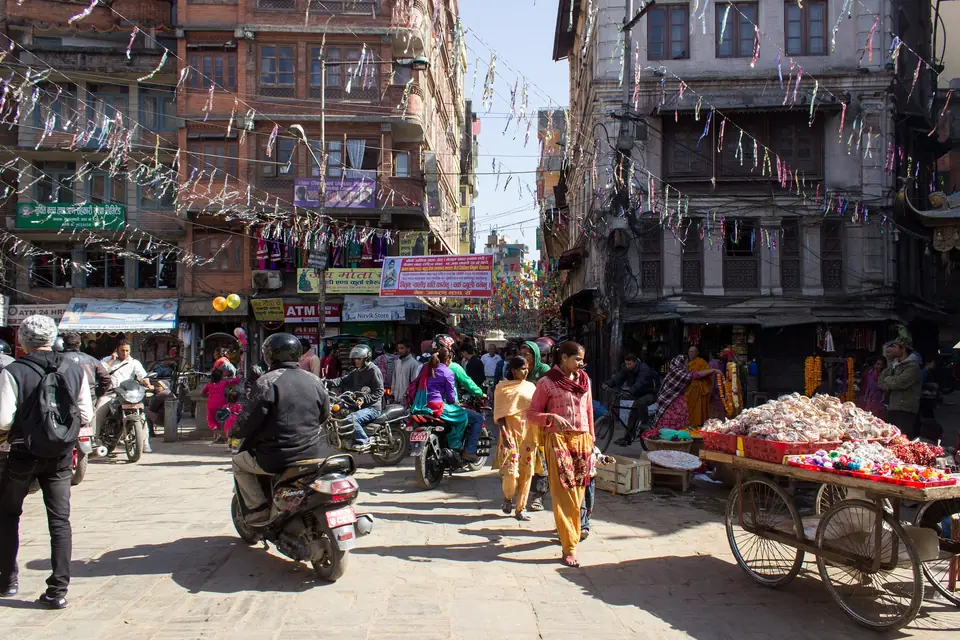
Asan sits on one of the two trade routes between India and Tibet that crossed Kathmandu, the diagonal line that leaves Durbar Square and continues to the northeast. Until the 19th century Tibetans arrived here with salt, wool, silver, gold, musk, pashmina and paper, and Indians with cotton, spices, areca nut and coconuts. Today each of its six streets keeps its own kind of shop, and around the square are scattered temples, a hymn pavilion and the Buddhist courtyards of the Newar merchants.
The brightest building on the square holds a surprise: the Annapurna Ajimā temple has no image of the goddess, but a purnakalash, a silver pot surrounded by a silver serpent and covered with a silver cloth. And once every eighty years, in the Newar ceremony of Taya Ma, the whole temple disappears under a net of puffed rice.
Highlights
- Annapurna Ajimā Temple — three golden pagoda roofs and a silver pot in place of a statue
- Six street mouths — each specialised in one kind of goods, from pulses to electronics
- Nyālon, the fish stone — a caged figure between two temples, revered by Hindus and Buddhists
- Ganesh Temple — two storeys with an ornate brass roof, tiles replaced in 1928
- Yita Chapā pavilion — shrine rooms and a hymn hall where neighbours gather to sing
In 1643, the year 763 of the Nepal Sambat calendar, King Laxmi Narsingh Malla summoned all the Uray, the Newar Buddhist caste of merchants, to Asan for a religious service. The choice of place was no accident: the square sat squarely on one of the two trade routes linking India with Tibet through Kathmandu, and until the 19th century Tibetan salt and wool passed through it on their way south and Indian cotton and spices on their way north. The Tuladhars, one of those merchant lineages, are still principal residents of the square today.
The history of Asan is that of a market that never stopped praying. It was Kathmandu’s great rice market, presided over by the goddess of grain, and every year palanquins of goddesses and the chariot of a god pass through it. Even the origin of its name is disputed: some attribute it to a great ashoka tree, others to a Newar phrase, others to the legend of a fish fallen from the sky. The route is made on foot inside the square itself, among open stalls, and the audio guide, documented and checked against historical sources, links trade and gods stop by stop.
That same commercial diagonal starts at Kathmandu Durbar Square, and the Buddhism of the Newar merchants has its greatest sanctuary at Swayambhunath, on the western hill. To the south, Patan Durbar Square shows what the craftsmen of that same Newar culture built.
Six streets on the Tibet route
Asan Tole
Summary of this stop
Six streets flow into the centre of Asan, towards Indra Chowk, Bhotahiti, Kamalakshi, Tyora, Bange Muda and Mahabouddha, and each specialised in one kind of goods: stationery, bicycles and clothing, pulses and dried fish, electrical supplies, hardware, kitchenware and electronics. That division of trade by streets is the trace of a caravan crossroads, the point where the diagonal line leaving Durbar Square continued northeast, on its way to Tibet.
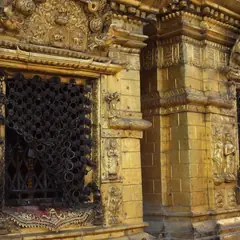
Until the 19th century Tibetans arrived at this square with silver, gold, wool, salt, bags of musk, pashmina and paper, and Indians with cotton fabrics, spices, areca nut and coconuts. Around the crossing also open the entrances to the neighbourhood’s Buddhist courtyards, such as Takse Bāhā, with its decorated gateway, or Dhālāsikwa Bāhā, with its carved window.
What the name of the square has to do with all this is another open question, with several competing versions. Which of them carries the most weight is told in the narration, in the very middle of the crossing.
The fish stone and the night of the gods
Ganesh Temple and Nyālon fish stone
Summary of this stop
On the north side of the square rises the Ganesh temple, with two storeys and an ornate brass roof whose tiles were replaced in 1928. Between this temple and the Annapurna one, behind some bars, a pedestal holds Nyālon, a fish figure in stone revered equally by Hindus and Buddhists, which one of the legends about the origin of Asan turns into its foundation.
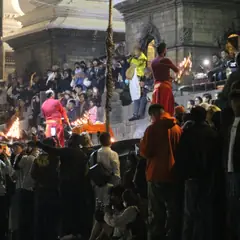
Several times a year the market crossroads turns into a festival square. Each April, the chariot of Jana Baha Dyah, Seto Machindranath, spends a night halted in Asan, beside the Annapurna temple, before continuing to Durbar Square, and devotees fill the square with butter lamps. In the Dyah Lwākegu, within the spring festival of Pahan Charhe, three mother goddesses, Tebaha, Kanga and Lumadi Ajima, arrive in palanquins, are set head to head and their bearers exchange lit torches as a greeting between sisters; sources do not fully agree on which day of the festival it happens.
The neighbourhood also keeps the memory of a feat of strength. In the Rana period, two street bulls had been fighting for two days and blocking the crossing when Sancha Pahalman appeared, a wrestler from Thahiti whom the playwright Bal Krishna Sama would remember as the strongest man of his time. How that fight ended is one of the episodes the narration reserves for this point.
Annapurna, the goddess who is a pot
Annapurna Temple
Summary of this stop
On the southeast corner, the Annapurna Ajimā temple raises three heavily gilded pagoda roofs, with a gilded door and torana and gilded lions at the entrance. Inside there is no statue: the goddess is a purnakalash, a silver pot surrounded by a silver serpent and covered with a silver cloth. Neighbours circle the temple, touch their foreheads with a coin, throw it inside and ring the bell. The temple’s records are dated to 1839 and show that it already needed renovation by the end of the 19th century; another source gives it as built in 1893, a date that could correspond to that refurbishment.
Asan was Kathmandu’s great rice market. Beside this temple sacks of rice, beaten rice, beans and lentils were piled up, and custom required offering a share to the goddess before selling them; buyers came from Thankot, Nuwakot and Sankhu. Once every eighty years, in the Newar ceremony of Taya Ma, the whole temple is covered with a net of puffed rice, a scene recorded on a glass plate in the Dirgha Man Chitrakar collection.
According to tradition, Annapurna lived in Benares or in Calcutta, missed the mountains and begged to be brought to Kathmandu. She was installed under a tree and ended up facing west, perhaps towards the peaks that bear her name, when no building blocked the view. What remains of that tree inside the temple is the detail the narration keeps for the stone platform that opens before her door.
Kerosene queues before the goddess of abundance
Yita Chapā hymn pavilion
Summary of this stop
On the south side of the square stretches the Yita Chapā, an elongated building with shrine rooms and a hymn hall where neighbours gather to sing. From here one understands how far Asan survived the attempt to empty it: the Rana prime minister Juddha Shamsher moved its small shops to Bhotahiti, but the new market did not prosper, closed after eight or ten years and buying returned to the Asan and Indra Chowk axis.
The square remains a neighbourhood of Buddhist merchants, and in one of its courtyards a woman sells Tibetan rock salt from a large wooden vessel, a centuries-old tradition in the place where salt and wool from Tibet arrived. Since April 2026, moreover, the Kathmandu city council closes Asan to traffic every Saturday and programmes music, dance and traditional crafts in the square that day.
At the end of the 20th century, according to the neighbourhood’s documented tradition, shortage drew a scene here that would be hard to invent, almost under the golden roofs of the goddess who guarantees that nothing is ever lacking. What happened around the temple in those years of blackouts is told in the narration, in front of the hymn pavilion.