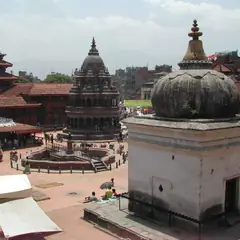
Shiva shrine
Pashupatinath Temple Audio Guide
A golden-roofed pagoda closed to non-Hindus and, at its feet, the pyres of the Bagmati, where the Kathmandu Valley cremates its dead, kings included. Pashupatinath is understood from the opposite bank.
- 90 min of audio
- Newar pagoda
- Cremation ghats
Pashupatinath Temple is Nepal's great shrine of Shiva, venerated here as Pashupati, the lord of animals. Its existence is already recorded around the year 400, when the Licchavi king Supuspa Deva raised a five-storey temple where there had previously been a shrine in the form of a linga. The present pagoda, in Newar style and with only two roofs, dates from the renovation of 1692, made after damage from termites and earthquakes.
The main enclosure opens only to Hindus, and barely four priests may touch the linga. The rest of the world looks on from outside: from the west gate, where the gilded rump of a brass bull peeks out, and from the terraces of the east bank, facing the ghats where the pyres burn day and night.
Highlights
- Main pagoda — two gilded copper roofs and 23 m 7 cm up to the golden pinnacle
- West gate — the gilded rump of the great brass Nandi, turned towards the shrine
- Aryaghat — the cremation platforms facing the temple where the royal family is cremated
- Bhasmeshwar ghats — wood pyres beside the Bagmati and, since 2016, Nepal's first electric crematorium
- Mrigasthali — the sacred forest where, according to tradition, Shiva lived as a deer
The history of Pashupatinath begins with a linga on the banks of the Bagmati. Over that primitive shrine, King Supuspa Deva, of the Licchavi dynasty, raised a five-storey temple, and around the year 400 its existence was already recorded. The exact antiquity of the cult is disputed: some sources place it in the 5th century, and the official website of the Pashupati Area Development Trust takes its first references much further back. It was later rebuilt by Shivadeva, who reigned between 1099 and 1126, and by Ananta Malla. The form seen today, that of a pagoda with only two roofs, dates according to the most-cited chronology from the renovation of 1692, although other sources give 1696 as the year of construction.
Before Prithvi Narayan Shah unified Nepal, devotees from outside the Kathmandu Valley could not enter the temple. The Shah dynasty opened darshan to everyone and held the god as protector of the royal house. Today the main enclosure remains forbidden to non-Hindus, so the history and architecture of Pashupatinath are explored from outside: the west gate, the cremation ghats, the terraces of the east bank and the Mrigasthali forest. The audio guide, documented and checked against historical sources, follows that path in five stops and tells why the god and the dead of Nepal share the same river.
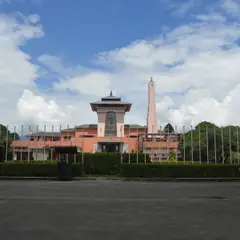
Less than two kilometres away, the Boudhanath Stupa gathers the Tibetan Buddhism of the valley, and the story of the kings who burned on these ghats is completed at the Narayanhiti Palace, the residence of the Shah dynasty until the end.
A golden bull with its back to the visitor
West gate and the Nandi's rump
Summary of this stop
The temple presents itself with a prohibition. From the west gate, the main entrance of the enclosure, which only Hindus may pass, the gilded rump of an enormous brass Nandi, Shiva’s bull, can be made out. It stands with its back to the visitor and faces the shrine where the black four-faced image of Pashupati is kept.
Inside, access to the god is even narrower. Only four priests may touch the linga: the bhatta, who perform the daily ritual. The 108 rajbhandaris, treasurers and guardians who take turns three at a time each full moon, are forbidden to touch the deity. That the bhatta come from southern India is a tradition whose antiquity is disputed, and in 2009 it became a political conflict: in January the chief priest Mahabaleshwar Bhatt and two other bhatta resigned under Maoist pressure, the government of Pushpa Kamal Dahal “Prachanda” appointed Nepali priests for the first time, in May the Supreme Court suspended the measure and in September two new bhatta from Karnataka were assaulted inside the temple.
A documented tradition also explains why this bull is here. After the war of the Mahabharata, the Pandavas sought Shiva to atone for the death of their kinsmen, and the god hid as one more animal of the herd and sank into the earth. Versions disagree on whether it was a bull or a buffalo, and on how far his body extends. Which part of that god stayed in Nepal and where the rest ended up is told in front of the gate.
Everyone’s pyres beside the Bagmati
Bhasmeshwar ghats
Summary of this stop
South of the temple, on the west bank, the Bhasmeshwar ghats line up, the cremation platforms of ordinary people. There shrouded bodies are washed in the river and burned on wood pyres. Next to them is the Brahmanal, ghat number two, where the cremators tend the pyres amid the tolling of great brass bells. Death here is a public, everyday rite, which families attend in plain view.
On 27 April 2015, two days after the Gorkha earthquake, at least 300 victims were cremated at the Aryaghat; 16 temporary platforms were set up on the bank, beside the Tilganga bridge, while the main temple withstood the quake. The figures from those days do not agree among sources, and the counts vary according to who recalls them.
The crematorium has also changed. In 2016 Nepal’s first electric crematorium opened within the enclosure, with two machines brought from Calcutta for 110 million rupees: it reduces a body to ashes in 45 minutes, against the 3 or 4 hours of a wood pyre. The idea had been raised in 1982. Why it took more than three decades to become reality, and what debate the smoke of the pyres beside the temple opens today, is left for the narration.
Where the kings of Nepal were burned
Aryaghat
Summary of this stop
From the east bank the Aryaghat is seen head-on, the cremation platforms located right in front of the temple. Only members of the royal family are cremated at that spot. After the royal palace massacre of 2001, the funerals of 10 members of the royal family were held there.
On those platforms worked Chandra Dhakal, who began cremating bodies at the Aryaghat of Pashupati at the age of 13, in 1983. At 49 he reckoned he had burned more than 27,000, among them King Birendra, Queen Aishwarya and King Dipendra. His trade sums up this place’s relationship with death: a daily job that suddenly carried the mourning of an entire country.
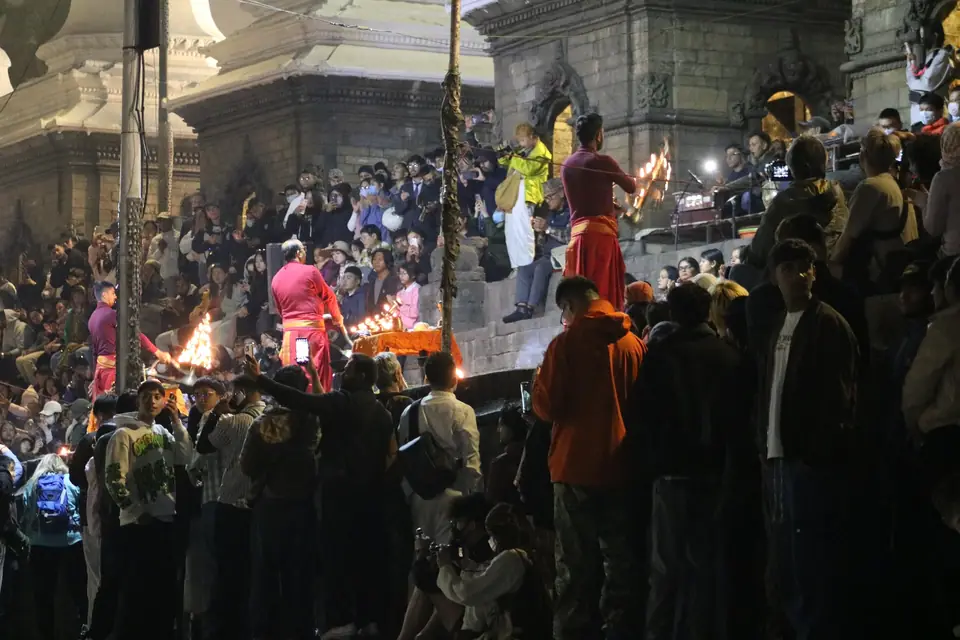
One night a year the place of mourning changes its look. On the eve of Bala Chaturdashi, between November and December, families who have lost someone in the past year camp at Pashupati and spend the night awake with oil lamps lit, amid songs and dances in memory of their dead. In 2016 more than half a million devotees took part in the ritual. What they do at dawn, and the value tradition attributes to each grain they scatter, is revealed at this stop.
The gold that drew a sultan
The 15 Shivalayas of the east bank
Summary of this stop
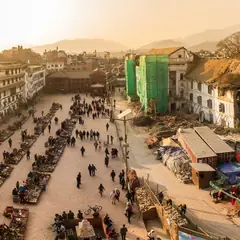
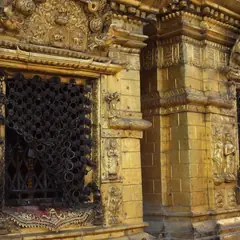
High on the terraces of the east bank line up the 15 Shivalayas, small shrines of Shiva with their linga, beside the visitors’ viewpoint. From here the two roofs of the main pagoda are almost at eye level: gold-covered copper, a gilded pinnacle 23 m 7 cm from the base and four doors lined with silver sheets. Around it, several small temples that fell or were damaged in the 2015 earthquake have been rebuilt, in contrast to the pagoda, which withstood it.
That shine is the thread of the temple’s history. In 1349 the Sultan of Bengal Shamsuddin Ilyas Shah entered the valley with some 20,000 men, drawn by golden temples that travellers believed to be solid gold, and an inscription at Swayambhu records that Pashupatinath was badly damaged. After the sacking, King Jayaarjun Deva dipped into the temple’s treasury to pay for the rebuilding of the devastated city.
Gold made the news again in 2021, when the silver jalahari that collects the water and milk poured over the linga was replaced by a gold one of 96.822 kg. President Bidya Devi Bhandari unveiled it just before the Supreme Court suspended the installation, and in 2023 the anti-corruption commission removed it from the shrine to weigh it. The petitioners alleged that the change violated the 1956 ancient monuments law, and the fate of the surplus gold remains in dispute. The figures that did not add up on that scale are detailed from the terraces.
The forest where Shiva was a deer
Mrigasthali
Summary of this stop
Above the terraces begins the Mrigasthali forest, and with it the legend that gives the place its name. According to the Nepala Mahatmya, Shiva came to the forest of Shleshmantaka, on the banks of the Bagmati, turned into a deer and with Parvati transformed into a doe. Brahma, Vishnu and Indra sought him through the three worlds and, as they tried to hold him by his single horn, it broke into four. Shiva then announced that he would stay there forever as Pashupati, the lord of animals. In Mrigasthali, the idol of Mrigeshwar Mahadev is the only one that represents him as a deer, and deer are still kept in the enclosure.
The surroundings preserve other beliefs. On the hill, during the Bala Chaturdashi round, devotees stop before the Bahira Ganesh, the “deaf Ganesh”, and shake him while shouting at him to carry their message to their dead. Beside the Bagmati, east of the temple, a figure of Virupaksha peeks out half-buried; according to some it is slowly emerging and according to others sinking, and in both cases its movement would mark the end of the world.
The legend coexists with the documented origins of the Licchavi temple and with a devotion that never stops growing. For Maha Shivaratri 2026 the Pashupati Area Development Trust expected at least 800,000 devotees and some 4,000 sadhus from Nepal, India and other countries, with four separate queues to enter. What became of the four pieces of Shiva’s horn is the close of the route.