Buddhist stupa
Swayambhunath Audio Guide (Swayambhu Mahachaitya)
On top of a wooded hill, the so-called monkey temple hides a rock, not relics, under its white dome: the mother stupa of Newar Buddhism has spent centuries being dismantled and remade among Hindu kings and Tibetan lamas.
- 75 min of audio
- Newar Buddhist stupa
- Monkey temple
Swayambhunath is the mother stupa of Newar Buddhism, raised over a rock on the hill that myth places in the lotus of the primordial lake of the Kathmandu Valley. Its foundation has no firm date: the 5th century or earlier is mentioned, and sources disagree on the king. The dome, the harmika with the eyes and the mast add up to more than 25 metres, measurements it reached in the 17th century, when it was enlarged by about a third. Around it crowd Hindu and Buddhist temples, Tibetan monasteries, prayer wheels and the macaques that give it its nickname.
The monument has never been finished. From the 13th to the 19th century it was thoroughly dismantled about twice a century to change the mast, a sal-tree trunk of some 25 metres brought from the Trishuli valley. The kings of Kathmandu, Hindus, held ultimate responsibility for the shrine; the money and the drive were often supplied by Tibetan lamas who came from western Tibet to Bhutan.
Highlights
- Great golden vajra — installed by Pratap Malla around 1668 over twelve calendar animals
- Dome and harmika — over 25 metres of stupa raised on a rock, with no relic chamber
- Pratappur and Anantapur shikharas — two towers from around 1655 bearing the names of the king and his queen
- Shantipur Temple — it held a 170 to 180 metre mural of the Swayambhu Purana
- Hariti Temple — the smallpox goddess whose original image a king destroyed in 1799
According to the Swayambhu Purana, the Kathmandu Valley was once a lake, and on its waters floated a thousand-petalled lotus flower from which an eternal light sprang: Swayambhu, “the self-created one”. The stupa that now crowns the hill, west of the city, was raised, says the legend, to hide that light. The history of Swayambhunath is more earthly and no less intense: a foundation with no firm date (around the 5th century or earlier, depending on the sources consulted), a sacking in 1349, thorough renovations about twice a century, an earthquake in 2015 and new gold on the dome in 2010.
What rises over the hill is the result of centuries of shared labour between Hindu kings, Tibetan lamas and Newar families who still live beside the stupa. The audio guide walks the shrine in six stops, from the top of the eastern stairway to the Hariti temple, with narration documented and checked against historical sources, to read on the spot what stone, gold and closed doors do not tell at first sight.
The valley’s other great stupa is the Boudhanath Stupa, east of the city, and in the centre the Buddhist courtyards of the Newar merchants surround the square of Asan.
A golden thunderbolt at the top of the stairs
Great golden vajra
Summary of this stop
The climb from the east is made by a long stone stairway that crosses the forest, popularly of 365 steps, with three great seated Buddhas at its foot. Legend has it that whoever climbs them in a single breath reaches nirvana, and that the macaques prowling the steps were born from Manjushri’s lice. At the top, the first thing that appears is the great golden vajra, the diamond-thunderbolt of Buddhism, on a gilded copper mandala and a round stone base carved with twelve calendar animals.
The detail is disconcerting: that Buddhist emblem, like the stairway itself, is the work of Pratap Malla, a Hindu king, who installed it around 1668 in front of the Akshobhya chapel. It is not an exception but the key to the whole hill. The kings of Kathmandu held ultimate responsibility for Swayambhu, while Tibetan lamas from regions ranging from western Tibet to Sikkim, Kham and Bhutan often acted as donors and drivers of its renovations. How those two powers fitted together is what the narration unpacks at this first point.
Two towers a king raised without permission
Pratappur and Anantapur shikharas
Summary of this stop
Facing the east side of the stupa rise two towers in the shikhara style. Pratap Malla built them around 1655: the northern one, Pratappur, bears his own name; the southern one, Anantapur, that of his queen Ananta Priya. Their doors stay closed except at special ceremonies.
According to the Rajbhogmala chronicle, the king did not obtain the permission of the “lord of Swayambhu” to raise them and responded by ordering all the temples of the shrine closed for six months. The story of Pratappur did not end there either: cracked by the 2015 earthquake, it was pulled down by the Department of Archaeology in January 2017 and rebuilt to its original form and size. It was its third reconstruction, after a fire and a lightning strike. The dates of the later works do not fully agree among sources, and in March 2025 another renovation of both temples was declared complete.
The eyes that cover a rock
Dome and harmika with the eyes
Summary of this stop
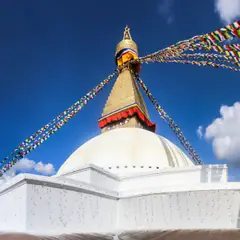
From the east side the stupa shows itself whole: the white dome of almost 8.5 metres, the gilded cubic harmika of about 5 with a pair of painted eyes on each face, the thirteen rings and the final parasol. Set into the dome are the gilded chapels of the Five Buddhas. But several of its hallmarks are less ancient or less solid than they look. The nose-shaped curl between the eyes, derived from the Buddha’s tuft of hair, was not added until the early 20th century. And the whiteness of the dome comes from layers of lime applied again and again: in June 2026 the removal began of a layer accumulated over a decade that reached some 33 centimetres in thickness.
The most surprising thing is inside and cannot be seen. The central mast rests on a rock that protrudes 3.3 metres above the level of the summit, and no historical record mentions relics or a relic chamber. The legend of the lake, the lotus and King Prachandadev, who would have raised the stupa to protect the light from the arrival of the kaliyuga, offers its own explanation of why this dome was made to hide and not to show. The narration tells it in front of those eyes.
A new mast every half century
Prayer wheels on the west face
Summary of this stop
On the west face, beside the prayer wheels that the faithful spin as they walk clockwise around the stupa, and opposite the Drukpa Kagyu monastery, one senses that Swayambhunath is a work that never ends. An inscription found on the stupa itself records that in 1349 the army of the Sultan of Bengal Shamsuddin Ilyas Shah entered the valley and sacked the shrine the next day.
From the 13th to the 19th century, each thorough renovation meant dismantling everything above the dome and opening it up to change the mast, a sal-tree trunk of some 25 metres brought from the Trishuli valley. The one still standing was installed in 1817. Between 1918 and 1921, the complete renovation had as one of its main donors Dharma Man Tuladhar, a Newar merchant who had lived for years in Lhasa, inspired by the Tibetan lama Tokden Shakya Shri. What happened to him in 1931 because of his faith is one of the twists the audio guide reserves for this point.
The closed door of Shantipur
Shantipur Temple
Summary of this stop
North of the stupa, off the usual circuit, a discreet white stucco building holds more than it seems. On the inner walls of the tantric Shantipur temple there was a 170 to 180 metre mural of the Swayambhu Purana, the longest known Buddhist narrative painting, last repainted in 1904 by a Chitrakar family. Only the Buddhacharya priests and the Thakalis may enter; after much of it fell in the 2015 earthquake, the fragments were moved to the National Museum in Chhauni. Its earlier dating is also disputed.
According to tradition, beneath the temple the tantric master Shantikar Acharya, “the Peacemaker”, is still alive; he ended a drought and shut himself in an underground chamber to return when the valley needs him. In 1658, it is told, Pratap Malla forced the entrance to recover the manuscript with which rain was made. What the king found on his descent, according to the popular version, is related by the narration in front of that door, which today only the eldest priest of the Buddhacharya family crosses, twice a month.
The goddess a king declared war on
Hariti Temple
Summary of this stop
Beside the northeast side of the stupa, a temple with tiered roofs is dedicated to Hariti, the mother goddess to whom the Newars pray for the health of their children. The image venerated today dates from the 19th century. The earlier one did not survive 1799: according to documented tradition, when Kantivati, the favourite wife of King Rana Bahadur Shah, died of smallpox despite donations to the goddess, the king desecrated and destroyed the temple, banned her worship and had sick children taken out of the valley under soldiers’ escort. A Newar song still mourns the goddess for that expulsion.
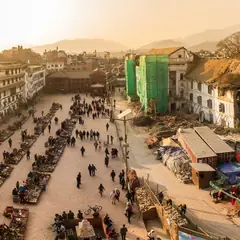
The shrine has kept on resisting. The earthquake of 25 April 2015 damaged the stupa, the chaityas and stone sculptures, and brought down 27 of the houses of the priestly community that lives beside it; its 30 families kept performing the daily rites from tents. Earlier, between 2008 and 2010, more than 100 people had dismantled, restored and regilded with pure gold the vajra, the harmika and the thirteen rings, with 20 kilos of gold paid for, among others, by the Tibetan Nyingma Meditation Center of California. The audio guide closes the route here, with the gold of the dome in view.