Royal square
Kathmandu Durbar Square Audio Guide (Hanuman Dhoka Durbar Square)
In this palace-square Kathmandu received its name, lost its last Malla dynasty in a single night in 1768 and still today asks a child goddess to bless whoever rules it.
- 90 min of audio
- Newar royal palace
- Kumari, the child goddess
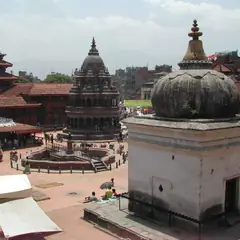
Kathmandu Durbar Square is the complex of the old Hanuman Dhoka royal palace: multi-roofed temples, stone gods and courtyards where the Mallas reigned and later the Shahs. Its name comes from the statue of Hanuman that Pratap Malla placed before the gate in 1672. The 35-metre Taleju temple has dominated it since 1564 according to most sources, and on its southern edge stands the Kasthamandap, the wooden pavilion from which the city takes its name.
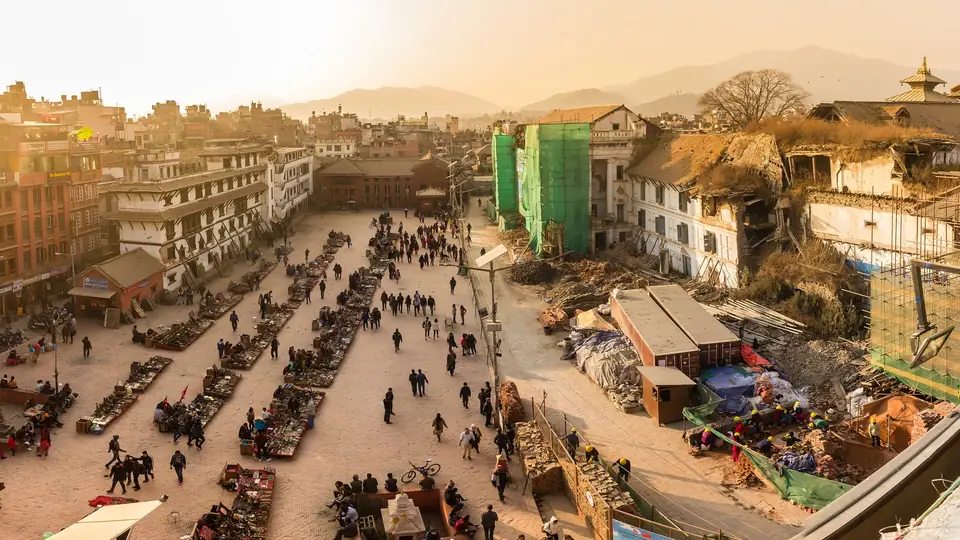
The humblest-looking building on the square is also the oldest: the Kasthamandap is documented in 1143 and the 2016 excavation pushed its foundations back to the 7th century. It collapsed on 25 April 2015, four minutes before noon, in the middle of a blood-donation drive, and a committee of local residents rebuilt it and saw it reopen in April 2022.
Highlights
- Kasthamandap — a wooden pavilion documented in 1143 and rebuilt after the 2015 earthquake
- Kumari Ghar — the house of the child goddess, with a courtyard in the style of a Buddhist monastery
- Kal Bhairav — an idol of about 3 m covered in vermilion, crowned with skulls
- Taleju Temple — 35 m on twelve steps, closed for most of the year
- Nasal Chowk — the courtyard of the Shah coronations and the nine-storey Basantapur tower
On the night of 26 September 1768 the Gorkhali troops of Prithvi Narayan Shah entered the Hanuman Dhoka royal palace and the last Malla king of Kathmandu, Jaya Prakash Malla, fled to Lalitpur. From that night until 2008 the city was the capital of the Shah dynasty, and Kathmandu Durbar Square was the stage of its coronations, its festivals and some of its massacres: in September 1846, in the courtyard of the Kot, the palace arsenal, Jung Bahadur Kunwar and his brothers killed between 30 and 40 courtiers, officers and guards, and opened 105 years of rule by the Rana prime ministers.
The history of Kathmandu Durbar Square is often stretched back to the 3rd century or the Licchavi era, although the oldest surviving wing of the palace dates to the mid-16th century. Its architecture mixes the wood and Newar brick of the Mallas with the white neoclassicism of the Ranas, and much of what is seen has been raised again since the 2015 earthquake. The route runs from the pavilion that named the city to the courtyard of the coronations, and the audio guide, documented and checked against historical sources, explains what to see at the square stop by stop, along with the rites still celebrated in it.
Its rival twin lies to the south, at Patan Durbar Square, capital of the valley’s other Malla kingdom. From the square, the old diagonal of the caravans leads in a few minutes to Asan, and the last chapter of the Shahs is told at the Narayanhiti Palace.
The pavilion that named Kathmandu
Kasthamandap
Summary of this stop
The Kasthamandap is a large three-storey wooden pavilion-rest house beside the Maru bazaar, with a shrine to Gorakhnath inside. Kathmandu takes its name from it. It was attributed to King Laxmi Narsingh Malla in the 17th century, but a manuscript kept in the Tibetan monastery of Sakya already mentions it in 1143, and the 2016 excavation by the Department of Archaeology and Durham University pushed its foundations back to the 7th century. Whether it was then as large as it still is today is a matter of debate.
On 25 April 2015, four minutes before noon, the pavilion collapsed during a blood-donation drive and killed 10 donors. Part of its fragility came from a hasty cement repair in 1960, made for the visit of Queen Elizabeth II, which left a keystone badly placed and buried beams that ended up rotten. The rebuilding was not simple either: the first contractor used cement and iron rods, there were protests from residents and the work passed to a citizens’ committee of 55 members. President Bidhya Devi Bhandari inaugurated it in April 2022.
According to tradition, the Kasthamandap was made from a single tree. The tests carried out during the reconstruction found timber of four species in its beams and a carved piece with a lion’s face that Durham University dated to the 5th century. Where the new wood came from, without deliberately felling a single tree, is one of the paradoxes the narration tells while looking at those beams.
A child goddess facing the royal balcony
Kumari Ghar
Summary of this stop
On the southern edge of the square stands the Kumari’s house, three storeys high, with carved windows and an inner courtyard in the style of a Buddhist monastery. It was built by Jaya Prakash Malla, the last Malla king of Kathmandu, who in 1756 instituted the Kumari’s chariot procession during Indra Jatra; the foundations of her residence, Kumari Chowk, were laid in 1757. It is the only chariot procession in the valley that leaves from and returns to the same point, Basantapur.
The square still works as the stage of that living ritual. Every Indra Jatra the Shah king bowed before the child goddess and received from her the tika that renewed his legitimacy. Since the abolition of the monarchy in 2008, the ceremonial role has been filled by the president of Nepal, and since 2012 the Kumari’s chariot has been pulled only by women on the third day of the festival.
Opposite, the white façade of the Gaddi Baithak breaks with the wood and brick. It is the neoclassical hall of about 9 by 37 metres that Prime Minister Chandra Shamsher Rana built in 1908, the year of his trip to Europe, in place of an 1847 hall with Mughal ornamentation; from its balcony the royal family watched Indra Jatra. Its restoration after the earthquake also had critics, and the narration explains why.
Kal Bhairav, the god before whom no one lied
Kal Bhairav
Summary of this stop
The idol of Kal Bhairav, the terrible form of Shiva, is a block of black stone about 3 metres tall covered in vermilion, with a garland of heads, a crown of skulls, a trident and a sword, flanked by two lions. It is dated to around 1640, in the reign of Pratap Malla. Two versions circulate about its origin: one says it was found in a rice field and the king moved it to the square; the other, that it turned up in pieces while a canal was being dug towards the palace and stayed outside because, once assembled, it would not fit through the doors.
According to tradition, suspects were judged before this god. They had to touch the idol’s feet and declare their guilt or innocence in the presence of the court officials, whose office stood on the site of today’s Metropolitan Police building. Whoever lied was said to die vomiting blood. The offerings and incense around it today show that the worship has never been interrupted.
Taleju, the goddess who is not seen
Taleju Temple
Summary of this stop
The Taleju temple is the tallest building on the square: 35 metres above a plinth of twelve steps, with small temples around it and doors guarded by stone lions. Mahendra Malla built it for the dynasty’s tutelary goddess, in 1564 according to most sources, although Nepal’s official tourism website gives 1549. It stays closed for most of the year: devotees enter only on Mahanawami, the ninth day of Dashain, when the palace also hosts mass sacrifices.
In the palace stands Mohan Chowk, the residential courtyard that Pratap Malla built in 1649 and that set a dynastic rule: only the prince born in it could inherit the throne. When Jaya Prakash Malla, born outside Hanuman Dhoka, was crowned, several nobles protested. A jewel from the temple, the necklace bearing Pratap Malla’s name, ended up far from here, at the Art Institute of Chicago, and Nepal is demanding its return.
From the closed temple comes, according to the most-told legend, the origin of the Kumari: the goddess appeared at night to Jaya Prakash Malla to play dice with him and advise him, on the condition that no one should know. What broke the pact and what the goddess announced as she left is kept for the narration in front of her door.
The gate signed by Pratap Malla
Hanuman Dhoka
Summary of this stop
In 1672 Pratap Malla placed before the palace’s main gate the stone statue of Hanuman that gave the complex its name, Hanuman Dhoka, “Hanuman’s gate”. Today it is wrapped in red cloth, under a parasol and with its face unrecognisable beneath layers of red paste. To its left, in 1673, the same king erected a stone Narasimha disembowelling the demon Hiranyakashipu; according to its own inscription, he commissioned it out of fear of having offended Vishnu by dancing disguised as Narasimha.
On the palace’s white outer wall, a long, low slab with a spout in the middle brings together characters from several scripts: Pratap Malla had it engraved in 15 languages, among them Greek, French and Persian, as a fountain for travellers. One source dates it to 1654 and another to 1664. A popular belief circulates about it, with a prize that no one has ever collected, and the narration tells what it consists of and why it remains only partly deciphered.
The courtyard where the throne changed dynasty
Nasal Chowk coronation platform
Summary of this stop
Behind the Hanuman gate opens Nasal Chowk, the palace’s largest courtyard, surrounded by carved façades. It replaced the narrow Mul Chowk as the stage for the coronations of the Shah kings: Birendra was crowned in 1975 on the central platform, and the practice continued until 2001. In a gallery on the east wall, the gilded image of Maha Vishnu is still on view without the temple it lost in the 1934 earthquake.
The fall of the Mallas is concentrated here. Prithvi Narayan Shah’s troops took the palace on the night of 26 September 1768, and the salvoes that celebrated the victory the following morning ended in tragedy for one of his commanders. On the south side rises the nine-storey Basantapur tower, the Nautalle Durbar that Prithvi Narayan Shah himself raised after the unification, with struts carved with erotic figures. It lost its upper floors in 2015, and a Chinese team from Hebei province took on its restoration in November 2016 and handed it over to Nepal after an eight-year project. How the throne changed hands that night is told in the middle of the courtyard.