Buddhist stupa
Boudhanath Stupa Audio Guide
A white dome with painted eyes in northeast Kathmandu: a stop for Tibetan caravans for centuries, the heart of the Tibetan exile since 1959 and regilded by its own faithful, with no state money, after the 2015 earthquake.
- 60 min of audio
- Tibetan Buddhist stupa
- UNESCO heritage
The Boudhanath Stupa, a UNESCO World Heritage Site since 1979, rises on the old trade route between Tibet and India. Newar chronicles mention a stupa at this spot as early as the 5th century, but the present structure was most probably raised in the 14th. Tibetan sources attribute the visible dome to the reconstruction by the master Shakya Zangpo in the early 16th century; the thirteen-step spire and the golden parasol were added much later, between the 18th and 19th centuries.
Its name also has layers. The Newars called it Khasti Mahachaitya, “great stupa of the dewdrops”; the Tibetans, Jarung Khashor or Chorten Chenpo, “the great offering support”. “Boudhanath” is a Sanskritised name that took hold in the 1960s. And its gold is recent: after the 2015 quake, Buddhist groups and volunteers gathered more than 2 million dollars and 31 kilos of gold without a single government fund.
Highlights
- Buddha's eyes — four pairs painted on the tower, one facing each cardinal point
- Jung Bahadur Rana's prayer wall — hundreds of copper wheels along the kora
- Three mandala platforms — stepped terraces up to the foot of the dome
- 13-step pinnacle — covered with 31 kg of gold donated after the 2015 earthquake
- Ajima shrine — the protector of the stupa, facing the north entrance
For centuries, Tibetan merchants heading down towards India entered the Kathmandu Valley through Sankhu and stopped to pray before a great white dome. In the mid-20th century, pilgrims from India, China and Nepal arrived in autumn and spent the whole winter beside it, waiting for the snowbound mountain passes to open. After 1959 other travellers came who never left: the refugees of the Tibetan uprising, who made Boudha a small homeland of exile and raised more than 50 gompas and monasteries around it.
The history of Boudhanath mixes chronicles of Licchavi kings, biographies of lamas and legends that do not agree on who founded it. It joined the UNESCO World Heritage List in 1979; the earthquake of 25 April 2015 cracked its spire, and on 22 November 2016 it was the first World Heritage monument in the valley to reopen rebuilt after the quake. The route circles the dome with the faithful, clockwise, and climbs the platforms to the foot of the golden pinnacle. The audio guide, documented and checked against historical sources, separates in five stops what the documents say from what tradition says.
Its natural partner is Swayambhunath, the mother stupa of Newar Buddhism, on the western hill, and less than two kilometres away lies the Pashupatinath Temple, the great shrine of Shiva on the banks of the Bagmati.
Eyes above the dewdrop dome
White dome and Buddha's eyes
Summary of this stop
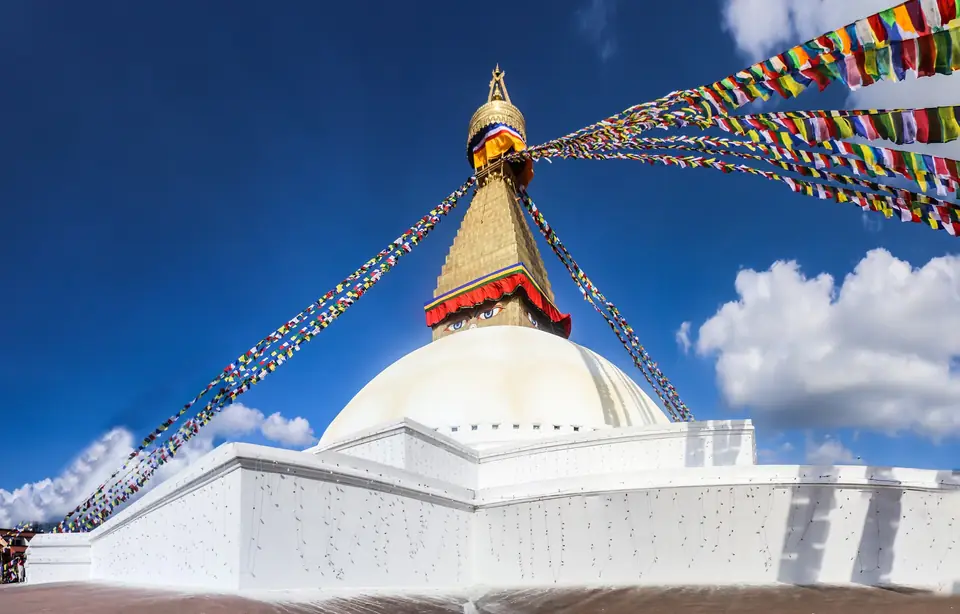
On entering the circular square, the first thing that imposes itself is the gaze: four pairs of eyes painted on the sides of the golden tower, one for each cardinal point, with a question-mark-shaped sign in place of a nose and a third eye above. Below opens the great whitewashed hemisphere, which sometimes shows stains or yellow arcs. It is no neglect: at the start of Saka Dawa, the fourth month of the Tibetan calendar, saffron water is thrown over the dome, as was done in June 2014. From the top the prayer flags descend in four directions, and in December 2021 they were replaced by biodegradable cotton flags.
The original Newar name, Khasti Mahachaitya, means “great stupa of the dewdrops”, and a Newar legend explains it. An ancient king of Kathmandu made a pond whose three stone spouts gave no water; the oracles demanded the sacrifice there of a man with the thirty-two virtues, and the prince who carried out the order discovered afterwards that the victim was his own father. To atone for it, according to the tale, the goddess Bajra Yogini told him to raise a shrine to the Buddha where a white bird alighted.
But the drought was such that there was no water to knead the clay and the sand. How it was solved, and what the older women of Boudha still tell about the origin of this dome, is what the narration reserves for this first point.
Copper wheels on the Tibet route
Prayer wheel wall
Summary of this stop
The kora, the ritual circuit of the stupa, runs beside the high prayer wall that surrounds the base, with hundreds of copper wheels and small images in niches that the faithful spin as they pass. That continuous rattle is the sound of a trade route: Boudha rises on the old road between Tibet and India, and Tibetan merchants have prayed here for centuries. The wall was paid for by Jung Bahadur Rana, Nepal’s first maharaja prime minister.
The arrival of the stupa’s guardians is also linked to Jung Bahadur, although the beginning of that story has two versions. According to the family account, the first Chiniya Lama was a monk from Sichuan who had come to meditate in a cave near Pashupati, and Jung Bahadur, who was preparing the invasion of Tibet, had him arrested as a Chinese spy; once convinced of his innocence, he entrusted him with the care of Lumbini, Swayambhu and Boudha. Another version presents him as an abbot already settled at Boudha, who was called in as interpreter. What is documented is that in March 1856, when the peace treaty with Tibet was signed at Thapathali, the Chiniya Lama Taipo Shing acted as interpreter and mediator, received the abbey of Boudha and married a daughter of Jung Bahadur and of a Tamang wife from Helambu.
His lineage ended up looking after Boudha alone and still watches over the stupa, although today the post is appointed by the Guthi Sansthan. How a suspected spy became custodian of the great stupa is told with the wheels turning alongside.
The ring of houses that exile brought
Ring of houses and monasteries
Summary of this stop
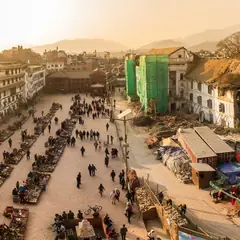
Around the square, a continuous circle of buildings encloses the stupa, and above them peek the golden roofs of the gompas, such as Shechen Tennyi Dargyeling, founded by Dilgo Khyentse Rinpoche. That landscape is recent. Before 1959 the only monastery beside the stupa was the domestic chapel of the Chini Lama, who supervised the ritual bathing of the dome and the hanging of the flags. With the Tibetan refugees came the so-called Mongol Lama, who founded his monastery “a stone’s throw” away, and the two proclaimed themselves representatives of the Dalai Lama. Between the late 1960s and the 1990s, the diaspora raised more than 50 gompas and monasteries in Boudha, besides workshops, shops and guesthouses.
The price of that growth is in the façades. In 1979 the ring counted some 88 historic buildings; in 1993 there were 27 left and in 1998 only 15. The concrete that replaced them led the World Heritage Committee to consider placing the valley on the Danger List, and today only a few traditional façades survive.
In this current of faithful turning always in the same direction there is also room for a dark and recent episode, which took place on Losar, the Tibetan new year, in 2013. What happened that morning, and what occurred weeks later with a body that nobody ever identified, is told at this point with the caution demanded by a story never fully cleared up.
The chicken keeper who founded the stupa
Ajima shrine
Summary of this stop
Facing the north entrance, the main one, stands the small shrine of the protector Mammo Pukkasi, whom the Newars call Hariti or Ajima. On its back wall, a painting shows Samvari tending ducks beside a pond. Before the stupa, devotees leave flowers, grains of rice and bottles of mineral water every morning, renewed daily: they continue an offering of fresh spring water from when Boudha was surrounded by fountains, wells and ponds.
The woman in the painting points to the Tibetan foundation legend. According to the Tibetan history of the stupa, a low-caste woman who raised poultry in the valley, Jadzima, “she who tends hens”, set up her four children with her earnings and, with what was left over, asked the king for land for a great stupa. The king said “jarung”, “let it be done”. From that permission, and from what happened when the rich of the court wanted it withdrawn, comes the Tibetan name Jarung Khashor.
The chronicles tell something else. The Gopālarājavaṃśāvalī, an early chronicle of the valley, attributes the foundation to the Licchavi king Śivadeva (c. 590–604), whom an inscription links to the place; other Nepali chronicles take it back to the reign of Mānadeva (464–505). And in the early 16th century, the master Shakya Zangpo came to Nepal looking for the stupa and found only an abandoned mound; his restoration probably gave it its present size. Three origins for the same dome, and a smaller stupa a few kilometres away, at Chabahil, whose Tibetan nickname holds the last detail of this stop.
Thirty-one kilos of the faithful’s gold
Golden 13-step pinnacle
Summary of this stop
From the upper platform, reached by the north entrance, the stupa reads vertically. The three stepped terraces narrowing towards the dome draw, seen from above, a mandala. Above rise the white hemisphere, the tower of the eyes and, at the very top, the thirteen-step pyramid with the golden parasol. The dating of Boudhanath’s architecture remains in debate: general historiography places the present structure in the 14th century, while the line based on Tibetan sources attributes the rounded dome to Shakya Zangpo’s reconstruction in the early 16th. The spire and the parasol came much later, between the 18th and 19th centuries.
The gold at the top is almost new. The earthquake of 25 April 2015 badly cracked the spire and everything above the dome had to be dismantled. On 22 November 2015 a new “tree of life”, the central mast, loaded with consecrated relics, was inserted, and the stupa reopened exactly a year later. The work was paid for without government funds: Buddhist groups and volunteers organised by the Boudhanath Area Development Committee gathered more than 2 million dollars and 31 kilos of gold, which cover the pinnacle and its 13 steps. Prime Minister Pushpa Kamal Dahal inaugurated it.
Not everyone celebrated without reservations: UNESCO said it had not been consulted and feared that the new concrete platform at the top was too heavy. How the spire was remade and what that work says about who feels the stupa to be theirs closes the route.