Royal palace and museum
Narayanhiti Palace Audio Guide (Narayanhiti Palace Museum)
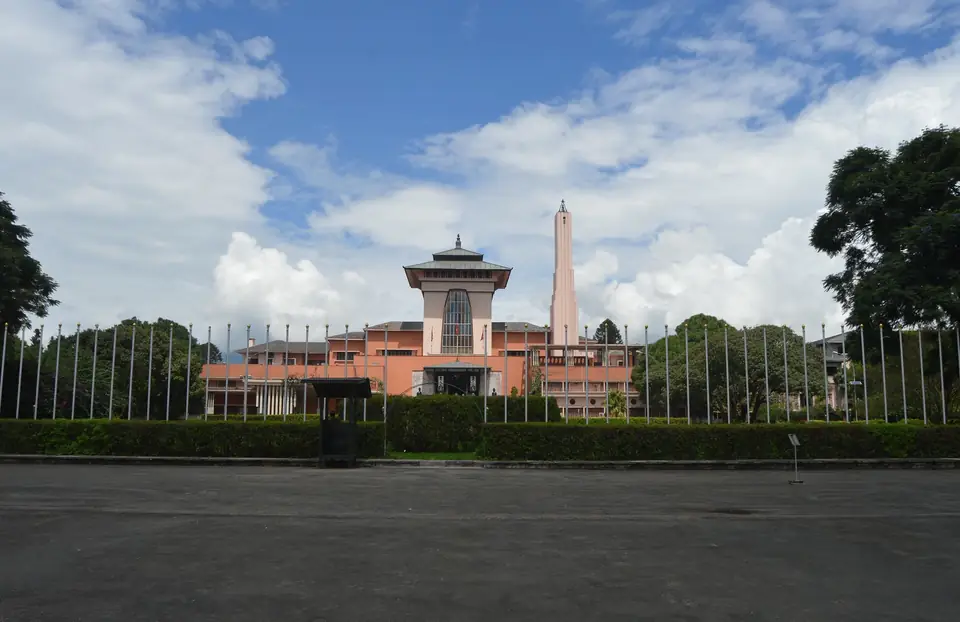
A pink concrete palace with a pagoda roof, designed to proclaim Nepal's independence, where its last kings lived and which since 2008 has been the museum of the republic that abolished the monarchy.
- 75 min of audio
- Nepal's last monarchy
- 2001 royal massacre
The Narayanhiti Palace was the home of the Shah dynasty to the end. King Mahendra had the Rana palace on the site demolished and commissioned the present one from the Californian architect Benjamin Polk, who raised it between 1964 and 1970 with a reinforced concrete and steel structure. Polk wanted the great throne hall and the even taller temple spire to express Nepal's will to remain independent of its two giant neighbours.
The name does not come from a king, but from a water spout: it joins Narayana, an epithet of Vishnu, with the Newar word “hiti”. In front of the Narayan temple that stone spout still stands, and according to a documented tradition two of its mouths have looked backwards since a prince killed his father without knowing it. In front of the palace of a dynasty that ended in a family massacre, the coincidence weighs heavily.
Highlights
- Stone spout and Narayan temple — the Newar hiti that gives the palace its name
- Gorkha Baithak — the throne hall under a pagoda roof on four columns with nagas
- Kaski Sadan — a reception hall with two stuffed Bengal tigers
- The Shah crown — a bird-of-paradise plume behind bulletproof glass
- Site of the Tribhuvan Sadan — the billiard room of the 2001 massacre, seen through a window
The history of Narayanhiti begins long before the pink palace that closes the axis of Durbar Marg. Around 1794 this site was the Kirti Mandir, the residence of the kaji Dhokal Singh Basnyat, with a Narayan temple raised beside it out of devotion by his mother, Surprabha. In the Kot massacre of 19 September 1846, Prime Minister Fateh Jung Shah, who lived here, was killed. The house passed to Ranodip Singh Kunwar, brother of Jung Bahadur Rana, who turned it into a palace of several wings and was assassinated in its south wing during the coup of 22 November 1885. Sources do not fully agree on the dates of origin, nor on those of the present building.
In 1886 Bir Shumsher pulled down the old house and had a new palace built for the king, his son-in-law. The 1934 earthquake damaged it and killed two young daughters of King Tribhuvan; the repair added a portico and a grand staircase. In the 1960s Mahendra replaced it with the present one. Here the 1990 Constitution was promulgated, here King Birendra, Queen Aishwarya and other relatives died on 1 June 2001 and from here the last king left at night, escorted, on 11 June 2008. Four days later Prime Minister Girija Prasad Koirala inaugurated the museum, which opened to the public on 26 February 2009.
The history of the Narayanhiti Palace Museum is best read room by room, because each one holds a different scene from the end of a monarchy. The audio guide, documented and checked against historical sources, walks the grounds from the spout at the entrance to the foundations that remain behind the palace.
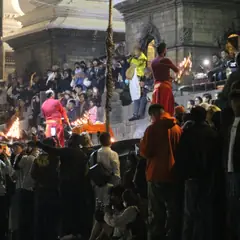
The kings who lived here were crowned in the courtyard of Nasal Chowk, at Kathmandu Durbar Square, and cremated at the Aryaghat of the Pashupatinath Temple.
The spout that named the palace
Narayanhiti stone spout
Summary of this stop
East of the main entrance, facing the Narayan temple, a traditional stone spout is preserved. It is the origin of the place name, which was fixed in the time of Prime Minister Bir Shumsher: “Narayanhiti” joins Narayana, an epithet of Vishnu, with “hiti”, the Newar word for a water spout. Some guides translate it as “house of Vishnu”, a folk etymology that the spout itself refutes. The neighbouring temple was born of the devotion of Surprabha, mother of the kaji who lived in the first house on the site.
A documented tradition weighs on the spout. In the time of the Licchavi king Dharmadev, the spouts of Kathmandu stopped flowing, and the astrologers decreed that only the sacrifice of a man with the thirty-two signs of perfection would bring the water back. In the kingdom only the king and his son, Manadev, had them. Dharmadev decided to offer himself, and the legend tells what happened that night and why two spouts of Narayanhiti still look backwards.
On the spout there are three inscriptions, one from the Malla era, but none Licchavi: the stone does not confirm the legend, although it has not erased it either. The end of that night, and what the spouts refused to see, is told right there.
A concrete pagoda facing two giants
Narayanhiti Palace Museum
Summary of this stop
Facing the Gaurishankar Gate, today the museum’s only entrance, the visitor has before them the pink brick façade, the stepped pagoda roof over the throne hall and, on the right, the tallest spire crowning the temple built into the palace. Where that façade stands there was once another palace: the one the architect Jogbir Sthapit raised in 1886 for King Prithvi Bir Bikram Shah, son-in-law of Bir Shumsher. With it the royal residence left the Hanuman Dhoka of the old city and came under the tutelage of the Ranas.
The architecture of the Narayanhiti Palace Museum is Mahendra’s answer to that history. He had the Rana palace demolished and summoned from Calcutta the Californian Benjamin Polk, who wrote that the throne hall and the temple spire should express Nepal’s will to remain independent of its two giant neighbours. The work, according to the most-cited chronology, lasted from 1964 to 1970, with a reinforced concrete and steel structure.
The façade was to be marble and ended up clad in “Chinese” brick made in Nepal; some architects compared it to a railway station. The palace did not even have an inauguration of its own: it debuted within the wedding celebrations of Crown Prince Birendra, in early 1970.
Tigers in the hall, districts on the doors
Bengal tigers of the Kaski Sadan
Summary of this stop
The Kaski Sadan, the reception hall, greets the visitor with two stuffed Bengal tigers in an attacking pose, shot by Mahendra and Birendra, and with the grand staircase flanked by portraits of the Shah monarchs. Here the king received foreign heads of state and the credentials of ambassadors, and swore in the heads of constitutional bodies.
Each room is named after a district of Nepal. Gorkha held the throne; Myagdi, Parbat, Rukum, Rolpa, Dailekh or Baitadi had other protocol uses, and today they fill with diplomatic gifts and photos of official visits. In the Dhanusha room, where the tika was applied on the day of Vijaya Dashami, hang two group portraits of the royal family signed below by all its members, one on each side of 2001 on the calendar.
Court tradition also keeps an uncommon custom of hospitality, tied to the Dhankuta Baithak, the king’s bedroom inside the palace. What the monarch did when a state guest spent the night here, and why the last king broke that custom, is part of the narration in this room.
The throne under the pagoda and the room that spied
Gorkha Baithak
Summary of this stop
The Gorkha Baithak occupies the centre of the palace, above the Kaski Sadan. Its pagoda-shaped roof rests on four concrete columns with nagas, among figures of the Ashta Matrika and Ashta Bhairava and under a great chandelier. Here royal edicts were proclaimed, and here King Birendra, seated on the throne, promulgated the 1990 Constitution, the year 2047 of the Nepali calendar.
To the right of the throne hall opens the Dolpa Sadan, a secret room. From it, members of the royal family who had no permission to attend watched unseen the special ceremonies of the Gorkha Baithak. It is the point where the palace lets protocol be seen from the inside: who could be in the room and who could only watch it, and which ceremonies were followed from that hiding place is what the narration reveals beside the throne.
A feathered crown behind bulletproof glass
Shah crown in the Surkhet and Rupandehi rooms
Summary of this stop
In the Surkhet and Rupandehi rooms, behind a bulletproof display case with an alarm, are shown the Shah crown with its bird-of-paradise plume, the queens’ tiara, the sceptre, the sword and the shield. The crown was nationalised in 2008, but was not shown to the public until 15 October 2018. According to the director general of Archaeology it carries 723 diamonds and 2,372 pearls, although another account gave different figures. It was modified for Birendra in 1971 and last worn by Gyanendra.
The end of that story is well known: the Constituent Assembly abolished the monarchy on 28 May 2008, and on 11 June Gyanendra and his wife Komal left the palace at night, escorted. The beginning is less well known. According to a documented tradition, in November 1950 a family picnic served as cover for King Tribhuvan to escape the tutelage of the Ranas, and only his three-year-old grandson stayed behind in the palace.
That child was Gyanendra. What the Ranas did with him as soon as the throne was left empty, and how that flight ended in a proclamation of democracy, is told in front of the crown.
The window onto the billiard room
Site of the Tribhuvan Sadan
Summary of this stop
Behind the palace remain the brick foundations of the Tribhuvan Sadan, with signs marking where each room was. On 1 June 2001, during the monthly family dinner, Crown Prince Dipendra fired in the billiard room at his family and killed King Birendra, Queen Aishwarya and other relatives. Proclaimed king while he lay in a coma after shooting himself, he died three days later, and the crown passed to his uncle Gyanendra.
The story of that night remains disputed. Sources count nine or ten dead of the family, depending on whether Dipendra is included. The official commission named him as the perpetrator, but several details fed conspiracy theories that have never been proven. Nor is there agreement on who ordered the building demolished: the Tribhuvan Sadan was razed around 2005, and in 2015 part of it was rebuilt. Today one looks through a window at the recreated billiard room, with its table and its seats around the rug.
On the east side of the grounds, facing the palace of the abolished monarchy, stands the Ganatantra Smarak, the monument to the republic whose first stone was laid by Maoist Prime Minister Baburam Bhattarai on 27 March 2012, after changing site four times. How those two buildings dialogue, and what stands of that night near the foundations, closes the route.