Newar royal square
Patan Durbar Square Audio Guide
The royal square of Lalitpur, the Malla kingdom that split from Kathmandu in 1619: a palace of courtyards turned into a museum facing a row of stone, brick and wooden temples that earthquakes brought down and Newar craftsmen raised again piece by piece.
- 90 min of audio
- Newar architecture
- Rebuilt after 2015
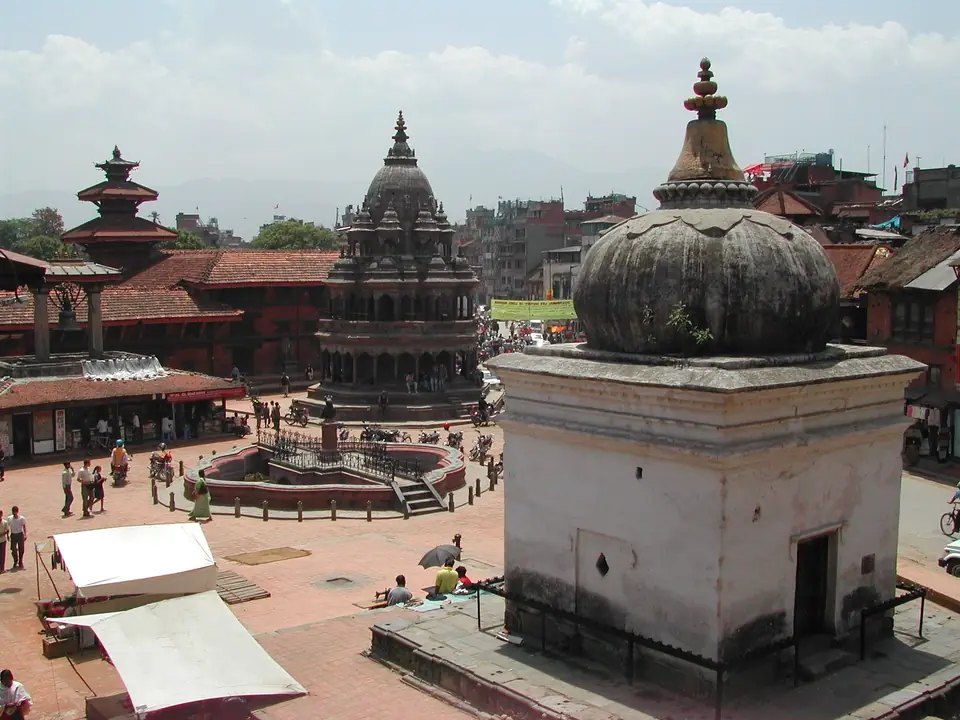
Patan Durbar Square was born of a family rupture. In 1619, on the death of Shiva Simha Malla, his grandson Siddhi Narasimha Malla declared Patan independent of Kantipur, the Kathmandu kingdom ruled by his own brother. His descendants reigned here until 1768, and the square they left is their showcase: the stone Krishna Mandir, the pillar of King Yoganarendra Malla, a row of brick and wood pagodas and, opposite, the palace whose courtyards now form the Patan Museum.
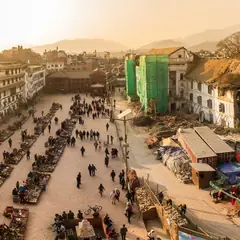
The April 2015 earthquake brought down the Hari Shankar temple, which had withstood those of 1809, 1833 and 1934, and left the Char Narayan reduced to its plinth. The reconstruction of the Hari Shankar took four years, sorted about 2,000 pieces and reused 90% of the original material. From the rubble of both temples came 162 carved arms of gods, and the 102 that found no place are displayed inside the museum.
Highlights
- Krishna Mandir — a stone temple with 21 golden pinnacles and friezes from the Mahabharata and the Ramayana
- Yoganarendra Malla pillar — some 8 m of stone with the gilded copper king and his two wives under a cobra
- Hari Shankar Temple — a three-roofed pagoda rebuilt from about 2,000 pieces and 90% of its original material
- Tusha Hiti — the stepped well of Sundari Chowk with 72 stone deities on its walls
- Manga Hiti — a sunken fountain with makara spouts dated to AD 570
Patan, today’s Lalitpur, shares a valley with Kathmandu and for a century and a half was its rival. In 1619 Siddhi Narasimha Malla broke with his brother Lakshmi Narasimha Malla, king of Kantipur, and turned Patan into a kingdom of its own. The history of Patan Durbar Square starts there: a court that needed to prove it was no less than Kathmandu’s raised in front of its palace a stone temple without precedent in Nepal, a ceremonial well lined with gods and the column of a king who, according to legend, is still alive.
That competition ended in 1768. After a long siege and secret pacts with the nobility, the Gorkhali troops of Prithvi Narayan Shah took Lalitpur; the Malla kings of Lalitpur and Kathmandu fled to Bhaktapur, and the victors sacked the city and dismantled the palace. Two centuries later, the courtyard of Keshav Narayan Chowk opened in 1997 as the Patan Museum, after a restoration led by the Austrian architect Götz Hagmüller, and in 2017 Sundari Chowk, which had been a prison and a land registry office, was added.
In front of the palace there also hangs a great bell placed in 1736 by King Vishnu Malla and his wife Chandra Lakshmi. Tradition says any citizen could ring it to bring a complaint to the king, and it is said that in April 2015 it rang by itself. The route runs from north to south, from a 6th-century fountain to the temples rebuilt after the earthquake, and ends inside the palace. The audio guide, documented and checked against historical sources, follows that row of temples stop by stop.
The rival kingdom, Kantipur, was ruled from Kathmandu Durbar Square, some four kilometres to the north, and a few minutes from it the crossroads of Asan keeps the market of the old Tibet route.
6th-century spouts for a 17th-century kingdom
Manga Hiti
Summary of this stop
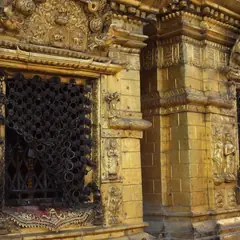
The route starts at the northern end, at the edge of the Manga Hiti, a sunken fountain with a cross-shaped pool and three stone spouts in the form of makara, the water monster of Hindu and Buddhist iconography. It is dated to AD 570, and above it rise the two wooden pavilions of the Mani Mandap. Opposite stands the temple of Bhimsen, god of the Newar merchants, with three joined golden windows and a doorframe of repoussé copper; it is closed to tourists.
The contrast gives the measure of the square. When Siddhi Narasimha Malla declared his independence in 1619, this fountain had already been giving water for over a thousand years. The new kingdom built its showcase around a place that was already ancient, and did so with Kathmandu, ruled by his brother, in mind.
What this fountain has to do with a night of theatre in which an actor falls unconscious, and why tradition needs it to wake him, is something the narration tells at this very edge.
A stone temple among brick and wood
Krishna Mandir
Summary of this stop
On the west side of the square rises the Krishna Mandir, a shikhara-style temple of dark stone with chhatri pavilions and 21 golden pinnacles. According to the most-cited date it was completed by Siddhi Narasimha Malla in 1637, although other sources give 1667 or 1693. Next to its brick and wood neighbours, the carved stone makes it the first temple of its type in Nepal. Over the pillars of the first floor, a frieze narrates episodes of the Mahabharata; over those of the second, scenes of the Ramayana. In front, Garuda kneels with crossed arms on a column, looking at the door.
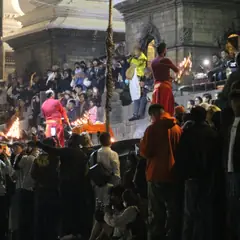
Popular legend places its origin in a dream: the king would have seen Krishna and Radha standing before the palace and ordered the temple built on that spot. Every year, in the Nepali month of Bhadra (August-September), the temple is the centre of Krishna Janmashtami, Krishna’s birthday, with devotees from all over Nepal keeping vigil past midnight.
The platform opposite, the Kartik Dabali, hosts every month of Kartik the Kartik Nach, the Newar dance-theatre that, according to tradition, Siddhi Narasimha Malla himself instituted and composed in 1641. Its most awaited night is that of Narsingha, the man-lion. What happens when, past midnight, the palace’s golden door opens is left for the narration.
A copper king still waiting to return
Yoganarendra Malla pillar
Summary of this stop
In front of the palace, a stone pillar of some 8 metres holds King Yoganarendra Malla in gilded copper, kneeling on a lotus between his two wives, beneath the hood of a great naga and armed with two swords and a shield. He faces east, towards the Degu Taleju temple. Sources do not agree on its date: Nepali Times gives 1693 and other guides, 1700.
The April 2015 earthquake knocked down the statue, which was left bent at the neck and waist. Instead of casting a new one, the Kathmandu Valley Preservation Trust and conservators from Vienna fitted it with a steel skeleton; the pillar was raised again in 2016, and the king and his wives returned to the top in 2017.
On the cobra’s head sits a small brass bird. Tradition links it to a promise the king made to his subjects, to a palace door that is never closed and to the stone elephants of the Vishwanath temple, which still show the cement patches of a bad repair after 1989. In 2015 the bird was lost in the rubble. What it means that it is still up there is revealed by the narration at the foot of the pillar.
Two thousand pieces for a fallen temple
Hari Shankar Temple
Summary of this stop
The Hari Shankar temple, a three-roofed pagoda built in 1706, survived the earthquakes of 1809, 1833 and 1934, and collapsed almost completely in 2015. Its reconstruction took four years: the craftsmen sorted about 2,000 pieces and reused 90% of the original material.
Inside, the image of Hari Shankar, a metre and a half tall with eight arms, split diagonally at the waist. As a broken statue cannot receive worship, the sculptor Amar Shakya carved a replica, and today the repaired original and the new one share the shrine. Very close by, the Char Narayan, begun in 1563 and the oldest major temple on the square, fell down to the plinth and was remade on it; twelve of its carved struts show Krishna as a herdsman.
At the edge of the square, the Bhai Dega tells another story of reconstruction. It is the only temple not commissioned by a king but by an enriched commoner, Bhagirath Bhaiya, who dedicated it to Shiva-Vishwanath in 1687. After the 1934 earthquake the Ranas rebuilt it with a Mughal stucco dome at less than half its size, and in January 2015 its return to the original pagoda began, guided by the drawings of Henry Ambrose Oldfield. What happened to the 162 arms of gods rescued from the rubble, and where those that found no place ended up, is explained in front of the Hari Shankar.
72 gods around a dry well
Tusha Hiti
Summary of this stop
The finale is inside the palace. The entrance of Sundari Chowk is guarded by Hanuman, almost unrecognisable under layers of orange paint, Ganesh and Narsingha tearing apart a demon. In the middle of the courtyard sinks the Tusha Hiti, an octagonal stepped well surrounded by stone serpents: three rows with 72 sculptures of deities line its walls and, on its axis, stands a miniature replica of the Krishna Mandir. Today it is dry, and its gilded copper spout is a replica of the one stolen in 2010.
The most-cited dating attributes the commission to Siddhi Narasimha Malla around 1647, although there are sources that give 1642, 1627 or 1626. Its use is also disputed: it is often called a “royal bath”, but some historians deny it, because bathing among so many divine images would be sacrilegious, and interpret it as a place of ritual ablutions. In 1974 Pier Paolo Pasolini shot a scene of “Arabian Nights” here.
This courtyard was a prison and a land registry office before opening to the public in 2017. Why, according to tradition, the king had a second miniature Krishna Mandir carved at the bottom of the well is the last story of the route.