11th-century cathedral
Bagrati Cathedral Audio Guide
The cathedral with which Bagrat III celebrated the unification of Georgia bears the year 1003 in the oldest Arabic numerals in the country. Blown up in the 17th century, it stood roofless for three centuries and in 2012 regained its dome at the price of its UNESCO status.
- 45 min of audio
- Medieval Georgian architecture
On top of Ukimerioni Hill, above Kutaisi and the Rioni valley, Bagrati Cathedral was the great stage of newly unified Georgia. Bagrat III, its first king, raised it in the early 11th century, when Kutaisi was the capital of the kingdom, and to consecrate it he gathered the neighbouring rulers, the bishops, the abbots of every monastery and the nobles of the land. It later became a coronation church and royal pantheon: George I was buried here in 1027 and Alexander I was crowned here in 1414.
Few buildings have had so many lives. It was the crown of a kingdom, an Ottoman fortress, a bombarded ruin, a quarry for the townspeople themselves and, in the 21st century, a political banner: President Mikheil Saakashvili promised to rebuild it, and the 2012 reopening came two weeks before an election. The reconstruction gave back its dome and its liturgy, but in 2017 it cost the cathedral its place on the World Heritage List.
Highlights
- North window inscription — the year 1003 written in the oldest Arabic numerals in Georgia
- East façade — five decorative arches and the inscription naming Bagrat III and his mother Gurandukht
- South portico — eagles, carved fantastic creatures and remains of a fresco of the Virgin
- Andrea Bruno’s west arm — a modern structure awarded the Domus Restoration Prize in 2013
- Green dome — covers the church again after more than three centuries under open sky
Bagrati Cathedral dominates Kutaisi from Ukimerioni Hill, and its silhouette, crowned by a green dome, is at once the oldest and the newest in the city. The history of Bagrati Cathedral begins with Bagrat III, first king of unified Georgia, who raised it in the early 11th century in the capital of his kingdom, and it continues with royal coronations and burials for centuries. At the end of the 17th century an explosion brought down the dome; for more than three hundred years the church was a ruin open to the sky, until the reconstruction of 2009-2012 roofed it again.
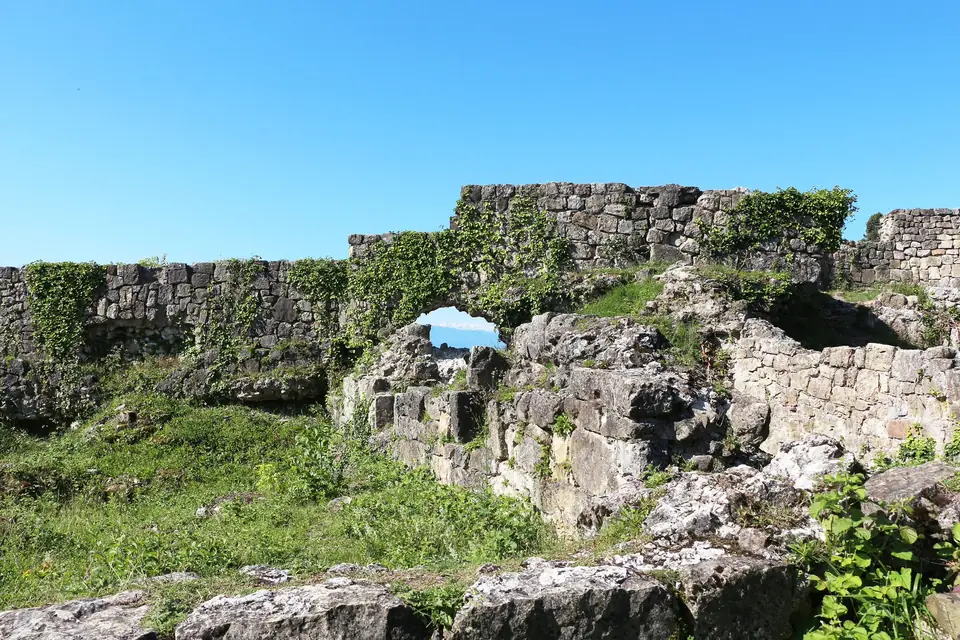
Anyone wondering what to see at Bagrati Cathedral finds much more than a restored monument: thousand-year-old inscriptions, a portico carved with eagles and fantastic creatures, a residential tower in the northwest, fragments of mosaic in the floor and, to the east, the remains of the Ukimerioni palace-citadel. There is also a live controversy, because the architecture of Bagrati Cathedral now mixes medieval stone, new stone and steel. In Kutaisi it is even said that David the Builder was crowned under this dome in 1089, though no chronicle names the place. The audio guide walks around its walls outside and ends inside, under the dome, with documented narration checked against historical sources.
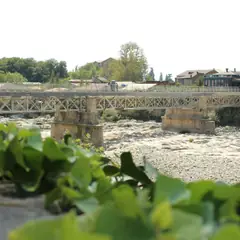
Across the Rioni, in the centre, stands the White Bridge, and the story of unified Georgia continues on the outskirts: at Gelati Monastery, founded by David the Builder, and at the small Motsameta Monastery, built over the tomb of two martyred princes.
Five arches for the king who united Georgia
Five-arch east façade
Summary of this stop
In front of the east façade, there is a composition of five decorative arches and two deep niches. Above the central windows, a foundation inscription names Bagrat III and his mother, Gurandukht. It is the signature of a king who chose Kutaisi, capital of the kingdom between 978 and 1122, to display a newly achieved unity: the neighbouring rulers, the catholicoi, the bishops, the abbots of every monastery and the nobles of the whole kingdom attended the consecration.
The ground, moreover, was already sacred. Excavations begun in 2003 revealed that the cathedral stands on earlier buildings, among them a large 6th-century basilica 30 metres long and 25 wide, on which some of Bagrat’s walls rest.
The architect’s name, on the other hand, has not survived. Beside the east window, an inscription announces that the church was built “by the hand of…”, but the master’s name has been erased. Everything suggests that the stonemasons came from Tao with Bagrat III, because his churches share plan and decoration. What that anonymous master left carved in other corners of the building is one of the secrets the narration reveals on the spot.
A thousand-year-old date in today’s numbers
North window inscription
Summary of this stop
Beneath the great window of the north wall survives an inscription dating the laying of the floor to “chronicon 223”, that is, the year 1003. It is the most precise reference for dating Bagrat III’s building.
What is extraordinary is how it is written. The date does not appear in the old Georgian letters that served as numbers, but in Arabic numerals: it is the oldest known use of Arabic numerals in Georgia. A detail a few centimetres across that turns this wall into a landmark in the history of writing in the country.
Anyone coming close recognises the numbers at once, a thousand years after a stonemason carved them. That small surprise is one of the most intimate moments of the route.
Gunpowder, cannon and a town that became a quarry
Northwest residential tower
Summary of this stop
At the northwest corner rises a three-storey tower with one room per floor, attached before the building was finished and probably the residence of the Bishop of Kutaisi. From here it is possible to learn to tell old stone from new, and in that contrast the history of the ruin can be read.
At the end of the 17th century, when King Archil besieged Kutaisi to expel the Ottomans who held the fortress, they destroyed the cathedral: the dome fell in, the walls cracked, and its marble cladding and columns ended up in Samtskhe. The date and the manner are still disputed; one version speaks of gunpowder in the four corners in 1691, others give 1692 and point to a cannonball or a looting with bombardment. In 1770 the cannon of the Russian general Totleben, who had come to help King Solomon I, damaged the east wall further. In 1837, ahead of Tsar Nicholas I’s journey, the architect Rippard proposed demolishing the ruins for 700 roubles, but the walls were so massive that there was no time to pull them down.
What the cannon failed to do, the townspeople tried. While the Swiss traveller Frédéric Dubois de Montpéreux ranked it above St Sophia in Kyiv for beauty and grandeur, in Kutaisi its stones were carried off to build houses and fences, until early in the 20th century a group gathered by Bishop Gabriel of Imereti ringed it with a wall to stop the plundering.
The steel arm that cost its UNESCO status
Andrea Bruno’s west arm
Summary of this stop
The west arm is the first thing that gives the reconstruction away. Where original material was missing, the architect Andrea Bruno built a modern structure that stands apart at a glance from the medieval fabric, and the whole mixes old stone, new stone and some steel sections. It was a deliberate decision not to imitate what had been lost, and it won him the Domus Restoration and Conservation Prize in 2013.
UNESCO saw it differently. Inscribed in 1994 together with Gelati as a partly reconstructed, roofless ruin, the cathedral was removed from the World Heritage List in July 2017: it is the only site delisted over a full reconstruction. The Georgian state defended the work as necessary for liturgical continuity; the World Heritage Committee judged it harmful to the site’s integrity and authenticity.
The reopening, on 16 September 2012, had something of a political stage set: Patriarch Ilia II presided in front of Saakashvili and the opposition leaders, two weeks before the parliamentary elections, while Bidzina Ivanishvili stayed away and accused the president of appropriating the church. The twists of that story, from the colour of the dome to the role of the patriarch himself, are heard in front of the west arm.
Under the dome: coronations, tombs and weddings
Nave under the rebuilt dome
Summary of this stop
In the centre of the nave, under the rebuilt dome, the visitor stands on the space of royal ceremonies. In 1027 George I, second king of unified Georgia, was buried here; in 1414 Alexander I was crowned in this church, and the kings of Imereti went on being crowned in it between the 15th and 18th centuries. The Russian envoys Aleksei Yevlev and Nikifor Tolochanov, in Imereti between 1650 and 1652, described the gallery of the west arm, from which the queen and the nobles’ wives followed the liturgy on feast days, hearing the chant without being seen by the people.
Those same envoys left the last look at the intact interior, four decades before the destruction: eight carved round columns, a stone seat with painted kings and an icon of the Virgin so high that one had to climb steps to kiss it. What else that church held, and what was lost for ever, is the final revelation of the audio guide.
Life has returned to the nave. Between 1911 and 1913 the Bishop of Imereti resumed the liturgy in the ruins by turning the south portico into a chapel, and today the cathedral is the seat of the Metropolitan of Kutaisi, with regular services and one of the city’s favourite places to marry.