Royal pantheon of Georgia
Gelati Monastery Audio Guide
A royal pantheon and an academy that contemporaries called the “second Athens”, founded by David IV the Builder in 1106. Visitors enter stepping on the slab held to be his tomb, beside an iron gate seized from Ganja.
- 60 min of audio
- Medieval Georgian architecture
Gelati Monastery was founded in 1106, 11 km northeast of Kutaisi, then the capital of the kingdom, as the new pantheon of David IV the Builder’s dynasty and a showcase of his kingship. The king died in 1125 without seeing the main church finished, and his son Demetre I completed it, decorated it and consecrated it in 1130. Within the walled compound, above the Tskaltsitela valley, stand domed churches, a 13th-century bell tower and the ruins of the Academy where geometry, astronomy and philosophy were taught.
The contrast lies in its present state. Behind its main apse survives the only complete medieval mosaic in Georgia, but the church that was meant to last centuries suffered leaks in 2020 and 2021 because of a failed roof, and it is now wrapped in a temporary PVC cover made in Germany. In November 2026 the Ministry of Culture declared the church stable, with phased restoration still under way.
Highlights
- South portico slab — held to be the tomb of David IV and laid so that it is stepped on when entering
- Gate of Ganja — an 11th-century iron gate with an Arabic inscription, a war trophy of Demetre I
- Apse mosaic — the Virgin and Child between Michael and Gabriel, the only complete medieval mosaic ensemble in Georgia
- Gelati Academy — about 300 m² with stone benches where astronomy, music and philosophy were taught
- Bell tower over a spring — 13th century, one of the oldest surviving in Georgia
On a wooded slope above the Tskaltsitela valley, 11 km northeast of Kutaisi, a stone wall encloses the complex with which David IV the Builder meant to fix the memory of his dynasty for ever. He founded it in 1106, when Kutaisi was the capital of the kingdom, as a royal pantheon and as an academy; he died in 1125 and it was his son Demetre I who consecrated the main church in 1130, dedicated to the Nativity of the Virgin, although some sources cite it as the Dormition. Anyone wondering what to see at Gelati Monastery finds kings’ tombs, a war trophy hanging on the wall, the only complete medieval mosaic in Georgia and the stone benches of a 12th-century school.
The history of Gelati Monastery is not that of an untouched museum. It burned in 1510, lost its most famous treasure in 1859, was closed by the Bolsheviks in 1923, and today its main church lives wrapped in a temporary cover while restoration advances. The audio guide walks the compound from the south gate to the bell tower, with documented narration checked against historical sources that separates what the chronicles say from what legend repeats.
In Kutaisi, Bagrati Cathedral recalls the king who united Georgia a century earlier, and in the same Tskaltsitela valley, closer to the city, Motsameta Monastery leans out over the canyon.
A tomb on the threshold of the pantheon
Tomb of David IV
Summary of this stop
The main entrance to the compound, the portico of the south gate, holds Gelati’s most talked-about scene. In the floor lies a slab with the epitaph “This is my resting place for ever”, laid so that anyone entering has to step on it. According to tradition, it is the tomb of David IV, who is said to have wanted that gesture of humility from everyone crossing his monastery. In January 2004, after the Rose Revolution, the newly elected President Mikheil Saakashvili took his oath of office at Gelati in front of that very tomb.
Opposite it hangs a leaf of wrought iron with an Arabic inscription: the gate of Ganja, made by the smith Ibrahim for the emir of that city in 1062 or 1063, depending on the reading. Demetre I carried it off as a trophy around 1138-1139, and Ganja returned to the sultan’s hands in 1143. For centuries it was called “the gate of Derbent” and attributed to the father; it took deciphering the Arabic on its surface to restore its true origin.
What seems certain is less so. No chronicle from David’s time says he was buried at Gelati, whereas for Demetre it is recorded that he was taken to the monastery he had consecrated himself, and some propose that the slab covers the son and not the father. What clues feed that suspicion, and what a psalm has to do with the name of the tomb, is left for the narration, standing beside the stone.
A church of father and son under a temporary cover
Gelati Monastery
Summary of this stop
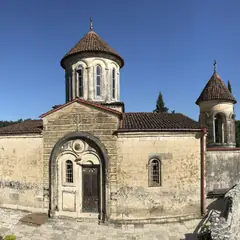
In front of the south façade rises the heart of the architecture of Gelati Monastery: a domed church of sandstone ashlar, with three apses to the east, blind arcades on the façades and annexes to the south, west and north. David IV conceived it as a showcase of his kingship and Demetre I finished it, decorating and consecrating it in 1130. It is a church of two kings, built to last centuries.
Its present look tells a different story. The tiled roof installed in the restoration begun in 2013-2014 failed: in 2020 water entered the church and damaged the wall paintings, the building was left under a blue tarpaulin and in 2021 it leaked again. Since February 2023 the works have been supervised by the Patriarchate, and today a temporary PVC cover, made in Germany for Gelati, wraps the church and its dome. In November 2026 the Ministry of Culture declared the church stable, with emergency conservation finished and phased restoration under way.
The roof is not a new problem. An episode from 1846, with a specialist who had to be brought in from elsewhere because nobody in the whole Kutaisi valley knew how to repair it, shows that the roofing was already Gelati’s weak point long before the recent leaks, and the audio guide tells it in front of the façade itself.
12th-century gold behind the apses
Apses of the main church
Summary of this stop
From the space between the eastern apses and the little church of St George, the curved stone wall gives no hint of what it holds. The main church measures 35.5 by 35.0 metres on plan and reaches 33.5 metres of interior height; its drum opens with 16 windows. And in the conch of the main apse, on a gold ground, is the mosaic of the Virgin and Child between the archangels Michael and Gabriel, from the first half of the 12th century: the only complete mosaic decoration that survives from medieval Georgia, restored in the 1970s and 1980s.
The condition of those surfaces is a matter of debate. After the leaks, an Italian conservation plan was criticised by a British review for recommending treatments while the walls were still damp, and the current rehabilitation committee rejects those criticisms and recalls that as early as 1989 it was detected that 85 % of the mosaic had come away from its support.
At this point the place changes scale. Gelati was the property and pantheon of the royal house: almost all the kings of unified Georgia lie here, among them David IV, Demetre I and George III, and later several kings of Imereti. Who else rests in these crypts, including a late and unexpected return, is revealed by listening to the narration on the spot.
The stone benches of the “second Athens”
Gelati Academy
Summary of this stop
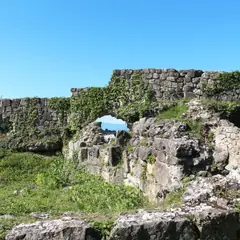
At one side of the compound survive the ruins of the Gelati Academy, from the reign of David IV: a sober rectangular building of about 300 m², with three entrances to the east, a decorated portico added to the central one and stone benches along the walls. In those rooms geometry, arithmetic, music, philosophy, rhetoric, grammar and astronomy were taught.
Here worked Ioane Petritsi, commentator on Proclus, and Arsen Ikaltoeli, author of the Dogmatikon. Their contemporaries called Gelati the “new Hellas”, the “second Athos” and the “second Athens”, titles that give the measure of what this school meant in the 12th century.
A legend also says that Shota Rustaveli, author of “The Knight in the Panther’s Skin”, the great Georgian national poem, trained in the academies of Gelati and Ikalto before going on to study in Byzantium. It is a tale that fills the gap the sources leave on the poet’s life, and the audio guide explains, in front of these same benches, why it is best taken as a tale.
A bell tower over water after the fire
Bell tower over the spring
Summary of this stop
Beside the church of St Nicholas, a two-storey building of the 13th and 14th centuries with a lower part of rough stone and an upper part of fine ashlar, stands the 13th-century bell tower, built over a spring and one of the oldest surviving in Georgia. The water still flows beneath it.
The history of Gelati Monastery is a succession of losses and rebuildings. On 23 November 1510 the Ottoman army that invaded Imereti set it on fire; the drainage system from David IV’s time stopped working and was left filled with earth, ash and charcoal, and Bagrat III of Imereti, who rebuilt the complex, came to be called its “second builder”. In 1859 the Khakhuli triptych, one of the largest enamels in the world, kept here since Demetre I, was stolen; the monastery received a metal replica in 1865 and the original returned to Georgia in 1923, badly fragmented.
That same year the Bolshevik regime closed Gelati, which operated as a branch of the Kutaisi museum until 1988, when monastic life returned; the Academy was reborn in 1990. How the water of the spring ties in with that chain of falls and returns is the image with which the audio guide’s route closes.