Icon of the central square
Colchis Fountain Audio Guide
A golden cascade in the middle of a roundabout, where some thirty figures enlarge to giant scale ancient jewels only a few centimetres long. The latest symbol of a square that has already changed hero several times.
- 20 min of audio
- Myth of the Golden Fleece
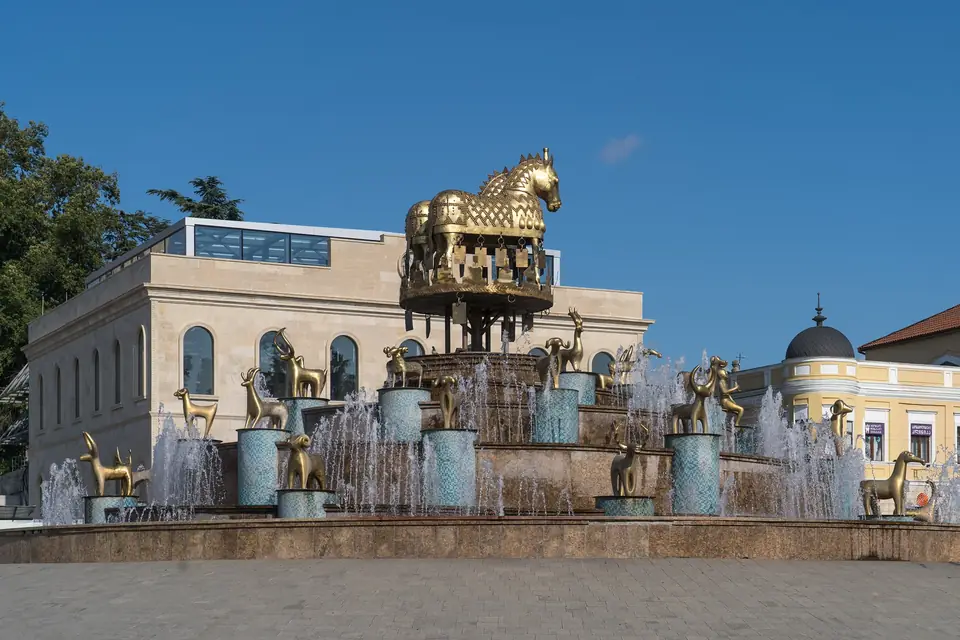
The Colchis Fountain stands at the centre of David the Builder Square, the heart of Kutaisi. It was designed by the Georgian architect David Gogichaishvili, and most guides date its inauguration to 2011, although other sources put its opening to the public in spring 2012. Its architecture is that of a cascade in terraces: each golden figure rises on a deep blue mosaic pedestal and the basin is lined with polished Kharagauli stone.
The contrast is in the scale. The horse crowning the fountain enlarges gold pendants whose original measures only 13 centimetres, and the lion reproduces a 5.2 cm statuette. To make room for this enlarged treasure, the equestrian statue of King David IV the Builder had to move in 2011 to the station square, although the square still bears his name.
Highlights
- Horses at the top — enlargement of ancient gold pendants that measure only 13 cm
- Gold lion — giant copy of a 5.2 cm statuette from the Tsnori kurgan in Kakheti
- Tamada with a horn — 7th-century BC bronze statuette of the Georgian toastmaster
- Terraced bestiary — ram, goat, bull, Caucasian tur, deer and tiger on blue mosaic
- Contested pedestal — the centre of the square once held Lenin, Stalin and King David on horseback
In the centre of Kutaisi, where Queen Tamar Street meets Shota Rustaveli Avenue, a cascading fountain gleams gold in the middle of the traffic. It is the Colchis Fountain, built under President Mikheil Saakashvili to a design by the architect David Gogichaishvili, and its idea is as simple as it is bold: take jewels and figurines of gold and bronze a few centimetres long, from the ancient kingdom of Colchis and other sites in Georgia, and turn them into sculptures visible from all over the square. Anyone wondering what to see at the Colchis Fountain finds horses, a lion, a man toasting with a horn and a small bestiary spread over the terraces.
The history of the Colchis Fountain is also that of the square around it, a pedestal that has changed symbol several times, and that of the land of the Golden Fleece, because the myth of Jason and Medea is set, according to tradition, in this very city. Even its name was not official at first: it began as a popular nickname. The audio guide circles the fountain from the pavement, from the park to the theatre, with documented narration checked against historical sources.
A few hundred metres away, the relief at the entrance to the Green Bazaar returns to King Aeëtes and the Golden Fleece, and on the outskirts the Prometheus Cave names its chambers after the voyage of the Argonauts.
A pedestal for Lenin, Stalin, King David and gold
Colchis Fountain
Summary of this stop
From the park pavement, the fountain is seen like a shop window ringed by asphalt. It occupies the centre of a roundabout with no pedestrian crossing, so almost everyone looks at it from the park or the neighbouring cafés: a monument turned into an island.
That centre is the most contested pedestal in Kutaisi. In Soviet times a monument to Lenin was raised first and then another to Stalin, who appears in a photograph from 1935. Later came the equestrian statue of David IV the Builder, by the sculptor Elguja Amashukeli, installed in the mid-1990s (sources hesitate between 1994 and 1995). In 2011 the king on horseback was moved to the railway station square to make way for the fountain, although the square still bears his name.
The exact date of the inauguration is also disputed: most guides say 2011, but one source points to May 2012. What that dance of heroes reveals about what Kutaisi wants to say of itself is best heard in front of the square itself.
13-centimetre gold horses for King Aeëtes
Golden horses at the top
Summary of this stop
At the very top of the cascade rises the main figure: the enlargement of some temporal gold pendants in the shape of a horse, a jewel of antiquity whose original measures only 13 centimetres. The leap in scale is the great stroke of the fountain’s architecture: an ornament meant to hang beside the temple now crowns the city’s main square.
Behind that jewel is the gold of Vani, not far from Kutaisi. Excavations begun in the 1930s have brought to light 28 tombs of around 450-250 BC, whose elite dead were covered in gold jewellery, sometimes accompanied by servants and sacrificed horses. From Vani, too, come gold ornaments with horsemen dated between 400 and 350 BC, now kept in the Georgian National Museum.
The horses at the top are also presented as those of King Aeëtes of Colchis. According to the myth of the Argonauts, Jason sailed up from Phasis, present-day Poti, to Kutaia, the city of Aeëtes, son of the Sun, to take the Golden Fleece, and he passed the king’s impossible trials only thanks to the magic of his daughter Medea. How each episode fits here, from the fire-breathing bulls to the dragon of the grove of Ares, is left for the narration in front of the summit.
A lion from Kakheti and a toasting tamada
Golden lion and tamada
Summary of this stop
On the lower terraces two figures change the way the fountain is seen. The golden lion is the giant copy of a statuette only 5.2 centimetres long, found in the second-largest kurgan at Tsnori, in Kakheti, in the east of the country: a masterpiece of Early Bronze Age goldsmithing that does not come from Colchis. Nearby, the tamada raises a drinking horn; it enlarges a 7th-century BC bronze statuette of the toastmaster of the Georgian feast, the supra, and has an enlarged replica on Shardeni Street in Tbilisi.
Not all the figures, therefore, come from Vani or have the age some guides give them, speaking of originals five or six thousand years old; the provenance and chronology of the thirty or so pieces are still presented in different ways. Around them, a ram, a sheep, a goat, a bull, a Caucasian tur, a deer and a tiger are spread over the terraces, and some of the figures have lost their shine and show a tone of aged bronze under the gilding.
Why everything here gleams gold has an earthly explanation going back to the geographer Strabo: the fleece may have been a sheepskin laid in the torrents of the Caucasus to trap nuggets, a practice that still survives in Svaneti. How far that reading goes, which is disputed, and what some geologists calculated in 2014 is told in front of the terraces.
Coins, Christmas goats and a banned rally
Stone basin of the fountain
Summary of this stop
From the pavement of the Lado Meskhishvili theatre, the fountain looks like what it has become: a stage of the city. Saakashvili called it the best and most expensive of all the fountains built in Georgia during his term, and soon after opening it was already at the centre of politics. On 1 June 2012 the city hall denied the square to the opposition coalition Georgian Dream for a rally on 7 June, citing a music and theatre festival that occupied it all month.
The city has also adopted it in a festive key. In December 2014 the city council added it to the Christmas decoration for 2015, year of the green goat in the Eastern horoscope, and its goats and sheep shone in front of the Christmas tree. By custom, newlyweds in Kutaisi throw coins into the fountain to ensure a happy marriage.
There remains the story of the name. In spring 2012 people still spoke of “the so-called Colchian fountain”, and at the end of 2014 the name was still being written in quotation marks. How a nickname ended up eclipsing even the king who gives the square its name closes the audio guide’s route.