Historic bridge
White Bridge Audio Guide
A white iron bridge resting on the posts of another that collapsed, with the Rioni in view beneath a glass floor and a bronze boy sitting on the railing, a hat in each hand, about to jump into the river since 1968.
- 20 min of audio
- 19th-century iron bridge
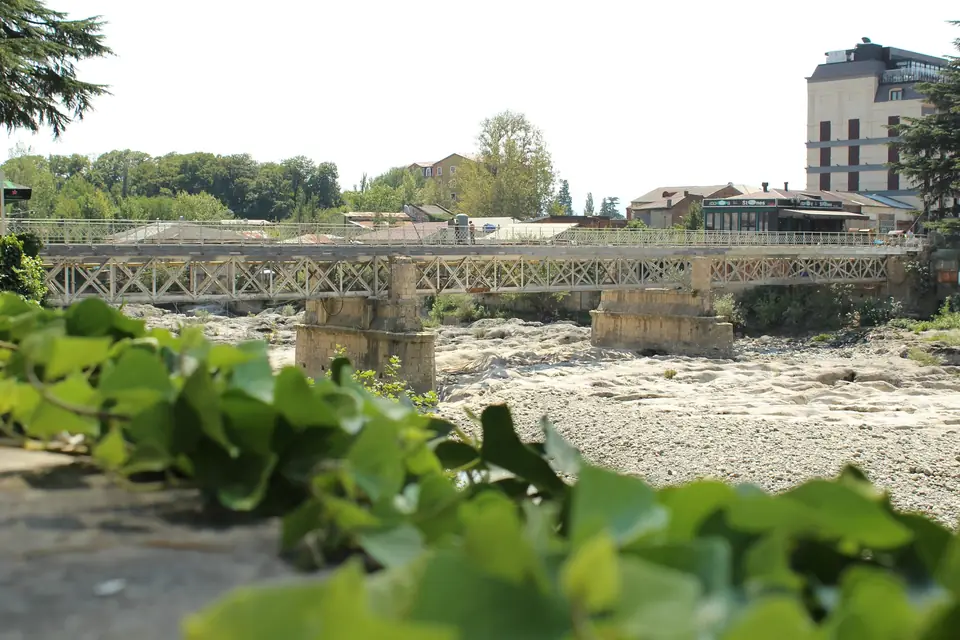
The White Bridge crosses the Rioni between the centre of Kutaisi and the bank of the Royal District. The first crossing at this point opened in 1852 to a design by the military engineer Witte and collapsed around 1860; the present three-span iron one was designed by the engineers Zezeman and Perep and built in 1871-1872 using the arched wooden posts of the earlier bridge. It was widened in 1948-1949 and completely renovated in 2019.
In the 20th century, jumping from its railing into the river was the baptism of a true Kutaisian, and it was said that whoever had not jumped was not from the city. Today the jump is no longer recommended: the water level has dropped and in dry weather the river runs beneath a single span. The only jumper left is made of bronze: the boy from the film “An Unusual Exhibition”, seated for ever just before diving in.
Highlights
- Glass floor — transparent 2019 slabs with the Rioni and its white rocks below
- Verses in iron — lines by Georgian poets engraved on the floor slabs
- Bronze boy — seated on the railing with two stolen hats, a scene from a 1968 film
- Three spans of 1871-1872 — resting on the arched wooden posts of the collapsed bridge
- White railings — lovers’ padlocks at Kutaisi’s old meeting point
Between the centre of Kutaisi and the bank of the Royal District, a pedestrian bridge with white railings spans the Rioni in three spans. It looks like a single 19th-century work, but it is two bridges one on top of the other: the iron one of 1871-1872 rests on the arched wooden posts of another, opened in 1852, which fell down some eight years later. Anyone wondering what to see at the White Bridge finds a glass floor with the river below, verses by Georgian poets engraved in the iron and a bronze boy with two hats beside whom visitors pose for photos.
The history of the White Bridge is also that of Kutaisi: a gathering place for the cultural elite in the mid-20th century, a lovers’ meeting point, the setting of a 1968 film and of the old rite of the jump into the river. On the left bank, a few steps away, starts the cable car opened on 29 May 1961, which in 80 seconds crosses the Rioni to the hilltop park. The audio guide walks the bridge from bank to bank, with documented narration checked against historical sources.
A few minutes from the bridge lie the halls of the Green Bazaar, and across the river, on top of Ukimerioni Hill, stands Bagrati Cathedral.
Two bridges in one over the limestone
Three spans over the limestone
Summary of this stop
From the left bank, beside the lower cable car station, the bridge reads in profile: three iron spans resting on the pale rock of the riverbed. The architecture of the White Bridge hides a superposition barely visible at first sight. In 1850 it was decided to lay the first crossing of the Rioni here, which opened in 1852 to a design by the military engineer Witte, also cited as Vite.
That bridge, held up by arched wooden piers, collapsed around 1860; the date varies by source, which speak of 1860 or 1861, and one describes it as a simple wooden bridge damaged by a flood. A decade later, the engineers Zezeman and Perep designed the present bridge, built in 1871-1872, which used as support the arched wooden posts left from Captain Vite’s bridge.
What the visitor sees as a single bridge is in fact a work raised on the remains of its own failure. How to tell from this bank what belongs to each era is something the narration reveals with the bridge in front.
A glass floor over the white rocks
Glass floor panels
Summary of this stop
In the middle of the bridge, the floor turns transparent. Since the 2019 renovation, some of the slabs were replaced with glass, and through them appear the Rioni and the blocks of pale limestone of its bed; on the iron slabs that remain, verses by Georgian poets were engraved. Beneath those recent layers is the iron structure installed in 1872 with parts ordered from abroad, although their origin is disputed: Georgia’s official tourism body speaks of France and the Imereti regional administration of London. In 1948-1949 the bridge was widened.
The name does not have a single explanation either. Some sources attribute it to the white paint of its railings; others, to how well the bridge matched the white stones of the river, the same ones now seen through the glass.
Those rocks also explain why a custom was lost. They say in Kutaisi that in the 20th century jumping from here into the river was the boys’ pastime, and that whoever had not jumped was not a true Kutaisian. After a hydroelectric plant was built upriver, the water level dropped a great deal, and in dry weather the Rioni runs beneath only one of the three spans. Today the jump is not recommended. What remains of that rite is best told on the glass itself.
The boy who stole two hats in 1968
Bronze boy with two hats
Summary of this stop
Seated on the railing, with a hat in each hand and his right arm raised outside, a bronze boy looks at the river; visitors put their heads under the hat for the photo. The scene comes from “An Unusual Exhibition” (1968), a film by Eldar Shengelaia with a script by Rezo Gabriadze: a boy sitting on this railing, played by Alika Giorgadi, a 14-year-old Greek boy from Kutaisi, snatches the hats from two passers-by and dives into the Rioni. The statue thus immortalises the baptism of a Kutaisian.
The idea was by the Kutaisi artist Merab Kajaya, nicknamed “Picasso”, and it was modelled by the sculptor Temur Pkhakadze, also from the city. On 30 September 2006, during a comedy festival, the boy took his place on the railing, and the next day Guram Lortkipanidze, the film’s lead, came to embrace him. Some guides, however, date the statue to 2004, and the origin of the nickname is split between a line from the film and its promoter’s sobriquet.
In the film, the man whose hat the boy steals is a sculptor returning wounded from the war, dreaming of carving a slender youth with hands raised to the sky, who ends up earning a living with gravestones. Who inspired that fictional sculptor, and why his dream in stone ended up fulfilled in bronze on this very railing, is the twist the audio guide keeps for this point.
Padlocks, verses and jumps for love
White railings with padlocks
Summary of this stop
Towards the end of the Royal District, the white railings that give the bridge its name fill with padlocks: couples hang them as a promise of eternal love. It is not a new custom in spirit. In the mid-20th century, Kutaisi’s cultural elite met here to discuss the news, and according to tradition the bridge was the lovers’ meeting point, where boys showed their courage to their sweethearts by diving into the river.
From that custom springs a legend. They tell in the city that the director Kote Marjanishvili, who had family roots in Kutaisi and in 1928 founded the Second State Georgian Theatre there, saw from the bridge a boy dive into the Rioni straight as an arrow, and that this is how he met the future actor Giorgi Shavgulidze, who would become his student.
In November 2007 the first phase of the renovation of Kutaisi’s historic centre began, which included the Royal District, the White Bridge and its surroundings. How that career born of a jump ended, according to the legend, is heard with the river still beneath your feet.