Karst cave
Prometheus Cave Audio Guide
Found by Soviet cavers in the 1980s, left half-finished and saved by a local man and his dog, the Kumistavi cave was renamed Prometheus in 2010. Today it is descended through chambers named after the Argonauts and left by boat along an underground river.
- 75 min of audio
- Geology and legend
Prometheus Cave opens beside the village of Kumistavi, on the Tskaltubo to Tsageri road, on the outskirts of Kutaisi. An expedition from the Vakhushti Bagrationi Institute of Geography, led by Jumber Jishkariani, came upon it on 15 July 1984, although some sources place the discovery in 1983. The Soviet development began in 1985 and was halted in 1990, with the collapse of the USSR. It reopened on 26 May 2011, already under its new name, and the public walks through six of its 22 known chambers, named after the tale of Jason and Colchis.
Beneath the colours bathing its stalactites lie two very different stories. One is geological: this limestone was seabed in the Cretaceous, and starfish, molluscs and cave-bear remains have turned up in the cave. The other is political and disputed: the lighting seen today replaced an earlier one amid the rivalry between the president who inaugurated it and his great adversary.
Highlights
- Stalagmites of 8 to 10 m — beside stalactites up to 2 m, helictites and “organ pipes”
- Six chambers of myth — Argonauts, Colchis, Medea, Love, Prometheus and Iberia
- Boat exit — 380 m navigable along the underground river, with music and lights
- Kumi spring — the cave’s river surfaces after a chain of siphoned lakes
- Statue of the guard and his dog — a tribute to the local man who protected the cave unpaid
On the outskirts of Kutaisi, beside the village of Kumistavi and on the road linking Tskaltubo with Tsageri, a large natural hollow hides the mouth of a karst cave that until 2010 bore the name of the village. It was found on 15 July 1984 by an expedition of the Vakhushti Bagrationi Institute of Geography led by Jumber Jishkariani; some sources give 1983, and the match of day and month points to a year error in one of the versions. In 2010 President Mikheil Saakashvili visited it and proposed renaming it Prometheus Cave, and after the works it reopened to the public on 26 May 2011.
Anyone wondering what to see at Prometheus Cave finds a descent along a path of 1,420 metres and 880 steps, among stalagmites up to ten metres tall, calcite flows lit in colours and six chambers named after the voyage of the Argonauts. The route ends by boat, on the underground river that feeds the Kumi. The cave’s figures vary by source: the instrumental survey gives 2,900 metres of galleries, official tourism speaks of 1.8 kilometres and other sources attribute some 11 to the complete system.
The history of Prometheus Cave goes beyond geology: a Soviet commission, a seventeen-year abandonment, a volunteer guard and a light that changed hands to the rhythm of Georgian politics. The audio guide accompanies the visit from the entrance sinkhole to the jetty, with documented narration checked against historical sources.
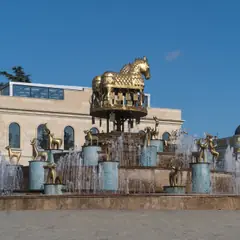
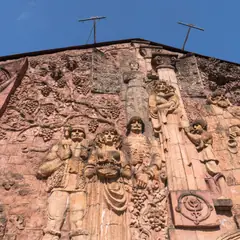
The myth that names its chambers is also at the centre of Kutaisi: in the golden figures of the Colchis Fountain and in the relief of King Aeëtes with the Golden Fleece that marks the entrance to the Green Bazaar.
A half-built entrance saved by a local man
Prometheus Cave
Summary of this stop
At the edge of the entrance sinkhole, behind the visitor centre, the bottom of the hollow where the cave opens can be seen. As the story goes, the search that led here began in 1982, when the Soviet authorities formed a group at the Tbilisi Institute of Geography to locate caves able to shelter the population in a nuclear war.
The tourist development began in 1985. By about 1989 there was already a path of nearly a kilometre with stairs, a 150-metre tunnel had been bored at the exit and small groups entered with temporary lighting. In 1990, with the collapse of the Soviet Union and no funds, the project stood halted for seventeen years.
During that time, a local man, Giorgi Tkabladze, protected the cave from vandals without being paid. Beside the entrance, a statue of him with his dog recalls that watch. What it meant to guard a half-finished cave alone for so many years is told in the narration, a few steps from his figure.
Mud, torches and the first chamber
Argonauts Chamber
Summary of this stop
The first chamber bears the name of the Argonauts and sets the tone of the route: of the 22 known chambers, the public visits six, named after the tale of Jason and of Georgia: Argonauts, Colchis, Medea, Love, Prometheus and Iberia. Colchis was the ancient name of western Georgia, the destination of Jason’s voyage.
Here the cave’s microclimate is felt at once: the air stays at 14 °C all year, with 96 to 98 % humidity, conditions offered as therapy for people with asthma.
None of this looked like this in 1984. The discoverers entered through a very narrow passage, covered in mud, until they emerged into a large chamber. Amiran Jamrishvili, a member of that team, recalled the scene in 2018, and his account is best heard in the very space where that crawl ended.
Ten-metre columns and a disputed light
Great stalagmites and calcite cascades
Summary of this stop
On the dry, higher level of the cave is concentrated the most spectacular of its natural architecture: stalactites up to two metres long, stalagmites eight to ten metres high, helictites, cascading flows and “organ pipe” formations. Skull fragments and fossils of cave bear have also turned up in the cave, along with starfish and molluscs from the Cretaceous, from when this limestone was seabed.
The light that colours these formations has its own history. In 2010 the German company GermTec installed an LED system, and the same firm modernised it in 2019. A disputed story adds another layer: according to that version, the development was paid for by the association of the billionaire Bidzina Ivanishvili, Saakashvili’s great political rival, and in 2012 the state reclaimed the unfinished cave and swapped that lighting for a coloured one.
That version also speaks of lamps installed very close to the stalactites, of plants that did not grow there before and of spots warmer than the cave should keep. What lies behind those colours and why light matters so much underground is left for the narration, with the columns in front.
Prometheus in the name, Amirani in the legend
Prometheus Chamber
Summary of this stop
The Prometheus Chamber bears the name the whole cave received in 2010, when Saakashvili proposed changing Kumistavi to Prometheus, after the legend of the titan chained in these mountains. It is a recent decision, not a tradition of the place: the local legend puts the chained one on the crags of Khvamli, some 16 kilometres away, and some hold that it would have been more coherent to call it Amirani Cave.
Amirani is the Georgian hero who beats beneath the Greek name. According to tradition, he defied God by giving fire or metal to men and was chained beneath a mountain or, in some versions, to the wall of a cave. His winged dog, Q’ursha, licks the chains ceaselessly until they almost break, but each time they are about to give way, the blacksmiths strike their anvils and the iron regains its strength.
If the cave’s name is borrowed, some of its inhabitants do bear Prometheus’s with every right: the millipede Leucogeorgia prometheus, described in 2020, and the troglobitic harvestman Nemaspela prometheus, in 2021. Alongside them live the amphipod Niphargus amirani and the shrimp Xiphocaridinella kumistavi. What happens, according to the legend, on one single night a year is reserved for the narration in the chamber itself.
A boat on a river opened with dynamite
Navigable lake jetty
Summary of this stop
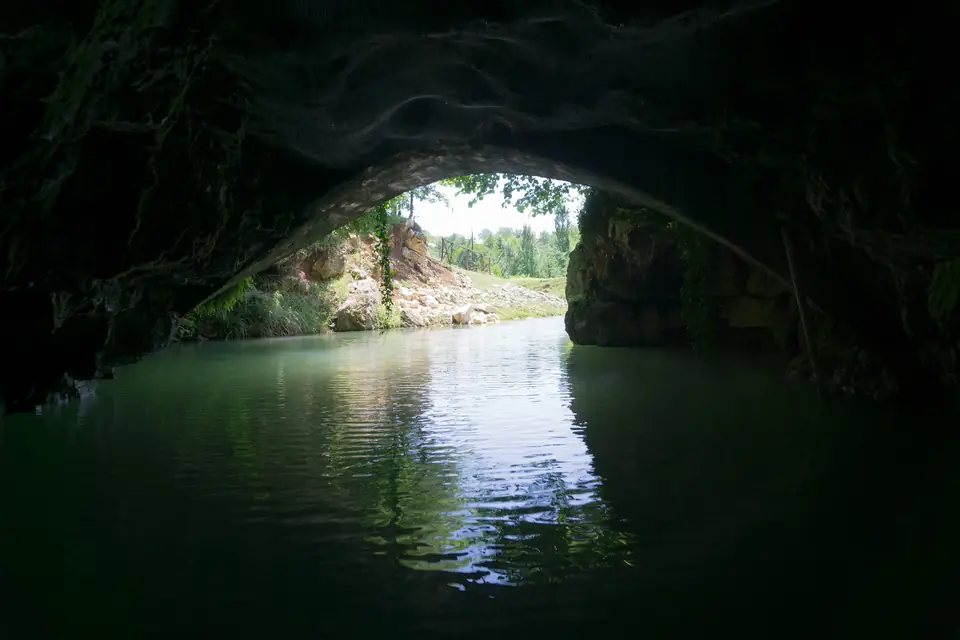
After the pedestrian path of 1,420 metres and 880 steps, the route ends at the jetty: a navigable stretch of 380 metres covered by boat, with music and lights, to the exit. An underground river runs through the whole active section of the cave and, after a chain of siphoned lakes, emerges at the surface as the Vauclusian spring of the Kumi river. About 30 kilometres of the river system have been explored, close to half of the whole.
The most placid moment of the visit has, however, a noisy origin. According to a documented tradition, the river was narrow and was widened with explosives to turn it into a channel suited to 15-seat plastic boats, with the help of a diver who afterwards checked the riverbed.
The story of the channel also includes an automatic door that never quite opened by itself and an inventory that dwindled after a change of hands. How the journey ends, with the cave’s water bursting into the light, is the last scene of the audio guide.