National monument of Georgia
Motsameta Monastery Audio Guide
A small fortress-monastery hanging over a bend of the Tskaltsitela, built over the tomb of two martyred princes of the 8th century. Its altar faces north and its reliquary is venerated by crawling underneath.
- 30 min of audio
- Medieval monastery
Motsameta means “place of the martyrs”. Here, inside the old fortress-town of Tskaltsitela, stood a church of the Annunciation that the Arab army of Marwan the Deaf razed between 735 and 737; in its ruined crypt were buried David and Konstantine, lords of Argveti executed after fighting him and canonised by the Georgian Orthodox Church as Great Martyrs. On that site the present church was built in the 11th century, generally attributed to King Bagrat IV, a single-nave hall that in the 19th century was enlarged and crowned with a dome.
The contrast lies in the fate of the saints. In the 18th century Vakhushti Bagrationi wrote that they rested in their coffers with the body still whole; on 18 February 1923, already under Soviet rule, a mob stormed the monastery, the relics ended up in the anthropological collection of a Kutaisi museum and the monastery was closed. They returned on 20 June 1954. Today the faithful pass three times beneath their coffer, making a wish.
Highlights
- Reliquary of David and Konstantine — a canopied coffer on a five-step platform, with a passage beneath for the faithful
- Two wooden lionesses — lying before the reliquary, carved in the 1840s
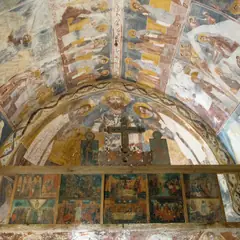
- North-facing sanctuary — an altar oriented to the north rather than the east, with a 14th-16th-century Deesis in the apse
- 16th-17th-century gate tower — followed by a covered corridor where a drawbridge once stood
- Viewpoint over the meander — a high retaining wall above the wooded canyon of the Tskaltsitela
On the outskirts of Kutaisi, where the Tskaltsitela river draws a tight curve at the bottom of a wooded canyon, a crag carries a tiny monastery ringed by walls. The history of Motsameta Monastery begins in the 8th century: between 735 and 737 the Arab troops of Marwan the Deaf, Murvan Kru in the Georgian sources, razed the fortress-town of Tskaltsitela and its church of the Annunciation. In the crypt of that ruined church were buried David and Konstantine, lords of Argveti, in Upper Imereti, captured and executed after standing up to the invader. The Georgian Orthodox Church venerates them as Great Martyrs, and the place takes its name from them.
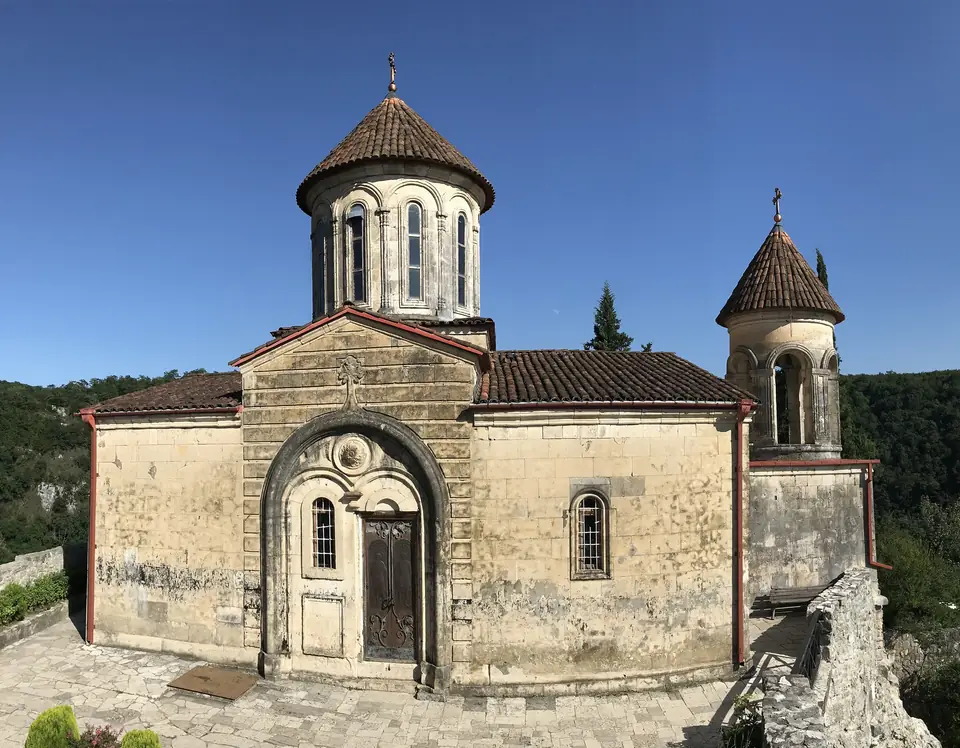
Anyone wondering what to see at Motsameta Monastery finds an 11th-century church remade in the 19th, an altar that breaks the rule and faces north, a two-storey bell tower and, above all, the reliquary of the two princes, which went to a museum in 1923 and returned in 1954. Since 7 November 2006 the complex has been a cultural monument of national importance in Georgia, and every 15 October it celebrates the feast of Motsametoba. The audio guide covers it in four stops, from the entrance tower to the reliquary, with documented narration checked against historical sources.
In the same Tskaltsitela valley, Gelati Monastery holds the pantheon of David the Builder, and in the city, on Ukimerioni Hill, Bagrati Cathedral completes the map of medieval Kutaisi.
A tower where a drawbridge once stood
Gate tower and covered corridor
Summary of this stop
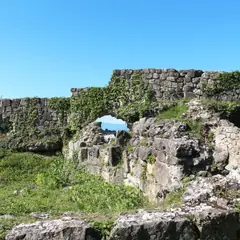
The compound does not open with a portal but with a tower. It is entered through the ground floor of a square tower of the 16th-17th centuries, with a small dome on pendentives, and a long covered corridor follows. That passage occupies the place of an old drawbridge that was still working in the 19th century. On both sides appear remains of the wall, made of large ashlar blocks.
Beneath that floor another city lies. On this crag stood the fortress-town of Tskaltsitela, with its church of the Annunciation, until the army of Marwan the Deaf razed it in the 730s. What now looks like a monastic retreat was once a fortified enclave, and the entrance still keeps that defensive character. What remains in view of that first city, and where, is what the narration points out at the foot of the tower.
An altar leaning over the precipice
Retaining wall over the Tskaltsitela
Summary of this stop
From the edge of the compound the meander of the Tskaltsitela is in view, and to the north of the church a high retaining wall lines the cliff. Part of the east end rests on that substructure, because the church of Motsameta has an unusual orientation: its sanctuary is to the north and not to the east, as custom dictates. The building seems to lean out over the void.
The hagiographic text of the Martyrdom of David and Konstantine, in its 12th-century version, tells that the princes were tortured and thrown alive into the “Phasis, which in the Georgian language is the Rioni”, and that the Georgians pulled their bodies from the water and buried them in a cave beside a church destroyed by the enemy. Popular etymology, for its part, explains the name Tskaltsitela, “red water”, by the martyrs’ blood; which river was the river of the martyrdom is still debated, and the very existence of the princes is known only from that hagiographic tradition.
According to tradition, the bodies, weighed down with stones, did not sink: they floated free of their bonds, and a mysterious light drew four warriors of their retinue. A voice ordered them to carry the bodies eastward until the morning star overtook them. Where first light caught them, and why no architect chose this crag, is best heard with the precipice in front.
A medieval-looking façade carved in the 19th century
West façade and bell tower
Summary of this stop
Facing the inner courtyard rises the west façade, the richest in the complex: a large moulded arch over rusticated masonry enclosing two smaller arches and a high-relief rose window, crowned by a cross. Above it, the drum of the dome is girded with arcades on triple half-columns. Everything has a medieval air, and yet it is from the 19th century.
The church began as a small single-nave hall, commissioned by a King Bagrat in memory of the brothers David and Konstantine, to whom tradition gives the surname Mkheidze. Most sources speak of Bagrat IV, in the 11th century, though others propose Bagrat III or Bagrat V, because the text of the Martyrdom does not specify which. In 1844-1845 it was enlarged by the Metropolitan of Imereti Davit Tsereteli and the abbot Porfiri Tsereteli, and in the 1860s it received its dome, which turned it into an inscribed-cross plan. The works were directed by the masters Levan, Mose and Pilipe Berekashvili, who dressed façades and bell tower with medieval-style elements, and Bishop Gabriel Kikodze consecrated the renewed church in 1863.
Some 1.5 metres to the south stands the two-storey bell tower, of 1845-1847, with an inscription naming the abbot Porfiri. Part of the money for that renovation has a story of its own: that of a prince of Abkhazia who arrived on horseback with his armed escort in the 1840s and what happened when the martyrs’ coffer was opened, an episode the audio guide keeps for this point.
A reliquary you crawl beneath
Reliquary of David and Konstantine
Summary of this stop
Beside the east wall of the church stands the reliquary of David and Konstantine: a rectangular coffer with a canopy on a five-step platform. In front lie two wooden lionesses, carved in the 1840s. Beneath the coffer opens a passage barely a metre high, and custom demands crossing it on all fours three times, making a wish to the saints. It is the tradition that today fills the monastery with the faithful and visitors.
That coffer is not the original. On 18 February 1923, a mob stirred up by anti-religious propaganda stormed Motsameta, the remains were taken to Kutaisi for biomedical examination and the monastery was closed. According to Georgian documentation, through the efforts of Trifon Japaridze the relics passed to the anthropological collection of the Kutaisi Historical Museum, and they returned on 20 June 1954, after an agreement with the Soviet authorities pushed by Metropolitan Gabriel Chachanidze; that same year the reliquary and its canopy were rebuilt. Other versions speak of a much quicker return.
Every 15 October, on the feast of Motsametoba, the monastery fills in memory of the two princes. Why there are lionesses at the feet of martyrs is the last story the narration tells before the reliquary.