Traditional market
Green Bazaar Audio Guide
Kutaisi’s great covered market opens beneath a terracotta ceramic relief where King Aeëtes, the Golden Fleece and the townspeople of the 1980s tell the story of Georgia. Inside, stalls with their Soviet numbers and the cheese, churchkhela and tklapi of Imereti.
- 40 min of audio
- Market and ceramic art
The Green Bazaar, as the locals call it, is the heir of a bazaar that already in the 1830s the traveller Frédéric DuBois de Montperreux described as the centre of life and movement in Kutaisi. Today it is a complex of halls under almost constant building work: the heart is the Soviet fruit-and-vegetable hall, with fixed brick stalls that keep their USSR numbering, surrounded by new halls, some of two storeys, forming one of the largest covered markets in Georgia.
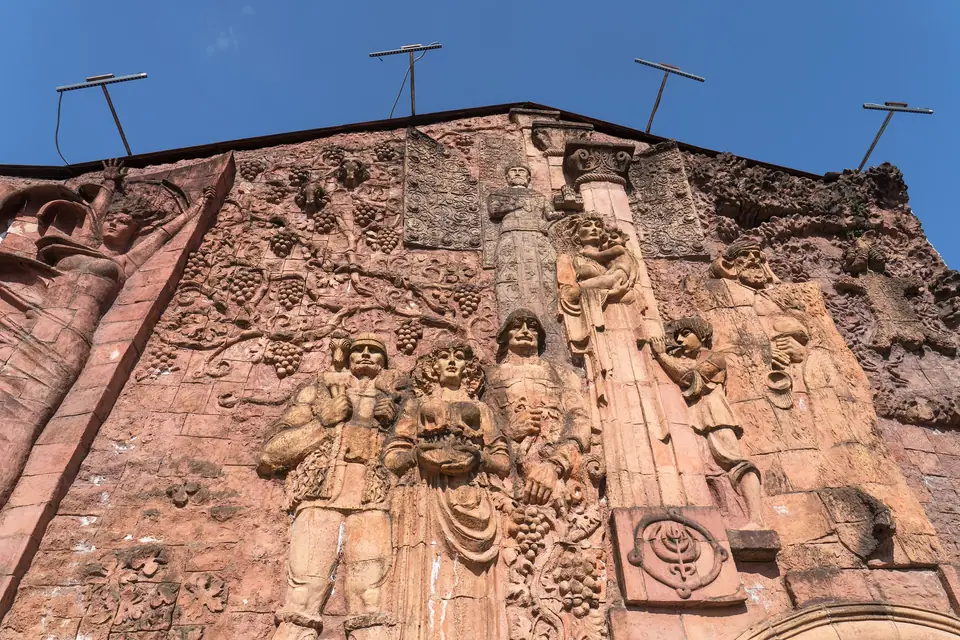
The contrast is at the door. Above the west entrance, on Paliashvili Street, rises the ceramic panel “Kolkheti”, the largest project of the artist Bernard “Franz” Nebieridze, who died in 1987 without seeing it installed. His colleagues finished it and it was mounted in 1995. It mixes kings, myths and portraits of Kutaisi residents, there was even talk of tearing it down, and in 2019 it entered Georgia’s cultural heritage list.
Highlights
- “Kolkheti” panel — a terracotta ceramic relief that arranges the history of Georgia in four periods
- King Aeëtes and the Golden Fleece — the Colchis of myth, right above the market door
- Man with a raptor mask — the villain in a tie, with a scorpion and a net, still undeciphered
- Soviet hall — fixed brick stalls that keep their USSR number
- New two-storey halls — imeruli cheeses, churchkhela, tklapi and homemade sauces from the villages of Imereti
In Kutaisi, the market has never been just a place to shop. In the 1830s, the traveller Frédéric DuBois de Montperreux compared the city’s bazaar with that of Athens: the central point of life and movement in Kutaisi. Market days were Wednesday and Friday, the city prepared for them, and going down to the bazaar was also a way of greeting acquaintances and swapping news. Heads of household went accompanied by a porter, the mekurtne, who carried the shopping on his back and, later, in a wheelbarrow.
That pulse continues in the Green Bazaar, as Kutaisi’s residents call it. Anyone wondering what to see at the Green Bazaar finds two stories in one place: that of the great ceramic relief “Kolkheti”, which opens the market with the myth of Colchis and the history of Georgia, and that of the halls where fruit, vegetables, dairy, meat, churchkhela and tklapi are sold, largely brought in from the villages of Imereti. The audio guide walks the wall from the pavement opposite and then the halls, with documented narration checked against historical sources.
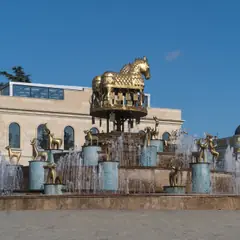
The myth of Colchis continues a few minutes’ walk away, in the golden figures of the Colchis Fountain, and outside the city, in the chambers named after the Argonauts in the Prometheus Cave. Towards the Rioni, the walk soon reaches the White Bridge.
The myth of Colchis above the market entrance
Kolkheti panel
Summary of this stop
From the pavement opposite, on Paliashvili Street, the blind wall of the west entrance building turns out to be a history book in relief. The “Kolkheti” panel, of terracotta ceramic and with no explanatory label, arranges the history of Georgia in four periods: before Christ, after Christ, the present and the future. Through it pass the Khakhuli icon, Mother Georgia in the centre, King David the Builder with a model of Gelati Monastery in his hands, the Georgian family, the struggle against evil and disarmament.
On the right-hand side, just above the door, appears Aeëtes, the king of Colchis and son of the Sun, in a fur mantle before a leafy oak from which hangs the Golden Fleece; beside his head, the Georgian letter Don, symbol of the sun. Tradition identifies Kutaisi with Aia, the capital of Colchis to which, according to Greek myth, Jason and the Argonauts sailed, and Apollonius of Rhodes is believed to have placed the end of the voyage here. Near the king is Medea, the sorceress daughter who helped Jason take the treasure.
Among kings and mythical heroes, very real faces also appear: many figures are portraits of Kutaisi residents of the 1980s, among them prominent citizens of the city. Who some of them are, and what links the scene with the landscape behind the wall, is told in the narration in front of the relief.
A masked villain in a relief born in the USSR
Man with a raptor mask
Summary of this stop
At the far left of the relief, among the faces of Kutaisi’s residents, appears a disquieting figure: a man in shirt and tie, with a raptor’s head behind a mask, a scorpion in his hand and a net, the figure of evil in the panel. His presence feeds the most debated story of the wall. The relief was begun in the heart of the Soviet era and includes not a single Soviet symbol, ideal or story, something that has been read as unusual and perhaps defiant; the opposite reading suggests that, in socialist terms, that man in a tie could embody the evils of capitalism. The question remains open.
The work is also a story of fragility. Bernard “Franz” Nebieridze drew the sketch in his studio, according to the most-cited version between 1980 and 1985, although dates vary by source. It was his largest project, and he died suddenly in 1987 without seeing it installed. His colleagues Vazha Kutateladze and Temur Zhorzholiani finished the relief in 1992, and in 1995, already in independent Georgia, it was mounted on the wall at the market entrance.
Years later there was talk of moving it and tearing it down. In 2019 the artist’s widow, Sveta Nebieridze, compared it with what the pyramids are to Egypt and called its demolition barbarism, and that same year, in April, an order of the National Agency for Cultural Heritage Preservation placed it on the list of Georgia’s cultural heritage objects. The detail of the villain that gives most clues to its meaning is pointed out in the audio guide, in front of the figure.
Stalls with the Soviet-era number
Soviet fruit-and-vegetable hall
Summary of this stop
Inside, the heart of the bazaar is the fruit-and-vegetable hall built in the Soviet era, when peasants could sell the surplus from their private plots in the collective-farm markets at prices not set by the state. The rows of fixed brick stalls still keep the numbering given to them in USSR times, a discreet trace of how that trade worked.
Those numbers link with a much older bazaar, the one DuBois de Montperreux described in the 1830s as the centre of life in Kutaisi, and with the market days of Wednesday and Friday, when shopping was also a way of meeting the whole city.
That bazaar even had its own language. According to a documented tradition, at the end of the 19th century and the beginning of the 20th, Kutaisi’s Jewish merchants invented “kivruli”, a secret jargon of Hebrew roots with Georgian prefixes and suffixes so that the customer would not understand what they said in front of him. In 1946 the scholar Ilya Papisimedovi collected 107 of those words. What some of them meant, and why the buyer was right not to trust them, is heard among the numbered stalls.
Imeruli cheese against the supermarkets
Imeruli cheese stalls
Summary of this stop
Around the Soviet hall, the bazaar has never stopped growing: it is a group of buildings under almost constant works, with new halls, some of two storeys, and small shops merged in the manner of a supermarket, forming one of the largest covered markets in Georgia. In the modern part, stalls of imeruli cheese, poultry, dried fruit, spices and pickles follow one another.
Despite the arrival of shopping centres and supermarkets in Kutaisi, the Green Bazaar still sells over two floors fruit, vegetables, dairy, meat, dried fruit, churchkhela, tklapi and homemade sauces, largely brought in from the neighbouring villages. In the narrow passages of the complex and on the pavements around, older vendors set up improvised stalls that keep the air of the bazaar of old.
The soul of the market remains in those who tend it. It is told that in the 1940s, when the future actor Eremia Svanadze went to the Green Bazaar as a boy with his father, the only woman behind a counter sold herbs, a widow to whom the other herbalists sent their customers, although the versions of the tale do not agree on the details. That story closes the audio guide’s route among the cheeses of Imereti.