Romantic Barranco
Bridge of Sighs Audio Guide (Puente de los Suspiros)
Forty-four metres of planks over a path that runs down to the sea: a Barranco footbridge opened on a 14 February, burned in a war, sung in a waltz and still crossed today by couples holding their breath.
- 45 min of audio
- 19th-century wooden bridge
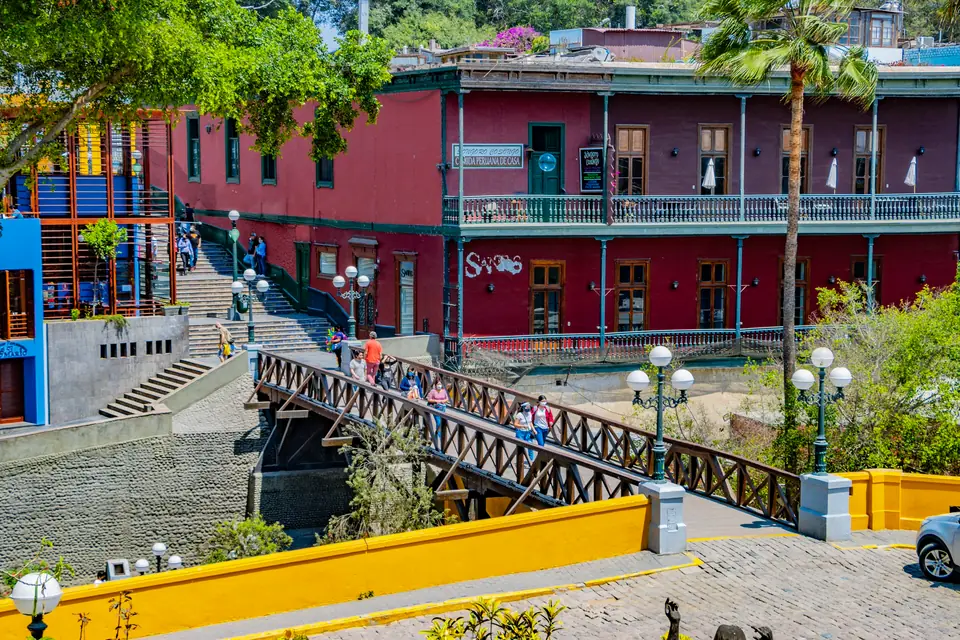
The Bridge of Sighs was opened on 14 February 1876, during the mayoralty of Francisco García Monterroso, to link Ayacucho and Ábregu streets over the Barranco ravine. Its wooden walkway, 44 metres long and 3 wide, spans 8.5 metres of height above the Bajada de los Baños, the cobbled path that runs down from the district to its beaches. It does not cross a river but a trail among ficus and bougainvillea, and at its end stands the Ermita de Barranco, the church from which, according to tradition, the town was born.
Few footbridges have carried so much on so little wood. In January 1881, after the battle of Chorrillos, the Chilean army burned part of the bridge and the Ermita, and it was Patricio Lynch himself, head of the occupation, who helped rebuild them. In 1960 Chabuca Granda, who had spent part of her childhood in a ranch on the Bajada de los Baños, dedicated to it the criollo waltz “El puente de los suspiros”, and in 2026 the bridge celebrated its 150th anniversary closed for works that renewed its planks, railings and lamps.
Highlights
- Wooden walkway of 1876, 44 metres long, spanning the Bajada de los Baños and not a river
- The wish for love that, legend says, comes true if the bridge is crossed without breathing
- Ermita de Barranco, burned in 1881 and rebuilt in 1882 with funds from the Chilean general Patricio Lynch
- Chabuca Granda's criollo waltz of 1960 and her stone monument by Fausto Jaulis, of 1992
- Historic streetlamps and decking renewed in the 150th-anniversary works, finished in August 2026
The story of the Bridge of Sighs begins on a Valentine’s Day. On 14 February 1876, with Francisco García Monterroso as mayor, Barranco laid a wooden walkway over the ravine to link Ayacucho and Ábregu streets. Below no water ran: what ran was the Bajada de los Baños, the path by which the people of Barranco went down to their beaches. Five years later came the war, and since then the bridge has gone through fires, reconstructions and restorations to become the romantic symbol of the whole district.
Its name comes from the place’s fame as a meeting point for lovers, a fame that Chabuca Granda popularised with her waltz of 1960; some sources also link it to the Ponte dei Sospiri of Venice, although local ones tie it to Barranco’s dates. About the history of its planks there is not a single version either: some sources speak of a partial fire in 1881 and others of complete destruction, and although most still cite 44 metres in length, some hold that it was rebuilt shorter. What happened in the earthquake of 1940, whether it left the bridge standing or brought it down again, remains unclear.
The audio guide walks the bridge in the order in which it is discovered: going down the Paseo Chabuca Granda, crossing the walkway, before the yellow façade of the Ermita and, at the end, facing the statue of the singer-songwriter. A narration documented and checked against historical sources that explains how humble planks over a path to the sea survived a war, earthquakes and their own fame.
To the north, in Miraflores, Huaca Pucllana keeps a much older Lima, that of the Lima culture, and the Larco Museum gathers in Pueblo Libre thousands of pieces from ancient Peru.
The Zepita street that became a passage
Paseo Chabuca Granda
Summary of this stop
The lovers’ path was once a street with traffic. The access to the bridge from the Parque Municipal is the old Calle Zepita, open to traffic until 1909, when it was closed and turned into a passage. In 1990, under Mayor Renato Lértora, it took the name Paseo Chabuca Granda. Today it is a covered passage with wooden roofs, panels of old photographs of Barranco and stairs that lead down towards the walkway.
Those images of the past have an illustrious forerunner: the poet José María Eguren photographed the bridge between 1918 and 1960 for his album of photographic miniatures, now held by the National Library of Peru. And the name of the place drags along its own legend. The legend says that the daughter of a rich man who lived beside the bridge fell in love with a mere street sweeper; her father shut her in her room and, from the window, the young woman watched the walkway and sighed with such melancholy that those crossing it could hear her.
The documented explanation is less novelistic: the name comes from the place’s fame as a meeting point for lovers. How the legend of the closed window and that real fame coexist is told on the way down the stairs, with the bridge already in view.
A bridge born on a 14 February
Bridge of Sighs
Summary of this stop
In the middle of the walkway the real scale of the bridge is understood: 44 metres long, 3 wide and 8.5 metres above the Bajada de los Baños, the cobbled path that runs among ficus and bougainvillea towards the sea. The wood that creaks underfoot today is recent. In 2014 the bridge was fully restored over six months, reinforced with huayruro wood, given LED lighting and reopened in December of that year.
The 150th anniversary, on 14 February 2026, found it closed. Mincetur invested S/ 1,027,354.70 in 180 days of works carried out by the Consorcio Barranco: the decking and railings were replaced, the historic streetlamps flanking the passage were restored and the works were declared finished on 29 August 2026.
A ritual is still alive on these planks. It is said in Barranco that whoever crosses the bridge holding their breath and makes a wish for love along the way will see it fulfilled, and that is why many couples walk it hand in hand and holding their air. One version adds a condition that changes the meaning of the walk, and what it is is revealed by listening to the narration in the middle of the walkway.
The Ermita burned and rebuilt by the occupier
Ermita de Barranco
Summary of this stop
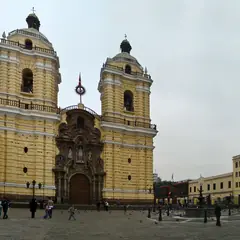
At the end of the bridge stands the Ermita de Barranco, a yellow-fronted church with two towers and a dome. It was an 18th-century chapel and in 1874 it was chosen as the capital of the town of San José de Surco. Behind it lies the district’s founding legend, a documented tradition that places it around 1750: a group of Surco fishermen saw a luminous cross appear over one of the cliffs facing the sea, and a baker named Caicedo raised the first chapel in gratitude to the Lord of Barranco, who according to tradition had saved his sick wife.
The war left its mark here. On 14 January 1881 the Chilean army sacked and burned the Ermita, and also part of the bridge; sources do not agree on the extent of the damage to the walkway or on the exact date, between the 13th and 14th of January. The irony came afterwards: Patricio Lynch, who had commanded the Chilean First Division at San Juan and Chorrillos and who on 4 March 1881 took over the military and political government of the occupied zone, helped restore the bridge and contributed funds to rebuild the church.
The Ermita was rebuilt in 1882 with neighbours’ donations collected by the chaplain Manuel de la Fuente Chávez and the money of the enemy general. Since the Lima earthquake of 1974 its doors have remained closed. What that façade says about the other version of the legend of the cross, that of the fishermen lost at sea, is part of the tour.
The girl of the ravine who sang it
Chabuca Granda monument
Summary of this stop
In the Plazuela Chabuca Granda, beside the bridge, the singer-songwriter gazes at the ravine turned to stone. The sculptor Fausto Jaulis, from Ayacucho, carved her monument, opened on 24 October 1992, and beside it stands that of the horse-rider José Antonio Lavalle. Very close, a mural dedicated to Chabuca Granda next to the Municipality of Barranco looks towards the descent, and a side passage leads to a viewpoint over the Pacific and the Costa Verde.
The singer-songwriter’s bond with this place dates from childhood: she spent part of it in a ranch on the Bajada de los Baños, the path that passes beneath the walkway. In 1960 she dedicated to it the criollo waltz “El puente de los suspiros”, the song that carried the bridge’s fame far beyond Barranco and fixed its romantic aura.
The waltz also has a verse with a claimed owner: the poet César Calvo, a close friend of Chabuca Granda, claimed to be the poet of “Es mi puente un poeta que me espera”. What that confession says about the song, and about the girl who grew up beside the planks, closes the audio guide in front of the statue.