Viceregal cathedral
Lima Cathedral Audio Guide (Basílica Catedral Metropolitana de Lima)
Peru's mother church looks like stone and is not: after every great earthquake, Lima rebuilt it in wood disguised as masonry, and even the conqueror who founded it turned out not to lie where he was venerated.
- 60 min of audio
- Earthquake-proof architecture
In 1535 Francisco Pizarro laid the first stone of Lima's first church and publicly carried the first beam of the works. That temple opened in 1540, but the cathedral that now presides over the Plaza Mayor follows the three-nave plan that Francisco Becerra drew from 1585 with Jaén and Seville in mind, and above all the reconstruction after the 1746 earthquake: 5,020 m², naves 21 m high, two 45 m towers and at least sixteen major quakes endured since its foundation.
Its great secret is in plain sight and goes unnoticed: the 14 pillars that look like stone hide thick wooden beams brought from Guayaquil, and the starry sky of the vaults is ribbed vaulting of wood and stucco, lighter and more flexible against tremors. Beneath the high altar, in 1977, workmen found behind a wall a lead box that changed the story of the mummy venerated for decades as Pizarro.
Highlights
- Wooden pillars and vaults: 14 pillars with Guayaquil beams and a ribbed ceiling that imitates stone
- Francisco Pizarro's funerary chapel, with the remains found in 1977 in a lead box beneath the high altar
- Pedro de Noguera's choir stalls, with 53 carved panels recovered in 2004 from under four layers of paint
- The Portada del Perdón and two 45 m towers rebuilt between 1794 and 1797, with the Cantabria bell
- Three naves 21 m high on Francisco Becerra's plan, inspired by the cathedrals of Jaén and Seville
The story of Lima Cathedral is that of a building that has never stopped being raised. Francisco Pizarro laid in 1535 the first stone of the city’s first church, finished in 1538 and opened on 11 March 1540; according to tradition, the site had been that of the Inca shrine of Puma Inti and the palace of the Cusco prince Sinchi Puma. Even so, in 1602 a letter from Philip III to Archbishop Toribio de Mogrovejo described Lima’s main church as “an old hut, thatched with great indecency”. Francisco Becerra’s work, the damage of the 1609 earthquake, the ruin of 1746 and the reconstruction by the Jesuit Juan Rher, completed in phases until 1778, explain the temple that now presides over the Plaza Mayor.
Its architecture is a response to the shaking earth: wood and quincha where the eye reads stone, light vaults that bend instead of breaking. Inside there are also Pizarro’s chapel, the carved choir stalls and a crypt where nearly all of Lima’s archbishops rest, open to tourist visits since 2024. And around its naves circulate tales that range from the documented to the legendary: one version of the Cocos Island treasure, printed in a US newspaper in 1929, calls it the treasure of Lima Cathedral, although hundreds of expeditions have searched for it without finding it.
The audio guide walks the cathedral in five stops, from the Portada del Perdón to the high altar, with documented narration checked against historical sources that separates what is proven from what tradition alone tells.
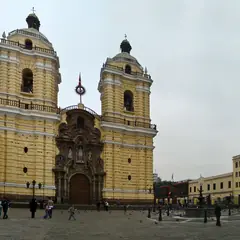
The cathedral presides over the eastern side of the Plaza Mayor of Lima, and a few streets away the San Francisco Convent tells another version of the same story: a viceregal temple rebuilt after the 1655 earthquake.
Pizarro’s beam and two late towers
Lima Cathedral
Summary of this stop
Before the Portada del Perdón, the cathedral presents itself as the city’s showcase. The central stone doorway, flanked by the Epistle and Gospel doors, gathers the apostles in niches, the Sacred Heart in the centre and, at the top, the coat of arms of Peru, in the place once held by the city’s own with the motto Plus Ultra. It all began in 1535 with a public gesture: Pizarro himself carrying the first beam of the works.
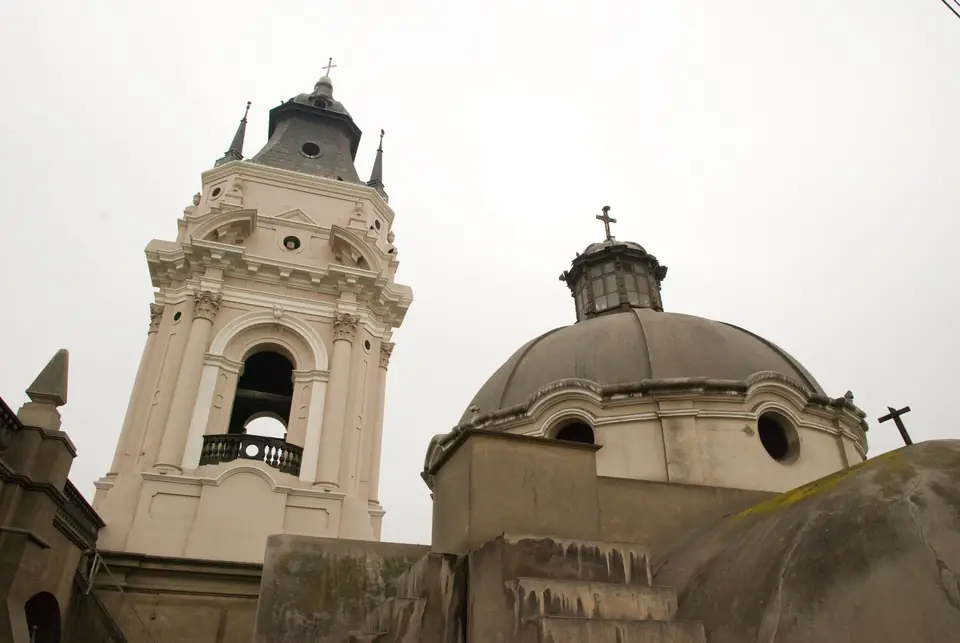
The two bell towers, 45 m tall with slate spires, are much later than they look. They were left unfinished after the 18th-century reconstruction and rebuilt between 1794 and 1797, when the priest Matías Maestro completed them. In the one on the left hangs the Cantabria, a 300-quintal bell cast in Lima itself.
Every October, the purple month, this façade changes colour: the Lord of Miracles, the Cristo Moreno of Pachacamilla, enters the Plaza Mayor in procession and receives the homage of the president, the mayor and the archbishop, the latter from the Archbishop’s Palace beside the cathedral, among purple and white balloons, flowers and fireworks. How far Pizarro’s first beam stands from these neoclassical towers is understood by listening to it right there.
From a thatched hut to the cathedrals of Andalusia
Three naves of equal height
Summary of this stop
At the foot of the central nave opens a clear hall of three naves of the same height, 21 m, held up by 14 pillars. That space was born from a plan: that of the Trujillo-born architect Francisco Becerra, called from Cusco in 1585, who took the cathedrals of Jaén and Seville as models. When he died, in 1605, only half the temple was built, and barely three years earlier the king was still calling Lima’s main church a hut.
These same naves were the stage for a custom that now seems impossible. According to documented tradition, every Holy Thursday, from Lima’s earliest days until 1812 and again between 1815 and 1820, the Alférez Real rode into the cathedral on horseback: dressed in old Spanish style, on a white horse with a crimson velvet caparison embroidered in gold, he crossed the central door with the city’s standard and waved the flag three times before the monument of the Blessed Sacrament.
Half of Lima filled the atrium and the naves to judge the rider’s skill, a hereditary office that belonged to the Marquis of Castellón. The Cortes of Cádiz abolished the parade of the standard in 1812 and in 1821 it was no longer held. How the horse left the church without turning its back on the altar is one of the details the narration keeps for this point.
The mummy that was not Pizarro
Francisco Pizarro's funerary chapel
Summary of this stop
The first chapel of the right nave, covered entirely in mosaics alluding to the Conquest, is Francisco Pizarro’s funerary chapel. Beside the coat of arms of Lima stand the sarcophagus with the remains found in 1977 and a chest of soil from Trujillo. The founder’s glory seems beyond question here, but the chapel holds a story that casts doubt on it.
In 1977, workmen repairing the crypt beneath the high altar found behind a wall a lead box whose inscription announced the head of the marquis don Francisco Pizarro. The skull fitted a skeleton with sword wounds, whereas the mummy exhibited as the conqueror since the late 19th century showed none; the bones took its place. The identification did not convince everyone: a symposium in December 1985 and two historians questioned it on the basis of a 1979 police study, and the debate remains open.
The ground of this story also has its own past. According to tradition, the cathedral rose on the site of the Inca shrine of Puma Inti and the palace of Sinchi Puma, the Cusco prince whom Pizarro made renounce his property before a notary. Who the mummy displayed for decades really was is the question that accompanies the listening in this chapel.
Guayaquil pillars disguised as stone
Wooden pillars and vaults
Summary of this stop
In the centre of the main nave comes the cathedral’s great revelation. The 1609 earthquake damaged the vaults already built, and the groin vaults were replaced by ribbed vaults of cedar wood, lighter and more flexible. Their Gothic ribs draw a starry sky of wood and stucco that, seen from below, anyone would take for stone.
The definitive test came on the night of 28 October 1746. That earthquake killed more than 10,000 people, a fifth of Lima’s population, and left the cathedral almost in ruins. By order of Viceroy Manso de Velasco and following the old plans, the Prague-born Jesuit Juan Rher directed the reconstruction with intensive use of wood and quincha in the vaults, completed in phases in 1755, 1758 and 1778.
It was then that the old brick pillars gave way to thick wooden beams brought from Guayaquil, covered in masonry to look like stone. How Lima learned, earthquake after earthquake, to build something that bends instead of breaking is told by listening to the narration beneath these vaults.
Choir stalls under four layers of paint
Choir stalls
Summary of this stop
The tour ends before the high altar, today flanked by the choir stalls, which once occupied the centre of the nave. They came out of a public competition called in 1623 in which five sculptors took part; the Catalan Pedro de Noguera won it, although litigation delayed the work, and the carving, on a design by Martín Alonso de Mesa, was finished in November 1632. Sources do not agree on the exact year it began. On the backs appear saints, apostles, popes and virgins, and on the canopied seat of honour, the figure of the Redeemer.
For years a good part of that work was hidden. In the 2004 restoration four layers of dark paint covering 53 carved panels were removed, and the stalls once again showed their worked wood.
This altar is also the one for the country’s great dates: every 28 July it hosts the Mass and Te Deum for Independence with the President of the Republic, and every 18 January the Mass for the anniversary of Lima’s founding with the mayor. The first of those thanksgivings was held on 29 July 1821, at San Martín’s request, presided over by Archbishop Bartolomé María de las Heras, a Spaniard and signatory of the Act of Independence. What became of him a few weeks later is the closing the audio guide keeps for the end.