Founding square
Plaza Mayor of Lima Audio Guide
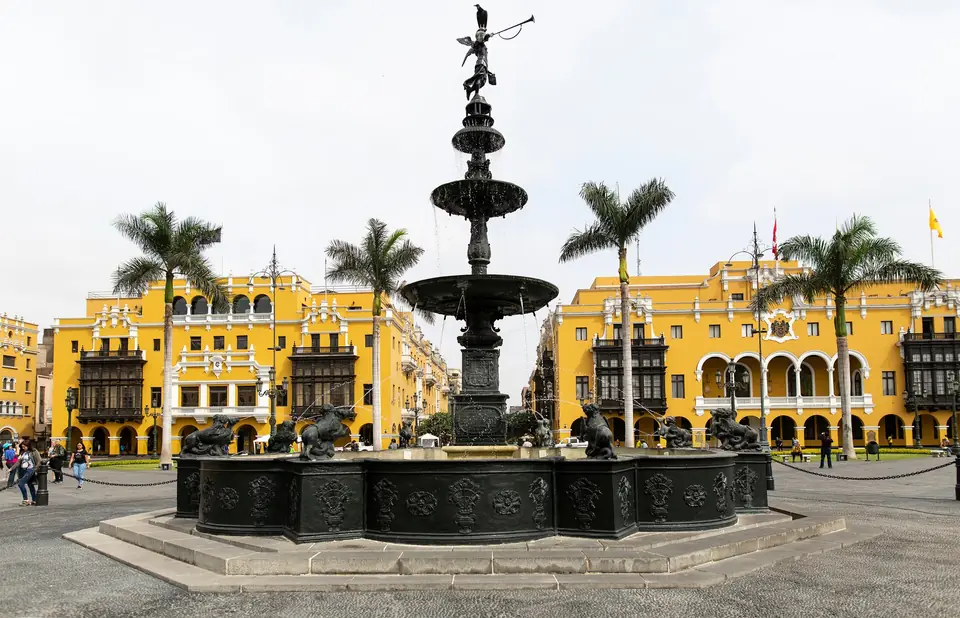
Lima was born on this plain in 1535 around a gallows post; today it is presided over by a bronze fountain of 1651, the only thing that has withstood bullfights, bonfires, earthquakes and revolutions.
- 30 min of audio
- Viceregal historic centre
The Plaza Mayor of Lima, also called Plaza de Armas, is the starting point of the city: on 18 January 1535 Francisco Pizarro planted the rollo, or gallows post, at its centre and divided the surrounding plots, the north for himself, the east for the church and the west for the town council. On that same layout stand today the Government Palace, the Cathedral, the Archbishop's Palace and the Municipal Palace, and in the centre remains the bronze fountain opened on 8 September 1651, the oldest element still standing.
Almost everything else is recent. The earthquakes of 1687 and 1746 forced the viceroys to live on the square itself, and the façades around it date from the 20th century: the Archbishop's Palace of 1922, the Government Palace of 1938, the neocolonial arcades of 1940 and the Municipal Palace of 1944. Until 1855 it did not even have paving or gardens. And the same fountain that saw autos-da-fé pass poured out, in July 2009, some 1,300 litres of pisco over three hours.
Highlights
- Bronze fountain of 1651, the oldest thing on the square, crowned by an Angel of Fame that is a 1997 replica
- Government Palace on the plot Pizarro kept in 1535, with the changing of the guard by the Húsares de Junín
- Stage of the proclamation of independence on 28 July 1821, before more than 16,000 people
- Portal de Escribanos, the town council's box for bullfights, processions and autos-da-fé
- Pasaje Olaya, the old rollo alley, named after the fisherman shot there in 1823
The story of the Plaza Mayor of Lima begins with a gesture of power. On 18 January 1535 Francisco Pizarro planted at the centre of the plot the rollo, or gallows post, the tall timber where the condemned were executed, and divided up the surroundings: the entire block on the north side, as far as the Rímac river, for himself; the east side for the church and the priest’s house; the west for the town council. Almost five centuries later, that division is still in sight, because on those same plots stand today the Government Palace, the Cathedral and the Municipal Palace.
During the Viceroyalty this plain was at once market, bullring and scaffold, and in the republic it was the stage for the proclamation of independence. Until 1855 it was a large expanse with no paving or gardens; that year Ramón Castilla opened here the first public gas lighting and its first flowerbeds were laid out. What the visitor finds today is a landscaped square fenced in by 20th-century façades, with a single truly old piece in the centre: the bronze fountain of 1651.
Every October, moreover, the procession of the Lord of Miracles enters the square and receives the homage of the municipality and the Government Palace, an appointment so deep-rooted that the year it did not enter, 2022, made national news. The audio guide walks the square from the fountain towards the northern edge and circles it to the arcades of the south side, with documented narration checked against historical sources that reads in each façade a different episode of its history.
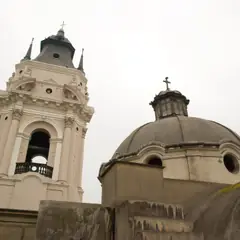
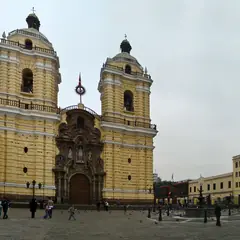
From the square, the visit continues at Lima Cathedral, which occupies its eastern side, and at the San Francisco Convent, a few streets away; republican Lima has its own stage in Plaza San Martín.
Where the gallows post became a fountain
Bronze fountain of the Plaza Mayor
Summary of this stop
In the centre of the square, where Pizarro drove in the execution post, the bronze fountain now stands. It is not the first: Viceroy Francisco de Toledo had an earlier one built, opened on 21 October 1578 with bullfights, harquebus salvos, trumpets, shawms and coins thrown to the crowd. The present one was commissioned by Viceroy the Count of Salvatierra and opened on 8 September 1651; Juan Bromley attributes it to the Lima founder Antonio de Rivas, although another version credits its design to the sculptor Pedro de Noguera.
At the top, the Angel of Fame holds a bugle in his right hand and a flag with the arms of Lima in his left. But the figure seen is not the original: that one fell and was lost during the repairs ordered in 1900 by Mayor Federico Elguera, and today’s is a replica placed in 1997.
The bronze has also had less solemn uses. In July 2009, for Fiestas Patrias and National Pisco Day, its four adapted spouts poured about 1,300 litres of quebranta pisco over three hours, and in 2018 it was repeated with up to 1,500 litres. How this spot went from being the place of punishment to the place of the toast is the key with which the narration opens its reading of the whole square.
The palace built on Pizarro’s plot
Government Palace of Peru
Summary of this stop
The north side is taken up by the Government Palace, opened in 1938 on the block Pizarro awarded himself in 1535. That plot was also the scene of his death. According to the account that has come down to us, on Sunday 26 June 1541, at the hour of the noon mass, nineteen Almagrists led by Juan de Rada crossed this square towards the marquis’s house before more than five hundred people who watched them pass without moving.
Inside, the guests fled through corridors and windows, and the mayor Juan de Velázquez, who hours earlier had sworn to protect him as long as he held the judge’s staff in his hand, lowered himself into the street with that same staff between his teeth. Pizarro, aged sixty-four, fell from a thrust to the neck; tradition says he traced a cross of blood on the floor with his finger and kissed it. The conspirators came out into the square shouting against the “tyrant”, and only the pleas of the bishop of Quito prevented them from dragging the corpse.
Today, before the same door, the Húsares de Junín No. 1 Cavalry Regiment, escort of the President of the Republic, performs the changing of the guard before the crowd in the square. The contrast between that motionless crowd and the one that gathers today to watch the hussars is the thread the audio guide follows in front of the façade.
Pizarro, a statue with no fixed place
Plaza Perú
Summary of this stop
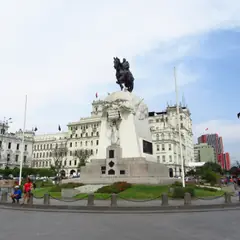
At one corner of the square opens the so-called Plaza Perú, which was formerly called Plaza Pizarro. There stood from 1952 to 2003 the equestrian statue of the conqueror, the work of Charles Rumsey, about 5 metres tall and 7 tonnes, inaugurated in 1935 for Lima’s fourth centenary. In 2003 it was removed, in 2004 moved to the Parque de la Muralla and in January 2025 it returned to the vicinity of the square, with a small protest nearby.
The corner reads better beside another date. On 28 July 1821, at ten in the morning, José de San Martín proclaimed here the independence of Peru before more than 16,000 people, with the Marquis of Montemira carrying the first flag, which then went round the square in procession. It is the documented and official proclamation, although San Martín had already declared it in November 1820 from a balcony in Huaura, with no act to prove it, and that same day in 1821 it was repeated in other squares of Lima.
The square that saw the republic born renamed the founder’s corner as Perú and has moved his statue from place to place for almost a century. What that coming and going says about how Lima looks at its own origin is the question the narration leaves posed at this corner.
The arcade from which bulls and bonfires were watched
Portal de Escribanos
Summary of this stop
On the western side, beneath the Portal de Escribanos, the square is understood as a permanent stage. From the council balconies the aldermen watched processions, bullfights and autos-da-fé; for that of Sunday 5 April 1592, the council even put up a wooden stand. The first of the Lima Inquisition was held on 15 November 1573: six penanced prisoners and the burning sentence of the French hermit Matheus Saladé, Mateo Salado, aged 47, held since 1571 for heresy. Whether the flames burned on the square itself or at a burning ground near today’s Acho bullring is something the sources do not resolve.
The building seen is the Municipal Palace, completed in 1944 in neocolonial style with wooden balconies. But this arcade also holds a story of republican Lima: between the 1820s and 1850s Juan José Cabezudo, “Comesuelas”, had his food stall here, an Afro-Peruvian cook of tamales and criollo dishes, in ruffled and polka-dot shirts and with satirical patter, today recognised as the first openly gay Peruvian figure.
He was so famous that he was commissioned for Simón Bolívar’s farewell lunch in 1826 and was portrayed by Pancho Fierro and the studio of Eugenio Courret. How he earned fortunes in this arcade and where they went every summer is the episode with which the audio guide closes this stop.
Olaya, the fisherman who did not speak
Pasaje Olaya
Summary of this stop
On the south side, among the neocolonial arcades of 1940 with their wooden balconies, opens the Pasaje Olaya, the old Callejón de Petateros. For centuries the execution post stood here: Viceroy the Count of Nieva had moved it towards the river to build the fountain in the centre, then it came back to this side of the square and, after an attempt to take it to Santa Ana square in 1668, it returned the following year.
The passage bears the name of José Silverio Olaya, a fisherman from Chorrillos who carried letters between the patriots of Lima and the independent government sheltering in the castles of Callao. Arrested in June 1823 with a letter from Sucre, he was tortured on the orders of the royalist governor Ramón Rodil without revealing a single name, and on 29 June he was shot in this alley. His body lay exposed on the square all afternoon, until at night some fishermen took it to his village, where nobody today knows where it rests.
Around it, the façades tell the other half of the story: the 1746 earthquake destroyed 90% of Lima’s colonial civil buildings, and what surrounds the square today was raised in the 20th century. How the passage, the new façades and the fountain of 1651 fit into one reading is the synthesis with which the tour ends.