Limeño Baroque
San Francisco Convent Audio Guide (Basílica y Convento de San Francisco de Lima)
A whole city inside a convent: the pope's coat of arms on the façade, Sevillian azulejos in the cloister, a Last Supper with guinea pig on the table and, beneath the church, the bones of viceregal Lima arranged in a well.
- 75 min of audio
- Baroque and catacombs
The Franciscans began here with a brush shelter as a chapel, and in 1546 Fray Francisco de Santa Ana raised a small church that the earthquake of 4 February 1655 brought down. The present church, to plans by the Portuguese Constantino de Vasconcellos and built by the Lima master builder Manuel Escobar, opened on 3 October 1672, and the convent kept growing until 1729. Its stone retable-façade is one of the great pieces of Limeño Baroque, and inside await a cloister of Sevillian azulejos, a Mudéjar cedar dome, choir stalls of 130 seats and a library of more than 20,000 volumes.
The convent's wealth came to trouble the friars themselves, bound by a vow of poverty, until Pope Clement X settled the debate by declaring the monument property of the Holy See. Beneath so much splendour lies the other side: the catacombs where confraternities, guilds and families buried their dead during the Colonial period, sealed under the Republic and opened to the public in 1950, with an anti-seismic well turned into an ossuary.
Highlights
- Stone retable-façade with the papal coat of arms carved in 1672
- Cloister with Sevillian azulejo dados from Hernando de Valladares's workshop and 39 canvases of 1671
- Mudéjar cedar dome of 1625 above the staircase, rebuilt after the 1940 quake
- Refectory Last Supper with guinea pig, potato, rocoto and ají on the table
- Catacombs with ossuaries and a 10-metre well dug to hold up the basilica
In the historic centre, the San Francisco Convent gathers in a single block almost every layer of viceregal Lima. Its story begins with a brush shelter that Fray Francisco de la Cruz raised as a chapel on the plot granted to the Franciscans, next to that of Santo Domingo. In 1546 Fray Francisco de Santa Ana recovered the land and built a small church, which Viceroy Andrés Hurtado de Mendoza helped to enlarge along with the convent. Tradition adds an episode about how the block grew: Viceroy the Marquis of Cañete is said to have granted them all the land they could fence in one night, and at dawn the friars had four hundred varas of frontage and even a public street inside.
That first church did not survive. As early as 1614 Fray Miguel de Huerta, the convent’s master of works, warned that its pillars barely had foundations, and the earthquake of 4 February 1655 brought it down. The present church was raised on the same site to plans by the Portuguese architect Constantino de Vasconcellos and built by the Lima master builder Manuel Escobar: Viceroy the Count of Alba de Liste laid the first stone on 8 May 1657 and the church opened on 3 October 1672. Work on the convent continued until 1729, and the complex is part of the UNESCO-inscribed Historic Centre of Lima, in 1988 or 1991 depending on the source.
The history and architecture of the San Francisco Convent are read from top to bottom: from the Baroque façade to the cloister, from the cedar dome to the refectory and, at the end, to the catacombs. The audio guide’s route, a narration documented and checked against historical sources, follows that descent stop by stop, in front of each piece.
A few streets away lie the Plaza Mayor of Lima, where the city was laid out in 1535, and Lima Cathedral, another viceregal temple rebuilt again and again after earthquakes.
A papal coat of arms before the recovered square
San Francisco square
Summary of this stop
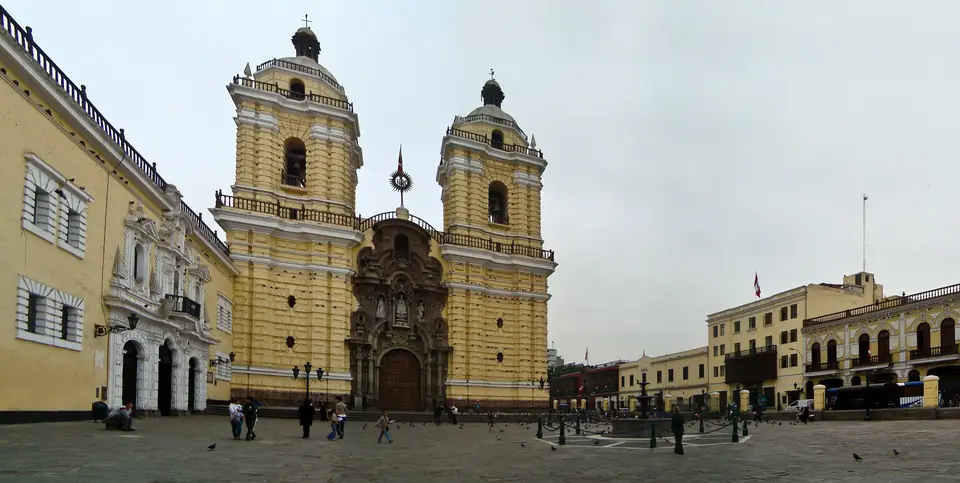
The visit starts in the square, facing the stone retable-façade: rhythmic rustication, niches with statues, Corinthian columns, a large oval window and, carved in the stone, the pope’s coat of arms. It is no mere ornament. In the mid-17th century the convent’s wealth opened a debate among the Franciscans because of their vow of poverty, and Clement X settled it by declaring the monument property of the Holy See; his coat of arms was placed on the façade in 1672, the year the church opened. On entering, a marble plaque recalls its elevation to minor basilica by John XXIII in 1963.
The square itself has a recent history. From 1989 a perimeter wall enclosed it, until the Municipality of Lima knocked it down in the small hours of 5 February 2022. The Franciscan order went to court, and in 2025 the Constitutional Court ruled that the wall had no heritage value and that the square is public space.
On the 28th of each month this block changes its look. From the early hours, hundreds of devotees of Saint Jude Thaddeus, the “patron of the impossible”, queue with bouquets of flowers along Jirón Lampa and Jirón Áncash, some on crutches or with babies in their arms. The Franciscan Apostolate of Knights of Saint Jude Thaddeus has had its seat here since 1941, and the feast has been Cultural Heritage of the Nation since 2017. What the convent keeps for those devotees, and the silver processional float that goes out in November, is part of what the narration tells at this first stop.
A convict’s azulejos and hidden murals
Sevillian azulejo dado
Summary of this stop
The main cloister, with eleven round arches per side, has its dado clad in Sevillian azulejos from the workshop of Hernando de Valladares, from the first half of the 17th century, with Franciscan saints and a different design in each stretch. The exact date is disputed: some sources say 1620 and others 1642. Above them hang 39 canvases of 1671 on the life of Saint Francis, and under the Mudéjar cedar ceilings carved altarpieces stand in the four corners.
Those walls held a surprise. In 1974, when the canvases were taken down for restoration, Mannerist mural paintings from the first third of the 17th century turned up behind them by chance, and remains can be seen today where they were removed.
The azulejos also have their own legend, gathered by Lima tradition: that of Alonso Godínez, sentenced to the gallows in 1619 for killing Marta Villoslada, and a convent guardian who discovered in confession that the convict knew pottery. In the convent, thousands of azulejos donated by the cacica Catalina Huanca had lain in a corner for years, with nobody in Lima able to lay them. How that morning at the foot of the scaffold was played out, and what price the convict paid to save himself, is revealed in the cloister itself.
The dome of the friar who feared earthquakes
Mudéjar wooden dome
Summary of this stop
Halfway up the pastry-coloured brick staircase, looking up, the wooden half-orange dome appears with geometric decoration of Mudéjar design. It is attributed to Fray Miguel de Huerta, the same who in 1614 warned that the first church rested on rubble, and is dated to 1625, with wood from Costa Rica. The 1940 quake collapsed its central part, which the architect Alberto Barreto Arce restored in 1969: only the pendentives are original. The chronology is not unanimous, and other versions speak of a second dome in 1725 or of a reconstruction in the 1970s.
The upper floor holds two other major pieces. The high choir, 22 by 12 metres, keeps a Baroque set of 130 stalls carved in Costa Rican cedar, with 71 figures in high relief and a revolving lectern in the centre for the choir books. And the library, with two-storey shelving joined by two cedar spiral staircases, holds more than 20,000 volumes (about 25,000 according to other sources), among them incunabula, the Antwerp Biblia Regia and the first dictionary of the Real Academia Española.
That library survived the 1746 earthquake and needed cracks and roof repaired after the quake of 15 August 2007. How a house that lives with one eye on the shaking ground has managed to keep its books, and what story is told about the wood of the cloister’s coffered ceilings, is left for the narration beneath the dome.
A guinea pig served at the Last Supper
Refectory Last Supper
Summary of this stop
In the old refectory, the far wall is taken up by a large Last Supper attributed to the Jesuit Diego de la Puente, dated 1656 or 1658 depending on the source. At first glance it is the usual subject; dish by dish, the table reveals Andean foods: potato, rocoto, ají and a plate of guinea pig.
Around the canvas hangs the series of apostles from Zurbarán’s workshop, and very close, in the De Profundis room, eleven canvases of Christ’s Passion from Rubens’s workshop, about three metres across, hang beside a lattice balcony that once stood in the Government Palace. In the chapter house, between two rows of high-backed seats, the regular clergy signed the Act of Independence, while the secular clergy did so in the cathedral.
What that Last Supper says about the painters who worked in Lima, and why it could only be painted here, is what the narration unpacks in front of the painting.
An anti-seismic well turned into an ossuary
Catacombs ossuary well
Summary of this stop
Beneath the church, confraternities, guilds and families buried their dead in vaults opened under the chapels, joined by corridors from 1657. The brick and lime-and-stone vaults now show skulls, femurs and tibias arranged by type in pits, and at the far end waits a well 5 metres in diameter and 10 deep, dug to absorb seismic waves and hold up the basilica, turned into an ossuary. The figures are disputed: about 25,000 bodies are mentioned, although other sources reach 70,000, and popular memory links these corridors with the Cathedral or the Government Palace, something that is not proven.
General José de San Martín banned burials here in 1821, although clandestine burials continued; under the Republic the catacombs were sealed and in 1950 they were opened to the public. In the Crypt of the Venerables rests José Mojica, a Mexican tenor of the Chicago Opera and film actor who left his career to become a Franciscan in Peru, was ordained a priest in 1947 and died in this convent in 1974.
The convent also keeps the relics of Saint Francis Solano, the Andalusian friar who preached through Lima with a skull in his hand and whom the Cabildo swore as the city’s patron in 1629. A disputed story circulates about his body, that of some friars who for a long time supposedly could not say exactly where it was; how that story ends is the last twist of the tour, told before the well.