Lima culture pyramid
Huaca Pucllana Audio Guide
Among the apartment blocks of Miraflores rises a mud pyramid some fifteen centuries old: a temple devoted to the sea, rebuilt again and again, later taken over by the dead of other peoples and rescued by a hair from the city around it.
- 60 min of audio
- Pre-Inca archaeology
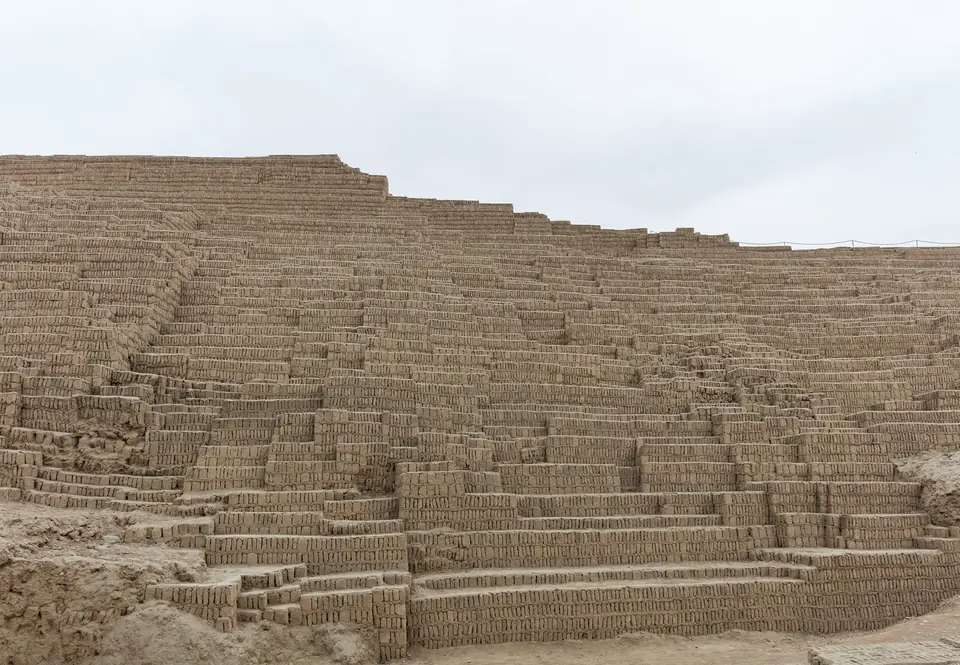
Huaca Pucllana is a ceremonial centre of the Lima culture, built during the Regional Development period, which most sources place between 200 and 700 AD. Today it sits wedged between Independencia, General Borgoño, Elías Aguirre and García Calderón streets, in the heart of Miraflores. Its great pyramid of seven stepped platforms measures about 25 metres, although at its builders' height it reached 36, and is made of millions of small adobe bricks of mud, water, stone and crushed shells.
The mound came close to vanishing. From 1940 the parcelling of farmland destroyed smaller pyramids and reduced the archaeological zone to 6 hectares, less than a third of its original extent, and in the 1960s the earthen hill, also used as a dump, was a motocross and BMX track that almost nobody recognised as a pyramid. The rescue began in 1981, and in 2017 the Ministry of Culture updated its declaration as Cultural Heritage of the Nation.
Highlights
- Bookshelf-technique walls: adobe bricks set on end like books on a shelf, in trapezoidal anti-seismic panels up to 8 metres high
- Stepped Great Pyramid: seven platforms that grew over earlier buildings buried under fills of river cobbles
- Hatun Pata, the great plaza where 26 sacrificed women appeared in the fills
- Ritual shark banquets and tricolour pottery with sea lions and eels in honour of the sea
- Wari cemetery on the summit: elite tombs from 800 to 900 AD, one found intact in 2011
The story of Huaca Pucllana is that of a temple that refused to disappear. The Lima culture built it in what is now Miraflores during the Regional Development period; most sources place the occupation between 200 and 700 AD, although other publications reserve the 5th to 7th centuries for the monumental architecture. Its builders worshipped the sea, and the pyramid seen today is only the last of a series of works raised one on top of another, each sealed with rites that archaeology has been bringing to light.
Then other peoples came. The Wari elite turned the summit into a cemetery between 800 and 900 AD, and later the Ychsma buried their dead there. Centuries later, the city ate up two thirds of the site, and in the 1960s what remained was a mound of earth that served as a dump and a motocross track, also called Huaca Juliana. The research and enhancement project led by the archaeologist Isabel Flores Espinoza began in 1981, and the site museum opened its exhibition hall in 1984.
Even the name has its own story. Pucllana is usually translated from Quechua as “place of play” or “sacred place of play”, but it is a colonial name: the ethnohistorian María Rostworowski found it in documents where the curaca don Pedro Chumbi Charna cited the site of Pugliana as the boundary of his lands, and other papers call it Pullana or Puliana. What it truly meant remains open. The audio guide climbs from the first wall to the summit viewpoint with documented narration checked against historical sources, reading each layer of mud as a different chapter.
Ancient Peru continues in the display cases of the Larco Museum, and further south, in Barranco, the Bridge of Sighs tells another Lima by the sea, that of the 19th century.
A library of adobe bricks in Miraflores
Huaca Pucllana
Summary of this stop
Just past the entrance the first wall appears, and it takes only a step closer for the mud to start falling into order. The adobe bricks are not laid flat but set on end, one beside another, with mortar only at the base and the top and small gaps at the sides. The archaeologist Pedro Villar Córdova named the bonding the “bookshelf technique”, because the wall looks like a shelf full of books.
That order has a reason. The whole complex was built with millions of hand-made adobe bricks of mud, water, stone and crushed shells, and the walls form trapezoidal panels, wider at the base and slightly inclined, which on the sides of the great pyramid reach 8 metres high. It is an anti-seismic solution that has stood up to more than a thousand years of earthquakes.
On the other side of the wall the traffic of Miraflores carries on, and the contrast between that mud engineering and the buildings around sets the tone for the whole tour. Why such small gaps make a wall so resistant is understood by listening to the narration in front of the bricks themselves.
Hatun Pata, the plaza of the twenty-six women
Hatun Pata great plaza
Summary of this stop
In the lower part of the complex opens Hatun Pata, the great plaza, an esplanade that today looks empty. Beneath it hides the temple’s harshest logic. Before each remodelling of the architecture, three rites were held almost at once: human sacrifices, the breaking of large vessels decorated with marine motifs, and banquets. In this plaza 26 sacrificed women appeared, buried in the fill with plain cloths and no offerings.
The excavation has not stopped. In the 2026 season, beside the base of the pyramid, an adult, probably a man, appeared, laid down around 650 AD as an offering when an underground channel linked to a ceremonial well was closed. He lay on his left side, with his skull facing the pyramid and the sea, and the well was made of river cobbles, something unusual on a site built with adobe bricks. What makes that well so strange amid so much mud is part of what is told in the plaza.
Shark banquets on yellow walls
Zigzag ramps and stepped courtyards
Summary of this stop
From the plaza, the circuit climbs by ramps and zigzag passageways that lead from one level of the pyramid to the next. The mass walked today has seven stepped platforms and, according to most sources, about 25 metres in height, although others say 23 and at its height it reached 36. What is visible is the last of several successive constructions: the earlier buildings were buried under fills of river cobbles and grey sand, so that the pyramid literally grew over itself.
That mass was not mud-coloured. Its walls were covered with a fine plaster painted yellow many times over, a colour of strong sacred charge, and in the courtyards with stepped structures, also yellow, the elite gathered for ceremonies. On the ramps and passageways ritual banquets were held in which seafood dominated and, for its symbolic value and the amount of meat, shark.
The main deity was the sea itself, represented with sharks, sea lions and eels on the tricolour pottery, red, white and black, of the Late Lima style. How a feast from fifteen centuries ago is reconstructed from broken vessels and food remains is explained halfway up the climb.
The summit the Wari took as a trophy
Wari cemetery on the summit
Summary of this stop
At the top, the truncated summit of the Great Pyramid changes owners. After the Lima culture abandoned the temple, the Wari elite turned it into a cemetery between 800 and 900 AD. In 2011 Isabel Flores Espinoza’s team found here a Wari tomb with four bundles, a woman and three children: the only intact one of the 62 excavated until then.
The tombs tell a story of conquest. In 2013, on the sixth platform, 22 metres up with a view of the Pacific, another elite burial appeared: a figure wrapped in a reed mesh, crouching, with a false head now gone, and beside him a child as an offering, next to guinea pigs, purple corn and gourds decorated with running felines. According to Flores, the Wari, warriors who came from the highlands, opened holes in the pyramid of the Lima, fishermen and farmers who worshipped the sea, to bury their leaders as a sign of dominance over their predecessors.
The temple of one people turned into the pantheon of another is the great revelation of this stop. What the archaeologist said about how those children were laid is kept for the narration on the summit itself.
From Morro Solar to the motocross track
Summit viewpoint
Summary of this stop
The summit viewpoint closes all the layers at once. Around the year 1000, when the pyramid was already a sacred place, the Ychsma used it as a cemetery and left offerings of human hair inside gourds or wrapped in achira leaves, scattered over the esplanade and tucked even into the cracks. According to the finds, they buried their dead seated, with legs flexed and feet crossed, and almost all face south, towards Armatambo, with Morro Solar in sight: none has appeared facing north or west.
Around it, the city tells the other half of the story. From 1940 the houses, avenues and parks built on the old farmland took over two thirds of the site, and in the 1960s the mound, covered in earth and vegetation, was a motocross and BMX track past which neighbours walked daily without knowing it was a pyramid.
The rescue came in 1981, with an agreement between the Municipality of Miraflores and the Ministry of Culture and the project led by Isabel Flores Espinoza. What can be seen today from the top that the Ychsma also saw as they buried their dead is the closing the audio guide keeps for the viewpoint.