Pre-Columbian art
Larco Museum Audio Guide (Museo Arqueológico Rafael Larco Herrera)
It all began with a single vessel given from father to son. Half a century later, that Moche piece had grown into a refuge against looting with tens of thousands of objects from ancient Peru, kept in a viceregal mansion in Pueblo Libre.
- 90 min of audio
- Moche ceramics and Chimú gold
The Larco Museum occupies a Lima mansion of 1700, the former Cueva hacienda, which Rafael Larco Hoyle bought in the 1950s and remade with grilles, doors, columns, beams and brackets brought from the house of the marquises of Herrera and Villahermosa in Trujillo. Inside it gathers one of the great collections of ancient Peru, between 45,000 and nearly 50,000 pieces depending on the source, surrounded by gardens of bougainvillea.
Its founder was also an archaeologist: he excavated the north coast, identified the Cupisnique and Salinar cultures and in 1946 proposed the first chronological ordering of the region, before radiocarbon existed. And he opened to the public what other museums hide: its storeroom, with some 30,000 ceramics on shelves, open to visitors since 1926.
Highlights
- The founding portrait huaco: the Moche bottle of 1923 with which the collection began
- Chimú gold attire: crown, ear ornaments, necklace, pectoral and shoulder pieces, the only complete one known in museums worldwide
- Visitable storeroom: aisles with some 30,000 classified ceramics, the only one open to the public in Peru
- Checan Erotic Gallery: ceramics that survived centuries of destruction and censorship
- Mansion of 1700: grilles, columns and beams brought from a stately house in Trujillo
The story of the Larco Museum fits in a date and a gesture. On 28 July 1926, Peru’s Independence Day, a 25-year-old Rafael Larco Hoyle opened a museum on the sugar hacienda of Chiclín, near Trujillo, and gave it the name of his father, still alive, to raise him a monument in his lifetime. A year earlier his uncle, Víctor Larco Herrera, had urged him to put the pieces in safekeeping that looters were relentlessly plundering in the north of the country. The starting point was a single vessel.
Since then the collection has never stopped growing: the purchases of 1933 in Trujillo and the Santa valley added thousands of ceramics, textiles and metals, and in the 1950s everything moved to Lima. The figures vary by source, between about 45,000 and nearly 50,000 pieces, but the scale can be felt without counting. What to see at the Larco Museum runs from the first huaco to Chimú gold, from the open storeroom to the erotic gallery, and the audio guide follows that path with a narration documented and checked against historical sources, which keeps for each room its most unexpected episodes.
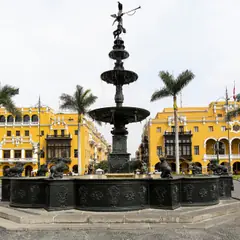
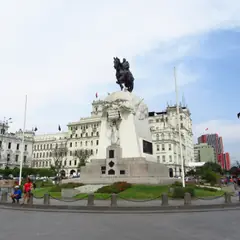
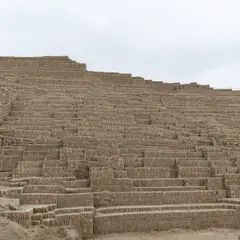
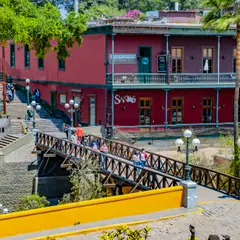
Outside the display cases, ancient Peru still stands at Huaca Pucllana, the adobe pyramid of the Lima culture in Miraflores; republican Lima of the 1920s is read in Plaza San Martín, and the coastal one at the Bridge of Sighs in Barranco.
A Lima mansion with bones from Trujillo
Larco Museum
Summary of this stop
In front of the doorway on Calle Navarra, the architecture of the Larco Museum already tells a story of relocations. The mansion dates from 1700 and was known as the Cueva hacienda; Larco Hoyle bought it from the Luna Cartland family and remade it with pieces from another house and another city: grilles, doors, columns, beams and brackets from the house of the marquises of Herrera and Villahermosa, in Trujillo.
Around it, gardens and terraces covered in bougainvillea of many colours over pale walls. And beneath, according to a tradition repeated by some tourist websites, a pre-Columbian pyramid of the 7th century on which the mansion is said to have been raised. The museum’s official pages describe the building and its gardens without mentioning any pyramid, so the claim stays in the realm of what is told.
The building, in any case, is already a collection of layers before crossing the door. Which of them is most surprising is revealed by listening to the narration right there.
The huaco the father did not give to Spain
Founding portrait huaco
Summary of this stop
In its display case, the founding portrait huaco shows the face of a Moche elite figure with a headdress of bird heads and ear ornaments. It is 31.5 centimetres high, appears in the catalogue as ML013572 and was a gift: in 1923 Rafael Larco Herrera gave it to his son, and with it everything began.
The father had been collecting pre-Columbian ceramics from northern Peru since 1903, but that set did not stay in the country: he donated it to Spain, where according to the museum it is on show in the Museo de América in Madrid (one source places it in the Prado). Of that whole collection, he kept only the piece he put in his son’s hands.
Three years later, that gift had become a museum on a sugar hacienda. What that clay gaze says about the person it portrayed is left for the audio guide.
The only Chimú gold attire that survived
Chimú gold attire
Summary of this stop
In the gold room, against a dark background, shines the Chimú attire of display case 156: a four-feather crown, ear ornaments, necklace, pectoral and shoulder pieces of repoussé gold, with figures of the great lord holding severed heads. It is the only complete Chimú gold attire known in museums worldwide, and it probably belonged to a great lord of Chan Chan.
Its rarity has a bitter explanation: similar pieces ended up melted down after the Spanish conquest. And it is not an untouched workshop treasure. The metal shows traces of wear, a sign that it was used in several ceremonies before being laid in the tomb.
On the way, the collection offers other pieces with a story, such as the Chimú cup that joins gold and silver, sun and moon. What ceremonies could have worn down that gold is one of the questions raised in front of the display case.
A storeroom open to the public since 1926
Visitable storeroom
Summary of this stop
The aisles of the visitable storeroom are where the scale of the rescue becomes physical: shelves with some 30,000 ceramics classified by culture and shape (35,000 according to the official plan). It has been open to the public since 1926 and is the only storeroom in Peru with that status. A good part arrived in 1933, with the Carranza collection from Trujillo, of more than 3,000 pieces, and the Roa collection from the Santa Clara hacienda, of more than 8,000.
Between 1933 and 1941 Larco Hoyle excavated the north coast, identified cultures such as Cupisnique in 1939 and Salinar in 1941, and in 1946 proposed the first chronological ordering of the region’s cultures, without radiocarbon dating.
Those pieces were ammunition in an academic duel with Julio César Tello, the great authority of his time, who saw in Chavín de Huántar the cradle of Andean civilisation. Larco maintained that high Peruvian culture had been born on the north coast and from there had risen to the highlands. How that duel between the hacendado of Chiclín and the patriarch of Chavín ended is told among the shelves.
The vessels that survived the hammer
Checan Erotic Gallery
Summary of this stop
The Checan Erotic Gallery occupies a space of its own. It gathers the selection that Larco Hoyle made for his book Checán, of 1966, a Moche word meaning “love”, and after its renovation it tripled its exhibition area. In the first room, display cases with the tree of life, a Salinar couple and keros; in the second, a stone phallus.
What draws laughter on entering hides a dark past. In the 1570s Viceroy Francisco de Toledo and his ecclesiastical advisers persecuted these practices, and many huacos ended up shattered. Later, in the 20th century, the “forbidden huacos” spent decades under lock and key, within reach of only a few researchers. Their meaning is still debated: the museum presents them as an expression of the tinkuy, the union of complementary forces that regenerates life, while the curator Steve Bourget linked them to funerary rituals and sacrifice.
In 2010, 134 of these ceramics travelled to the Quai Branly in Paris, the first time they were seen in Europe, and in 2022 their replicas served as models for the Liga Contra el Cáncer to teach male self-examination. How vessels persecuted for centuries ended up in a health campaign is the story that closes the tour.