Centenary square
Plaza San Martín Audio Guide
Lima built it in 1921 to celebrate its independence and ended up turning it into the place where it argues with itself: a liberator who hesitates atop the bronze, arcades out of a novel and a plaque of blood before which people still protest.
- 30 min of audio
- Neocolonial architecture
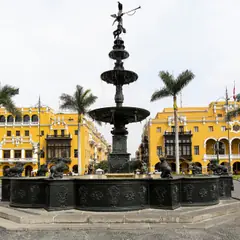
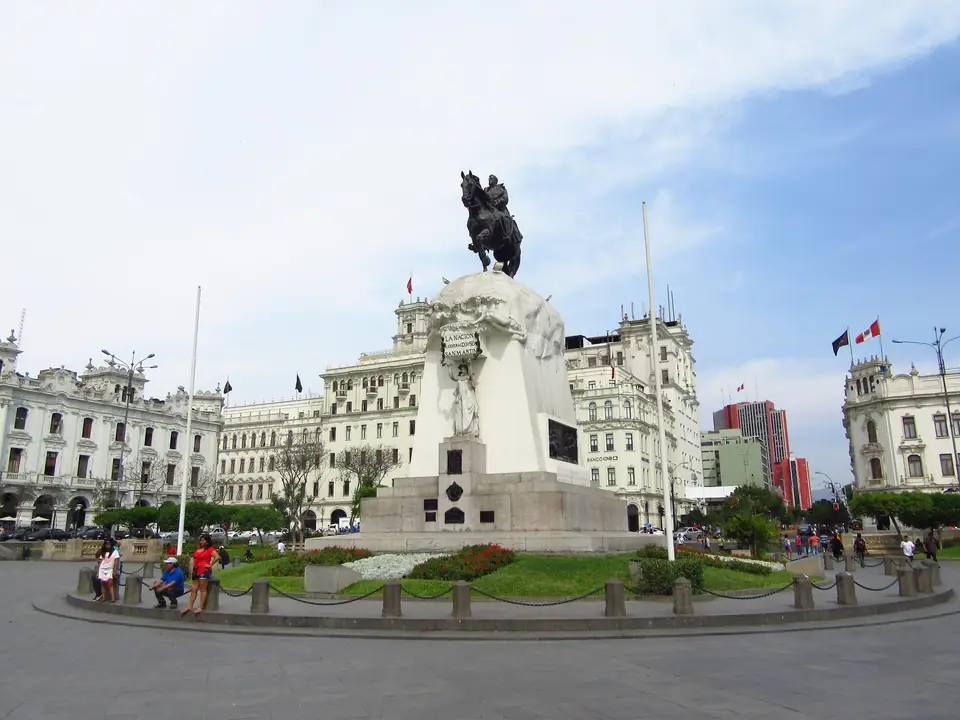
Plaza San Martín occupies a plot with a lot of earlier life: there stood the church and Hospital of San Juan de Dios, replaced between 1850 and 1860 by the San Juan de Dios and La Encarnación railway stations. After the demolitions of 1911 to 1918, President Augusto B. Leguía opened it on 27 July 1921, during the Centenary of Independence celebrations, with a layout by the Spaniard Manuel Piqueras Cotolí: 12,300 m² of granite, marble benches and balustrades and four fountains around Mariano Benlliure's equestrian statue.
The contrast lies in the hero himself. After seventy years of unfulfilled decrees, Lima did not receive a triumphant general but a brooding San Martín on a horse that advances with its front legs and brakes with its hind ones. Around him, the Zela and Pumacahua arcades and the neocolonial façades raised until 1945 make up a uniform backdrop that the city has filled with literary bars, political crimes and mass rallies.
Highlights
- Mariano Benlliure's equestrian statue, 16 metres with the pedestal, with a pensive San Martín and a horse that advances and brakes
- Allegory of Peru with a small llama on her head, quina branches and Glory and Fame with cornucopias
- The Gran Hotel Bolívar of 1924 and its bar of the Pisco Sour Catedral, served in a triple glass
- Neocolonial arcades of Zela and Pumacahua, with the Bar Zela of Conversación en La Catedral
- Plaque of 1950 opposite the Teatro Colón for the political crime of 1935 against the Miró Quesada couple
The story of Plaza San Martín begins long before the square. At this spot stood the church and Hospital of San Juan de Dios; between 1850 and 1860 they gave way to two railway stations, San Juan de Dios and La Encarnación, and between 1911 and 1918 these too fell. On 6 July 1917 the Municipality of Lima authorised the project, and on 27 July 1921 Augusto B. Leguía opened the enclosure in the midst of the Centenary of Independence celebrations. Long before, in 1825, in the plazoleta de la Micheo, one of the spaces the square later absorbed, the River Plate revolutionary Bernardo de Monteagudo had been murdered.
The layout, ornamentation, furniture and gardens were the work of the Spaniard Manuel Piqueras Cotolí: granite paving, marble benches and balustrades and four fountains over 12,300 m². Then came the buildings that enclose it. The Gran Hotel Bolívar opened in 1924 and set the language for everything else; the Zela and Pumacahua arcades were raised in 1926, and between 1930 and 1945 the Cerro de Pasco, Fénix, Cine Metro, Sudamérica and Boza buildings completed a front of uniform neocolonial façades. Beside the hotel still stands the streetlamp of the Three Graces, moved here in 1915, when the square did not yet exist.
What to see at Plaza San Martín goes beyond its architecture: since the 1930s the enclosure has been the usual stage of Lima’s protest. The audio guide walks it in five stops, from the monument’s pedestal to the Gran Hotel Bolívar, under the arcades of the Portal de Zela and on to the Teatro Colón, with documented narration checked against historical sources that reads the square as what it is: a space built to celebrate and used to argue.
The square is best understood facing the Plaza Mayor of Lima, its viceregal counterpoint of 1535, and alongside the Larco Museum, a collection of ancient Peru that opened to the public in 1926, in the same years as the Centenary.
The Motherland with a llama
Allegory of Peru with the llama
Summary of this stop
Facing the pedestal, the square shows its key to reading. A female figure personifying Peru holds the inscription “La Nación al General D. José de San Martín”, raises branches of the quina tree and wears on her head a small llama, the Andean camelid. Above her, two female nudes with cornucopias represent Glory and Fame. Together they reproduce the emblems of the coat of arms of Peru, in plain view at the heart of the monument.
That llama has its own disputed story. A widely repeated tourist version holds that the commission asked for a crown of flames, of fire, and that the Spanish craftsmen, because of the double meaning of the Spanish word, placed the animal; descriptions of the monument, by contrast, present it as a deliberate element of the coat-of-arms allegory. At the stop, the narration lays both readings on the bronze and lets the figure decide.
A horse that advances and brakes
San Martín equestrian statue
Summary of this stop
The monument arrived seventy years late. Ramón Castilla ordered in November 1850 a 20-foot column with San Martín’s statue; José Balta called a competition in 1869, Andrés A. Cáceres ordered the first stone laid in July 1890 and José Pardo opened another competition on 17 December 1904. None of those decrees was carried out until the Spanish sculptor Mariano Benlliure delivered a bronze equestrian statue on a granite pedestal in the form of a truncated pyramid, 16 metres high overall, showing San Martín crossing the Andes on horseback.
The unveiling was the central event of the 1921 Centenary, before official foreign delegations, and it had its stumble: the veil did not fall until the young Artidoro Cossio managed to untie the cloth’s ropes by hand. What appeared beneath still draws attention. The horse adopts a contradictory posture, with its front legs advancing with effort and its hind legs braking the step, and the rider has no martial attitude but a brooding one. On the flanks, the bronze high reliefs record the phrases of the blessing of the first flag and of the proclamation of independence; what that gesture of doubt says about the country is what the narration reveals right there.
The pisco sour drunk before mass
Gran Hotel Bolívar
Summary of this stop
On the north side rises the Gran Hotel Bolívar, a large block of Spanish Baroque expression signed by the architect Rafael Marquina and promoted by the Wiese brothers. It opened on 6 December 1924 to house the guests of the centenary of the battle of Ayacucho, was Lima’s first great modern hotel and in 1938 grew from three to five floors. Its architecture set the language of the buildings that came afterwards.
In the 1940s and 1950s the hotel was Lima’s salon for Hollywood: Orson Welles, Ava Gardner and John Wayne passed through, and many tried the pisco sour there. Its bar, known as “La Catedral del Pisco Sour”, keeps a local custom: the Pisco Sour Catedral, with up to six ounces of quebranta pisco against the usual four and served in a glass three times the normal size. According to tradition, the name comes from Augusto Wiese, owner of the hotel, who stopped by the bar before accompanying his family to Sunday mass at the Cathedral; another version extends it to the gentlemen who had one before mass. Of the starry nights at that bar there also circulate anecdotes that nobody can fully swear to.
Zavalita’s table under the arches
Portal de Zela
Summary of this stop
Beneath the arcades of the Portal de Zela, the half-light of the archways reveals the plan of the square. To the south the Portal de Zela and to the north that of Pumacahua, two nearly identical buildings raised in 1926, look at each other like twins; between 1930 and 1945 the remaining façades followed the same neocolonial pattern. The enclosure was conceived as a single backdrop, and that backdrop became the stage of a novel.
Conversation in the Cathedral, by Mario Vargas Llosa (1969), starts in these streets: Santiago Zavala, Zavalita, leaves La Crónica asking himself “At what moment had Peru screwed itself up?”, crosses Plaza San Martín and finds Norwin at a table in the Bar Zela, with a chilcano and having his shoes shined. The Bar Zela is still open beneath the arcades of block nine of Nicolás de Piérola, on the same block where the Negro Negro bar stood, another setting of the novel, and Miguel Gutiérrez also took the protagonist of Confesiones de Tamara Fiol (2009) to the Zela. The stop places the most quoted line in Peruvian literature very close to the table where Zavalita sits down to drink.
A plaque of 1935 opposite the Colón
Teatro Colón
Summary of this stop
On the Jirón Quilca side are grouped the Teatro Colón, the Club Nacional, in French academic style (1929), and the Giacoletti building, the first raised facing the future square, which burned for three hours in the early hours of 27 October 2018 and whose reconstruction, recovering the original façade, began with the first stone of 28 August 2025. Opposite the Colón, a municipal plaque of 1950 marks the site of a crime: on 15 May 1935, at 1:45 in the afternoon, the 19-year-old Aprista Carlos Steer Lafont shot dead Antonio Miró Quesada, director of El Comercio, and his wife María Laos, who were walking from the Hotel Bolívar to the Club Nacional.
That crime was not an isolated episode. Between 1931 and 1933 the square was the main stage of the political clashes of the Sánchez Cerro years, which tended to end with dead, wounded and detained. Since then it has been the meeting point of Lima’s protest: in 1987 it hosted Mario Vargas Llosa’s rally against Alan García’s nationalisation of the banks, and in 2020 the protests that forced Manuel Merino’s resignation. The stop ends with a very recent irony: on 14 November 2025, ahead of a march called by the so-called “Generation Z” and several unions, the square of all protests awoke declared untouchable for gatherings with political aims.