Museum of the peoples of Laos
Arts and Ethnology Centre Audio Guide (Traditional Arts and Ethnology Centre)
In a French judge's colonial house, at the foot of Phousi, the city of temples and the court gives the floor to the peoples of Laos's mountains: Akha silver headdresses, Hmong festival costumes and the Oma embroidery that an Italian fashion house printed without naming its makers.
- 45 min of audio
- Ethnic groups of the Lao mountains
The Arts and Ethnology Centre of Luang Prabang, known by its English initials, TAEC, is an independent museum that opened in July 2007 in the former mansion of a French colonial judge at the foot of Mount Phousi. It was co-founded by the Lao curator Thongkhoun Soutthivilay and the American anthropologist Tara Gujadhur, and its collection brings together more than 400 objects from thirty ethnic groups of a country with 49 officially recognised ones.
More than a museum of display cases, it teaches how to read clothing as a language: in an Akha headdress of over 300 silver pieces the marital status and origin of the wearer can be read, and in an Oma spiral, a chicken's foot. In 2019, the centre denounced that a Max Mara line was selling prints identical to Oma embroidery, a struggle still told in its rooms.
Highlights
- Akha silver headdress — More than 300 silver pieces from the Indochina era that tell marital status and origin
- Hmong New Year costumes — Festival dresses for a celebration of up to ten days of courtship
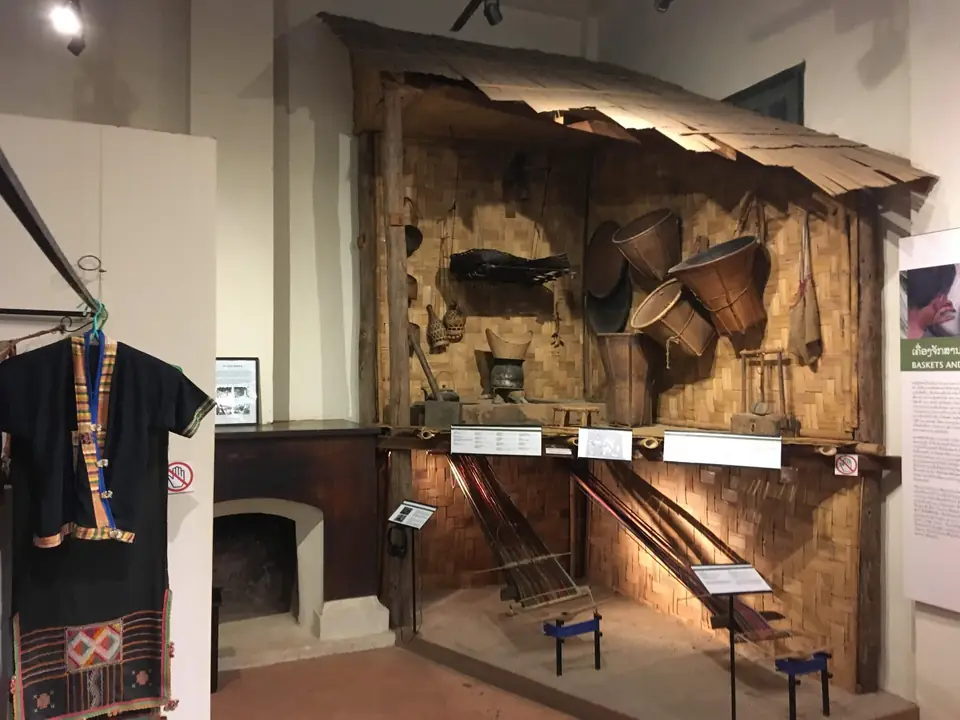
- Reconstructed Kmhmu kitchen — Bamboo and rattan basketry for winnowing rice, sheathing knives or fishing
- Between Worlds — Temporary exhibition on how people live alongside spirits in Laos
- Oma embroidery — The Phongsaly designs that ended up in a Max Mara line
Luang Prabang is usually told from its temples and its court. A few steps from the Royal Palace, a colonial house at the foot of Phousi tells it from the mountains. The Arts and Ethnology Centre (Traditional Arts and Ethnology Centre, TAEC) is a small independent museum devoted to the peoples of Laos, in a country with 49 officially recognised ethnic groups, and its permanent collection brings together more than 400 objects from thirty of them, from the country’s four ethnolinguistic families.
The history of the Arts and Ethnology Centre begins with two women looking for premises. Thongkhoun Soutthivilay, born in Luang Prabang, had worked for more than ten years as head of collections and curator of the city’s National Museum; Tara Gujadhur, an American anthropologist, had come to Laos in 2003 to advise the government on sustainable tourism in ethnic communities. In 2006 they co-founded the centre, found the house in mid-year and on 5 July 2007 opened it before more than a hundred guests, with a shop and a café in the courtyard looking toward That Chomsi.
Since then it has passed 280,000 visitors, admission is free for Lao citizens and, when its directors noted in 2016 that few locals came in because they saw it as a place for foreigners, they created school visits and a children’s summer programme. Its shop gives on average half of its income to the craftspeople, and the centre works with more than 600 of them in 13 provinces.
To know what to see at the Arts and Ethnology Centre, the audio guide walks the house in five stops and 45 minutes: the facade, the Akha silver headdress, the Hmong costumes, the exhibition on spirits and the shop. The thread joining them is a language of silver, indigo and embroidery that a fashion brand wanted to copy without naming it, and which has owners with names and villages.
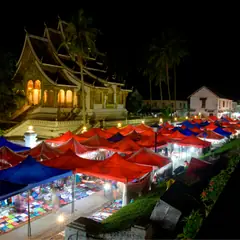
Part of that craft is sold every evening at the Night Market, although not everything presented there as handmade is. A few steps away are two temples tied to the Phra Bang: Wat Mai, about 230 metres in a straight line, and Wat Visoun, about 380.
The French judge’s mansion at the foot of Phousi
Traditional Arts and Ethnology Centre
Summary of this stop
The museum has no purpose-built building: it is entered through the house itself. It is the former mansion of a French colonial judge, one of the most opulent houses in the city in the 1920s, although one guide dates it to the following decade, and no open source gives the name of the judge or the architect. Its founders located it and renovated it as a heritage building between 2006 and 2007.
Inside, all the panels are in Lao and English, with quotations, photographs and videos of community members. It is a decision that sums up the project: telling Laos in the voice of its mountain peoples, in a house that belonged to the colonial administration. Facing the facade, the audio guide tells how two women turned a judge’s residence into the museum of those who never lived in it.
Three hundred Indochina silvers on an Akha head
Akha silver headdress
Summary of this stop
In the Akha room, a display case holds a woman’s headdress made of more than 300 silver pieces from the Indochina era, beside indigo cotton costumes with appliqué and embroidery. The room compares three subgroups, Luma, Akha Nuqui and Akha Pouly Nyai, and shows that adornment is a language: in an Akha headdress the woman’s marital status and her geographic and ethnic origin can be read.
That language can also be heard. According to a documented tradition, among the Akha of northern Laos a simple leaf blown between the lips is used to send a message from one mountain to another, while the discreet jaw harp is kept for declaring love. The centre showed it in Voices of the Wind, its first ethnomusicology exhibition, and the sound of the leaf remains at the room’s listening station. Beside the headdress, the narration explains how a head of silver is read.
A cloth ball for finding a bride
Hmong New Year costumes
Summary of this stop
The Hmong room is devoted to New Year, celebrated between December and January according to the lunar calendar and lasting up to ten days, with offerings to ancestors and spirits, games, feasts and courtship. The women’s costumes on display, highly elaborate, are not display-case pieces: Hmong women make them for the festival, and a listening station plays a soundscape and a love song.
Courtship has its rules. At the Hmong New Year in Luang Prabang, in early December, hundreds of boys and girls in facing rows play pov pob, tossing a cloth ball: whoever drops it hands over an ornament or a garment to the other, and gets it back by singing courtship songs. In front of the costumes, the audio guide explains why it is forbidden to toss the ball to someone of one’s own clan.
Living with spirits, never alone
Between Worlds exhibition
Summary of this stop
The temporary exhibitions room changes theme. The current one, Between Worlds: Living with Spirits in Laos, open until September 2028, deals with how people honour ancestors and deities in daily life, with ritual objects, photographs, videos and testimonies; earlier shows here covered Yao Taoism and traditional instruments. In other rooms, the reconstructed Kmhmu kitchen shows the bamboo and rattan basketry for winnowing and storing rice, and in the Tai Lue room the manual wooden “machines” for ginning and spinning cotton are lined up.
An anecdote explains the tone of the room. According to a documented tradition, in 2020, while preparing an exhibition on humans and spirits for the centre, the ethnomusicologist Marie-Pierre Lissoir recalled that her Lao colleagues often asked whether she was not afraid to sleep alone at home, because of the spirits that roam: in Laos, being alone, poudiao, is considered the most vulnerable state. In the room, the narration tells what is done when someone falls ill and why the soul-calling ceremony may come both before and after the hospital.
The Oma embroidery Max Mara copied
Museum shop
Summary of this stop
The exit passes through the museum shop, with fair-trade textiles, embroidery and basketry from different peoples of Laos; since 2014 it has also had its own boutique on the main street. Among its pieces are the embroideries of the Oma, a people of some 2,800 in Phongsaly province with whom the centre has worked since 2010. According to a documented tradition, their spirals and appliqué friezes evoke chicken feet or frog hands, and babies begin to wear caps with those motifs at four months.
On 2 April 2019, the centre discovered that the Weekend Max Mara spring-summer line was selling, with no mention of origin, prints identical to those embroideries. After the #MaxOma campaign, MatchesFashion.com withdrew the line; the brand denied any wrongdoing and, as no legal registry of the designs exists, the case went without recognition on its part. In 2023, the exhibition Claiming Inspiration brought Oma craftswomen from Phongsaly to the centre. Beside the embroideries, the last stop of the audio guide tells of that clash between a mountain village and an Italian catwalk.