Royal monastery of Lan Xang
Wat Xieng Thong Audio Guide
At the tip of the peninsula, where the Nam Khan hands its waters to the Mekong, a king gave up his own palace to build the temple of coronations: roofs that sweep the ground, black walls written in gold and a twelve-metre funeral carriage that still waits under cover.
- 60 min of audio
- Temple of coronations
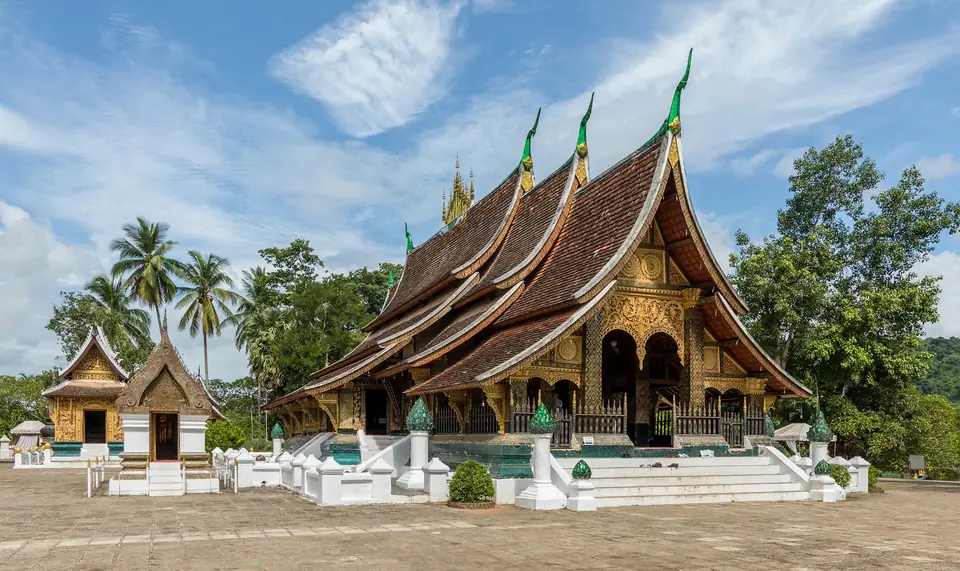
Wat Xieng Thong is the royal monastery of Luang Prabang, built in 1559-1560 by order of Setthathirath, king of Lan Xang, on the grounds of his palace when he moved the capital to Vientiane. Its sim, with overlapping roofs dropping almost to the ground, is the canon of the Luang Prabang style, and the temple was the setting for the coronations of Lao kings until the end of the monarchy in 1975.
In the sacking of 1887, the Black Flags chief Đèo Văn Trị set up his headquarters here and the temple came through unscathed: as a youth he had studied in it as a monk. Today it keeps the funeral carriage of King Sisavangvong, a reclining Buddha that travelled to the Paris Exposition of 1931 and a tree of life made of thousands of glass tesserae.
Highlights
- Sim roofs — Overlapping eaves that drop almost to the ground, the canon of the Luang Prabang style
- 17-segment Dok So Fa — Golden ridge finial that betrays royal patronage
- Black and gold interior — Gold stencils on black lacquer with the legend of the betel-selling king
- Tree of life mosaic — Rear gable covered in glass tesserae from the 1960s
- Royal funeral carriage — 12 metres tall, seven nagas at the prow and the urns of the royal family
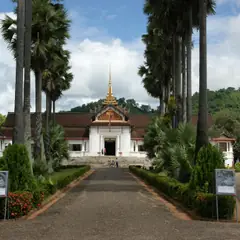
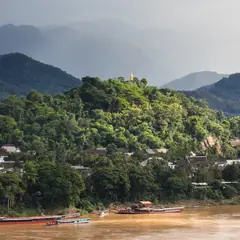
At the northern end of the Luang Prabang peninsula, beside the confluence of the Mekong and the Nam Khan, stands the temple that best sums up an entire monarchy. Wat Xieng Thong (ວັດຊຽງທອງ) was built between 1559 and 1560 by order of King Setthathirath, ruler of Lan Xang, and not on just any plot: when moving the capital from Xieng Thong, present-day Luang Prabang, to Vientiane, on the pretext that flat land was lacking here, the king gave up the grounds of his own palace at the tip of the peninsula to build the monastery.
The history of Wat Xieng Thong also has an older version. According to tradition, the name comes from a great thong tree that stood behind the temple, 27 fathoms in girth and 117 in height measured by body, and some accounts place a first monastery in the time of the legendary King Chanthaphanith, on the spot pointed out by two hermits beside that tree; the local annals, by contrast, attribute it to Setthathirath in 1560. What admits no dispute is its role: it was a temple of royal patronage and the setting for the coronations of the Lao kings until the end of the monarchy in 1975.
It survived the city’s worst night. In the sacking of 1887, the Black Flags chief Đèo Văn Trị, who had studied here as a young monk, set up his headquarters in the compound and the temple came through unscathed, although sources dispute whether it was the only monastery saved or whether Wat Mai met the same fate. Then came the restorations: that of 1928, for which King Sisavangvong got France to help pay, another between 1952 and 1960, and the one completed in 2015, awarded by UNESCO.
To know what to see at Wat Xieng Thong, the audio guide walks the compound in five stops and 60 minutes: the funeral carriage pavilion, the facade of the sim, its black and gold interior, the mosaics at the back and the old Mekong stairway. The thread joining them runs from a betel seller turned first king to a last monarch who never came to be crowned.
The last chapter of that monarchy is told at the Royal Palace, built for the same King Sisavangvong who pushed the 1928 restoration. A kilometre away in a straight line, in the centre of the peninsula, Mount Phousi offers the view of the whole city between the two rivers.
A twelve-metre carriage for a king
Royal funeral carriage pavilion
Summary of this stop
The visit begins, unexpectedly, with death. To the right of the entrance from the street rises the royal funeral carriage pavilion, begun in 1962 for King Sisavangvong, who died in 1959. It was designed by Chao Manivong Khattiyarath and carved by Phia Tan, both named national artists in 2010, and its carved and gilded outer walls narrate episodes of the Phra Lak Phra Lam, the Lao version of the Ramayana.
Inside waits the carriage: a golden mass 12 metres tall, with seven great nagas at the prow and the urns of the royal family on top, and behind it several standing Buddha images. The building was made to its measure, with a removable base so it could be taken out. What exactly each urn holds is unclear: some sources speak of the remains of Sisavangvong and his family, others of replicas, and the official tourism website contradicts itself.
That carriage is not decorative. According to a documented tradition, Sisavangvong’s body spent 18 months in a sandalwood coffin before being cremated, and on 29 April 1961 the royal urn was lifted onto this vehicle and set out in procession from the Royal Palace to the pyre on the That Luang field. In front of the carriage, the audio guide reconstructs that last journey.
Seventeen little spires that saved a temple
Wat Xieng Thong
Summary of this stop
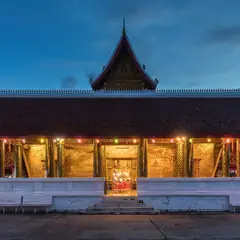
Facing the facade, the sim, the ordination hall, displays the trait that made it famous: overlapping roofs sweeping almost to the ground, on a building 6.80 metres wide, 22.40 long and 15.30 high. In Luang Prabang it is said to look like a hen sheltering her chicks under her wings; others see a bird with outstretched wings. The architecture of Wat Xieng Thong thus became the model for an entire style.
Power, however, is read on high. At the centre of the ridge gleams the Dok So Fa, a golden finial of small spires: here it has 17 segments, a mark of royal patronage, whereas a sim built by commoners could carry only between 1 and 7. The roof ends finish in horns with naga heads.
That royal status crosses with two episodes. In 1887, the invader who razed the city spared the temple where he had trained; about four decades later, in 1928, taking advantage of the visit of the French Governor-General, Sisavangvong got the protecting power to share the cost of the restoration. Before the facade, the narration explains how a roof could weigh so much in the temple’s fortunes.
The betel-selling king, in gold
Black and gold interior of the sim
Summary of this stop
The interior of the sim is a chest in black and gold: columns and walls lacquered in black, covered in gold stencils, dharma wheels on the ceiling and the great main image at the back. Those drawings tell, alongside the jataka, a founding legend: that of Chanthaphanith, a betel-nut merchant, come from Vientiane according to one version, who built a palace at this end of the peninsula and ended up chosen by the people as the first king of Luang Prabang, around the 8th century of the legendary chronology. According to that tradition, Setthathirath founded the temple in 1560 to honour his memory.
Among so much gold there are also warnings. On the wall to the right of the entrance, an adulterous couple climbs a thorn-bristling tree to flee a pack of dogs; other condemned souls boil in oil for having killed or hang from a hook driven through the tongue for having lied. And above the door runs a wooden channel shaped like a naga: at Lao New Year lustral water is poured through it to bathe a Buddha image and, through pipes under the floor, ends up flowing outside from the mouth of an elephant head covered in tiny mirrors.
The same tradition places at this confluence the home of two guardian nagas of the rivers. The decoration seen today shines after the restoration completed in 2015, which received the UNESCO Asia-Pacific Award of Merit for Cultural Heritage Conservation and was carried out by monks trained as craftsmen. In the half-light of the sim, the audio guide follows the betel seller’s trail along the walls.
A glass tree and the Buddha who came back from Paris
Tree of life mosaic
Summary of this stop
The rear gable of the sim is covered by a great tree of life of coloured glass tesserae, surrounded by animals. It looks ancient and is from the 20th century: it was made in the 1960s, at the same time as the mosaics of the former Royal Palace, and the temple’s mosaics are the work of the Lao artist Thao Sin Keo. Which tree it represents remains open: the golden tree that gives the temple its name, that of the two founding hermits, a flame-of-the-forest tree or a great Bodhi tree, depending on the source.
Very close by, the Red Chapel shows on its outer walls mosaics of 1957, made for the 2,500th anniversary of the Buddha, that narrate the story of Sieo Sawath, a hero of classical Lao literature famous for his wisdom. Inside rests a reclining Buddha lying on its right side, hand under its head, whose age is disputed.
That image has a traveller’s biography: in 1931 it left for France for the Paris Exposition, afterwards stayed in Vientiane and did not return to Luang Prabang until 1964. Beside the mosaic, the narration tells that long detour of thirty-three years.
The stairway of an uncrowned king
Mekong stairway
Summary of this stop
On the north side, a monumental stairway descends toward the Mekong. In other times, important visitors arrived by boat and climbed up here; today entry is from the south, from the main street. According to a documented tradition, on the eve of his coronation the king-designate spent three days in prayer at Wat Long Khun, on the right bank, and then crossed the river to enter the city by this landing, the same one at which the envoys of Siam disembarked.
The last king, Sisavang Vatthana, who ascended the throne in 1959, never made that journey: he postponed the coronation until Laos was at peace, the war did not end in time and the ceremony was never held. After the abolition of the monarchy in 1975 he ended up interned in Camp 01 in Houaphan province, where he died.
The temple, even so, remains alive. Behind the sim, the chapel of the Phra Man, the second most venerated image in Luang Prabang after the Pha Bang, stays almost always closed; once a year, at Pi Mai, the image comes out, walks three times around the perimeter of Wat Xieng Thong and is sprinkled with perfumed water, although its origin, 1968 or seven centuries ago, depends on whom one asks. At the top of the stairway, the last stop of the audio guide closes the story of a monarchy that came in by the river and said goodbye without a crown.