Sacred hill and viewpoint
Mount Phousi Audio Guide
In the middle of Luang Prabang, a sacred hill holds a golden stupa on the back of a seven-headed serpent: from the top the whole city can be read between the Mekong and the Nam Khan, and every New Year the naga comes down its stairs as a procession.
- 60 min of audio
- Viewpoint over the Mekong
Mount Phousi is the hill of about 100 metres that rises in the middle of the Luang Prabang peninsula, crowned by That Chomsi, a 21-metre golden stupa built in 1804 under King Anurut and formerly known as the stupa of the city pillar. From its summit the hours were marked by drum and the alarm was raised in disasters and wars, and today it is the city's great viewpoint.
The hill is still in use: on New Year's morning women climb it leaving balls of sticky rice for the spirits and make offerings at a crack in the rock held to be an entrance to the world of the nagas, and that same night a long naga of bamboo and paper comes down the stairs. Beneath the summit, according to tradition, lives Thao Srisatanak, the great naga who guards the city.
Highlights
- That Chomsi — 1804 golden stupa, 21 metres tall, with seven-tier bronze parasols
- Summit viewpoint — 360-degree view over the Mekong, the Nam Khan and the peninsula
- Naga rock — A crack behind the stupa that receives rice offerings every New Year
- Wat Pa Huak — The king's chapel at the foot of the hill with 19th-century murals of foreign visitors
- Buddha footprint cave — A footprint in the rock that, according to tradition, the naga guards
In the middle of the Luang Prabang peninsula, between the Mekong and the Nam Khan, rises a hill the city treats as its axis. Mount Phousi (ພູສີ) climbs some 100 metres above the streets, although some sources say 150, and on its summit gleams That Chomsi, the golden stupa seen from almost anywhere in town. Its name is often translated as “sacred mountain”, but it is also explained as “hermit’s mountain”, after the hermits said to have settled on it.
The history of Mount Phousi is written in its stones and in its papers. The stupa was built in 1804, during the reign of King Anurut of Luang Prabang, although Thai sources place it in 1794; the summit shrine was drawn by the Frenchman Delaporte in 1867 and photographed by Auguste Pavie in 1888, and the plan Pavie drew in 1887, the only one before that year’s sacking, already marks it on the heights. From the top the hours were beaten out on a drum and the alarm was raised in disasters and wars, and a little below, on the descent to the northeast, lie the remains of a position with a Russian-made anti-aircraft gun, used to defend the city during the revolution.
But Phousi is above all a mountain of legends. According to tradition, beneath the hill lives Thao Srisatanak, a giant seven-headed naga on whose back the stupa stands; another legend says the mountain was not born here at all, but that Hanuman, the monkey king of the Ramayana, tore it out in Sri Lanka and flew it over, and a sign on the hill itself recalls it. Along the slope come golden Buddhas in different gestures, a cave temple and, at the foot of the climb, sellers of small birds in bamboo cages that are released at the top to make a wish, a good-luck rite that at the same time feeds the capture of birds.
To know what to see on Mount Phousi, the audio guide accompanies the climb in five stops and 60 minutes: Wat Pa Huak at the foot of the stairs, the That Chomsi stupa, the offering rock at the summit, the viewpoint and the Buddha footprint cave. The thread joining them is a mountain that was drawn, watched the city burn at its feet and still receives rice, chanting and a paper serpent every New Year.
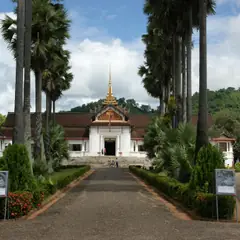
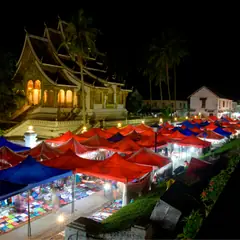
Facing the stairs that climb from Sisavangvong Road is the Royal Palace, and on that same street, at the foot of the hill, the Night Market sets up every evening. To the north, at the tip of the peninsula and a kilometre away in a straight line, stands Wat Xieng Thong.
Wat Pa Huak, the temple that got in the palace’s way
Wat Pa Huak
Summary of this stop
The climb starts on Sisavangvong Road, right opposite the former Royal Palace, where a staircase with golden naga balustrades accompanies the first stretches. It was in a restoration after the one of 1914 that this staircase was built from the palace side; the number of steps, usually given as 328, varies depending on who counts them.
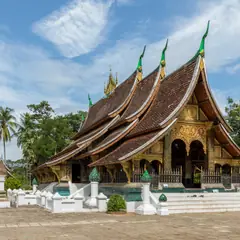
At the foot of the hill, Wat Pa Huak has a roof decorated with the torso of a naga. It was founded in 1861 by Phaya Si Mahanam, served as the king’s private chapel and keeps 19th-century murals in which Luang Prabang receives Chinese, European and Persian visitors, paintings the French art historian Henri Parmentier called “ridiculous”.
It was not the only severe gaze. In 1942, the Ministry of Religious Affairs evicted the temple’s monks and nuns and tore down their old quarters as unsightly opposite the royal palace; since then there have been no resident monks and the sim opens only on certain holy days. At the foot of the stairs, the audio guide tells the irony of a temple that blocked the view of the king it served.
That Chomsi, the golden pillar of the city
That Chomsi
Summary of this stop
At the summit, on an outcrop of rock, stands That Chomsi: a golden stupa on a square plan, with a base 10.5 metres on a side, reaching 21 metres to the finial and carrying at its four corners bronze parasols of seven tiers. Beside it, a small vihan holds a large seated Buddha surrounded by lesser images.
The stupa was raised in 1804 under King Anurut, and its old name reveals the function it had: That Lak Muang, “the stupa of the city pillar”. More than a monument, it was the symbolic nail that fixed Luang Prabang to the ground. Facing it, the narration explains why an entire city decided to anchor itself at this point.
The sealed rock behind the stupa
Naga crack in the rock
Summary of this stop
In the rock base of the summit there is an old blocked opening, and behind the stupa a crack the city takes as an entrance to the world of the nagas. On the morning of Meu Pimai, Lao New Year’s Day, many women climb up leaving balls of sticky rice on the stair walls for the spirits of the hill and make offerings at that crack; it is also said that people throw balls toward the top of the stupa and cheer when one stays up there.
The people of Luang Prabang believe a guardian spirit lives in the stupa and protects them, and each year they dedicate a merit ceremony to it, with decoration of the stupa, monks’ chanting for the ancestors and a sermon. The temple drum still sounds at 10:30, at 17:00 and at 4:00 in the morning on uposatha days.
That drum has its own legend. According to tradition, where the hill stands today there was a well that reached the centre of the earth; a monk went down it with the help of some villagers and found a treasure, and the villagers kept it and sealed the mouth of the well with him inside. Beside the rock, the audio guide tells how the monk got out and what sentence the king imposed on the traitors.
The peninsula that burned in 1887
Summit viewing terrace
Summary of this stop
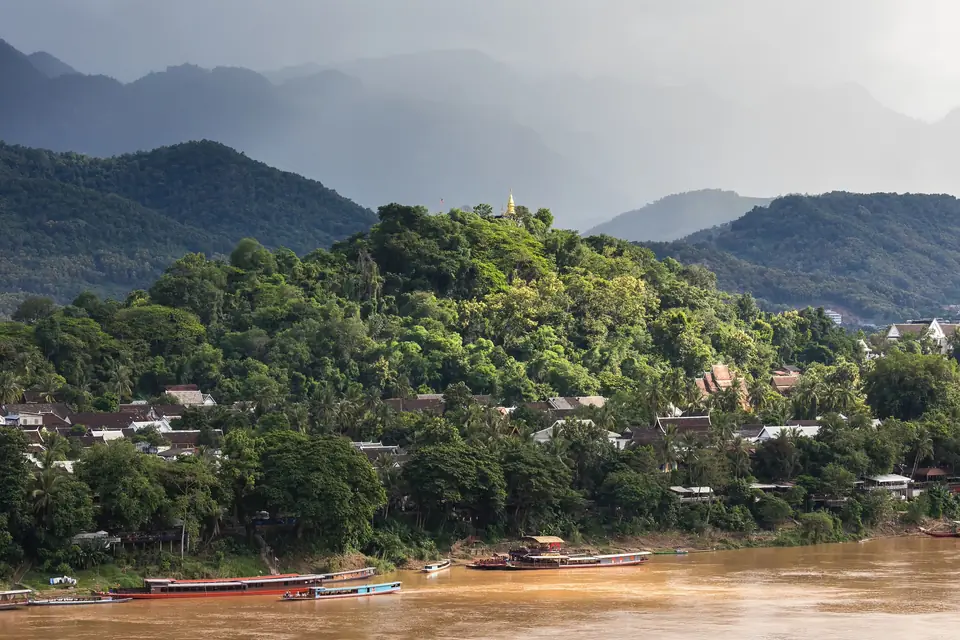
From the summit terrace, the view takes in 360 degrees: the Mekong, the Nam Khan, the weave of the peninsula and the mountains. It is the place for the sunset, and also the best point from which to read a city that the first French drew and photographed as if it were eternal: Delaporte drew it in 1867 and Pavie photographed the summit shrine in March 1888.
Between those dates came the disaster. On 10 June 1887, Haw bands sacked Luang Prabang and by afternoon the city on the peninsula was burning; Pavie’s plan of that same year, the only one before the destruction, already marked the Chomsi shrine on the heights.
The horizon keeps a kinder story. Across the Mekong two elongated mountains can be seen that look like a man and a woman lying with their heads together: legend says they are Phou Thao and Phou Nang, two lovers who died and were reborn as mountains. At the viewpoint, the narration helps tell their silhouettes apart.
The Buddha footprint the naga guards
Buddha footprint cave
Summary of this stop
The descent down the other slope passes a row of golden Buddhas: with the alms bowl, calling the rain, protected by the naga Mucalinda, reclining and with disciples. Further down, a small bridge with a black naga on one railing and a white one on the other leads to the Buddha footprint cave. Its temple, Wat Siphoutthabat, was born in 1957 from the merger of three monasteries and took its name from that footprint marked in the rock.
According to tradition, the guardian of that footprint is the same seven-headed naga that lives beneath the hill, whose eye lay in a pond where Wat Nong stands today and whose tail reaches the Nam Dong river. On New Year’s night, a procession comes down the stairs of Phousi with a long naga of bamboo and paper, Thao Srisatanak, which enters the old palace and circles the Nong Nak pond three times looking for its wife. Beside the cave, the last stop of the audio guide closes the circle joining the hill with the palace where the climb began.